


The Executive Yuan yesterday proposed amendments to the National Pension Act (國民年金法), with the government expecting to invest about NT$86 billion (US$2.72 billion) annually and an estimated 1.76 million people set to benefit.
The draft changes aim to raise benefit levels, ease means-testing thresholds and introduce a mechanism to adjust payments in line with price changes, the Cabinet told a news conference in Taipei.
The proposed amendments would significantly boost several payout categories, Ministry of Health and Welfare Department of Social Insurance Director-General Chang Yu-hsuan (張鈺旋) said.
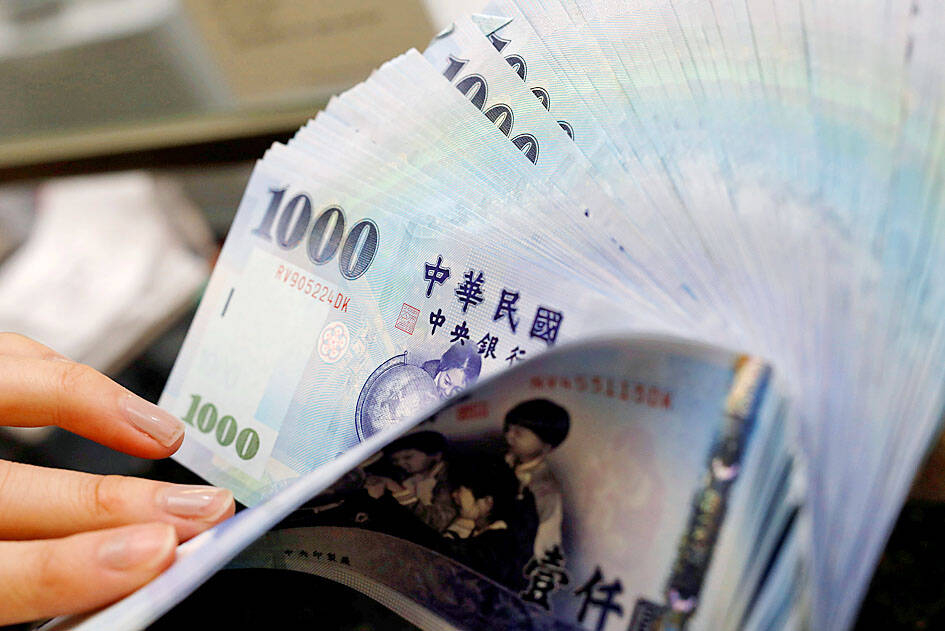
Photo: Tyrone Siu, Reuters
The basic monthly guaranteed amount for pensions would rise from NT$4,049 to NT$5,000, an increase of 23.5 percent, while the basic guaranteed disability pension would be raised from NT$5,437 to NT$6,715, she said.
The adjustments would help recipients cope with rising prices and maintain their basic purchasing power, the ministry said.
The proposed amendments would also relax “wealth exclusion” clauses to ensure that fewer people are disqualified due to asset valuations.
The annual personal income threshold would be raised from NT$500,000 to NT$600,000, while the real-estate asset cap would be adjusted to NT$10.25 million, the draft says.
To prevent people from losing pension eligibility because they own and live in a house, the cap on deductions for self-occupied residences would be removed, so such properties would no longer be included in asset calculations, it says.
To ensure that benefits better reflect price fluctuations and preserve real purchasing power, adjustments to the basic pension amounts would no longer be limited to reviews every four years, the draft says.
If the cumulative increase in the consumer price index reaches 3 percent within two years, an immediate adjustment could be made, it says.
Requirements that spouses pay premiums for the insured would also be removed.
Currently, spouses who fail to pay premiums on behalf of the insured within a stipulated period face fines.
Asked whether the changes would help boost participation in the national pension program, Deputy Minister of Health and Welfare Chuang Jen-hsiang (莊人祥) said he hoped they would lead to higher contribution rates.
The cumulative contribution rate for the national pension is about 60 percent, rising to about 90 percent among those aged 65 or older, he said.
The national pension is designed to allow people to continue accumulating contribution while transitioning between jobs, enabling them to receive higher retirement benefits while being covered by labor insurance during their working years, he said.
The bill is to be sent to the Legislative Yuan for deliberation.
If the increased benefits are to be implemented from this year, the funding could only be allocated after the central government’s general budget completes statutory procedures, the Cabinet said, adding that it would need to be covered through a supplementary budget of NT$16.98 billion.

A signaling system malfunction disrupted high-speed rail (HSR) services beginning at 8am today, with trains temporarily reduced to three northbound and three southbound trains per hour as authorities conduct inspections. The malfunction occurred on a section of track in Miaoli County during pre-operation checks early this morning, forcing northbound and southbound trains to use a single track, the HSR operator said. The regular schedule has been replaced with three hourly trains offering only nonreserved seating in each direction, stopping at every station, it said, adding that business class cars would still have reserved seating. Departures from terminal stations are scheduled at the top

Taiwan is still in the process of assessing the possibility of recruiting workers from Eswatini, the Ministry of Foreign Affairs said yesterday, adding that its goal is to help Eswatini upgrade its vocational training centers. If there are plans to recruit workers from Eswatini, safeguarding national security, protecting public health and ensuring the employment rights of Taiwanese would be prerequisites, Department of West Asian and African Affairs Director-General Yen Chia-liang (顏嘉良) told a news conference. Key considerations would also include filling labor shortages in specific industries, and fostering bilateral professional and technical exchanges, he said. Yen was asked about the progress of labor

A US uncrewed surface vessel (USV) encountered multiple Chinese warships during an autonomous transit of the Taiwan Strait, US defense company Seasats said in a statement on Wednesday. Seasats announced that a Lightfish USV had completed the first autonomous transit of the Taiwan Strait. Over five days, the USV traversed the entire length of the Strait while constantly monitoring surface vessel traffic, the company said. The Lightfish encountered multiple Chinese warships, one of which was a Chinese People’s Liberation Army Navy (PLAN) Type 056 corvette, it said. The Chinese vessels were operating “well within Taiwan’s exclusive economic zone without transmitting their identity via the

VERBOSE VESSELS: A CGA cutter and a China Coast Guard exchanged verbal barbs for more than a day in Taiwanese-controlled waters before the Chinese vessel left The Taiwanese and Chinese coast guards had a standoff near the strategically located Pratas Islands (Dongsha Islands, 東沙群島) in the north of the South China Sea, the Coast Guard Administration (CGA) said yesterday. The two sides engaged in intense radio exchanges over sovereignty claims during the 33-hour standoff. China Coast Guard vessel 3501 eventually left the restricted waters, 26.6 nautical miles (49.2km) west of the Pratas Islands, at 5pm yesterday, the CGA said. Lying approximately between southern Taiwan and Hong Kong, the Taiwan-controlled Pratas are seen by some security experts as vulnerable to Chinese attack due to their distance — more than


 RSS
RSS