


A South Korean court yesterday sentenced former South Korean president Yoon Suk-yeol to five years in prison in the first verdict from eight criminal trials over the martial law debacle that forced him out of office and other allegations.
Yoon was impeached, arrested and dismissed as president after his short-lived imposition of martial law in December 2024 triggered huge public protests calling for his ouster.
The most significant criminal charge against him alleges that his martial law enforcement amounted to a rebellion.
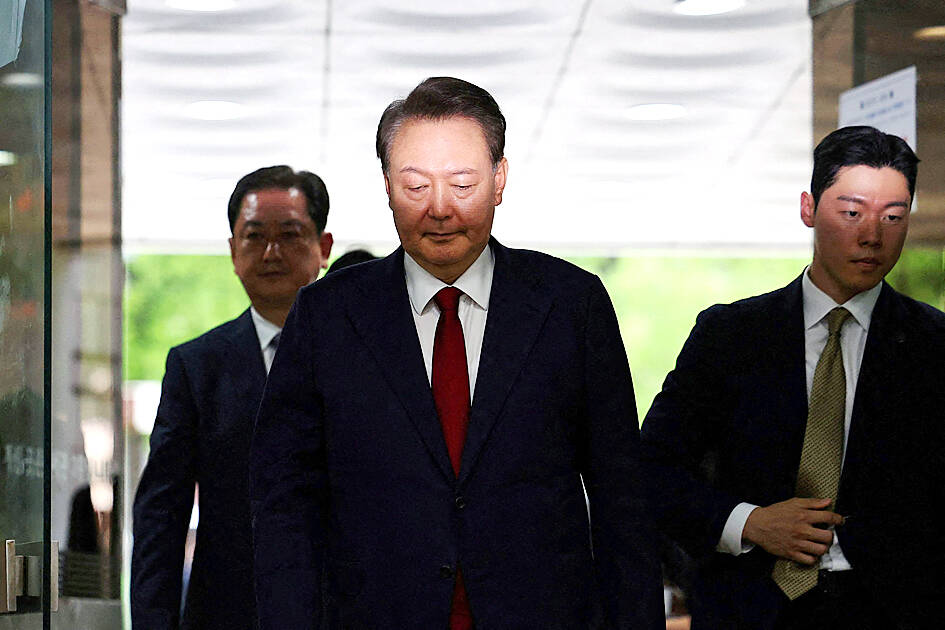
Photo: Reuters
An independent counsel has requested the death sentence over that charge, and the Seoul Central District Court would decide on that in a ruling on Feb. 19.
Yoon has maintained he did not intend to place the country under military rule for an extended period, saying his decree was only meant to inform the people about the danger of the liberal-controlled parliament obstructing his agenda.
However, investigators have viewed Yoon’s decree as an attempt to bolster and prolong his rule, charging him with rebellion, abuse of power and other criminal offenses.
The court sentenced Yoon for defying attempts to detain him and fabricating the martial law proclamation. He was also sentenced for sidestepping a legally mandated full Cabinet meeting, which deprived some members who were not convened of their rights to deliberate on his decree.
Judge Baek Dae-hyun said imposing “a heavy punishment” was necessary, because Yoon has not shown remorse and has only repeated “hard-to-comprehend excuses.”
Restoring legal systems damaged by Yoon’s action was necessary, Baek added.
Yoon’s defense team said they would appeal the ruling, which they believe was “politicized” and reflected “the unliberal arguments by the independent counsel.”
The ruling “oversimplified the boundary between the exercise of the president’s constitutional powers and criminal liability,” they said.
Park Sung-bae, a lawyer who specializes in criminal law, said there is little chance the court would decide Yoon should face the death penalty, adding that he would likely receive a life sentence, or a prison sentence of 30 years or more.
South Korea has maintained a de facto moratorium on executions since 1997 and courts rarely hand down death sentences.
The court would take into account that Yoon’s decree did not cause casualties and did not last long, although Yoon has not shown genuine remorse for his action, Park said.
South Korea has a history of pardoning former presidents who were jailed over diverse crimes in the name of promoting national unity.
Even if Yoon is spared the death penalty or life imprisonment at the rebellion trial, he might still face other prison sentences in the multiple smaller trials he faces.
Some observers said Yoon is likely retaining a defiant attitude in the ongoing trials to maintain his support base in the belief that he cannot avoid a lengthy sentence, but could be pardoned in the future.
The former president’s other trials deal with charges such as ordering drone flights over North Korea to deliberately inflame animosities to look for a pretext to declare martial law, manipulating the investigation into a marine’s drowning in 2023 and receiving free opinion surveys from an election broker in return for a political favor.
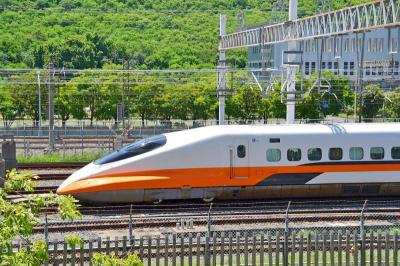
A signaling system malfunction disrupted high-speed rail (HSR) services beginning at 8am today, with trains temporarily reduced to three northbound and three southbound trains per hour as authorities conduct inspections. The malfunction occurred on a section of track in Miaoli County during pre-operation checks early this morning, forcing northbound and southbound trains to use a single track, the HSR operator said. The regular schedule has been replaced with three hourly trains offering only nonreserved seating in each direction, stopping at every station, it said, adding that business class cars would still have reserved seating. Departures from terminal stations are scheduled at the top
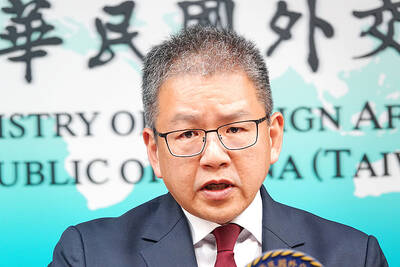
Taiwan is still in the process of assessing the possibility of recruiting workers from Eswatini, the Ministry of Foreign Affairs said yesterday, adding that its goal is to help Eswatini upgrade its vocational training centers. If there are plans to recruit workers from Eswatini, safeguarding national security, protecting public health and ensuring the employment rights of Taiwanese would be prerequisites, Department of West Asian and African Affairs Director-General Yen Chia-liang (顏嘉良) told a news conference. Key considerations would also include filling labor shortages in specific industries, and fostering bilateral professional and technical exchanges, he said. Yen was asked about the progress of labor

A US uncrewed surface vessel (USV) encountered multiple Chinese warships during an autonomous transit of the Taiwan Strait, US defense company Seasats said in a statement on Wednesday. Seasats announced that a Lightfish USV had completed the first autonomous transit of the Taiwan Strait. Over five days, the USV traversed the entire length of the Strait while constantly monitoring surface vessel traffic, the company said. The Lightfish encountered multiple Chinese warships, one of which was a Chinese People’s Liberation Army Navy (PLAN) Type 056 corvette, it said. The Chinese vessels were operating “well within Taiwan’s exclusive economic zone without transmitting their identity via the

VERBOSE VESSELS: A CGA cutter and a China Coast Guard exchanged verbal barbs for more than a day in Taiwanese-controlled waters before the Chinese vessel left The Taiwanese and Chinese coast guards had a standoff near the strategically located Pratas Islands (Dongsha Islands, 東沙群島) in the north of the South China Sea, the Coast Guard Administration (CGA) said yesterday. The two sides engaged in intense radio exchanges over sovereignty claims during the 33-hour standoff. China Coast Guard vessel 3501 eventually left the restricted waters, 26.6 nautical miles (49.2km) west of the Pratas Islands, at 5pm yesterday, the CGA said. Lying approximately between southern Taiwan and Hong Kong, the Taiwan-controlled Pratas are seen by some security experts as vulnerable to Chinese attack due to their distance — more than


 RSS
RSS