


The air force would install automatic ground collision avoidance systems (Auto-GCAS) on all of its F-16V jets by next year, Minister of National Defense Wellington Koo (顧立雄) said yesterday, two days after a fighter pilot went missing in an apparent mishap.
Air force Captain Hsin Po-yi (辛柏毅) was flying a Lockheed Martin F-16V on a routine training flight on Tuesday night when the jet vanished from radar over waters off Hualien County.
Hsin reported a software anomaly and displayed behavior consistent with spatial disorientation, the 5th Mixed Tactical Wing told a news conference the day after the incident.
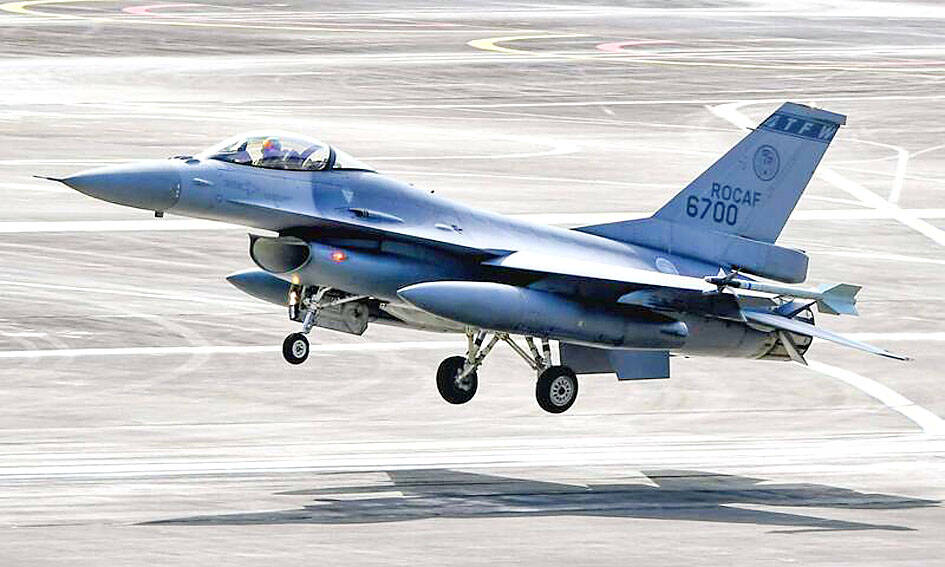
Photo: Yu Tai-lang, Taipei Times
The military previously said that Hsin had reported his intention to eject from the aircraft three times, but the onboard software did not confirm a successful ejection.
The search for the pilot was ongoing at press time last night.
Koo told the legislature’s Foreign Affairs and National Defense Committee that Taiwan’s 66 newly acquired F-16C/D Block 70/72 jets came with Auto-GCAS as a standard feature.
However, the air force operates 139 F-16Vs that lack the safety system, he said.
F-16Vs are older F-16A/B Block 20 aircraft that have been upgraded with the same advanced avionics and equipment in the Block 70/72 variants.
The US has been contracted to provide Taiwan with 141 of the jets.
Lieutenant General Lee Ching-jan (李慶然), the air force Chief of Staff, said that fitting F-16 jets with Auto-GCAS is a time-consuming process involving the integration of complex systems and additional pilot training.
Ensuring that the digital Auto-GCAS would function in fighter designs that fundamentally are based on analogue systems is part of the technical challenge, Lee said.
For the same reasons, the US Air Force has yet to fully outfit its F-16s with Auto-GCAS technology, he said, adding that test flights are still being conducted.
F-16Vs make use of “zero-zero” ejection seats that can be safely deployed from an aircraft with zero airspeed and altitude, Lee said.
The ejection seats utilized in F-16C/D Block 70/72 aircraft are capable of the same performance with enhanced ejection distance and limb protection, he said.
Floatation devices and rafts that automatically inflate upon impact with water bodies are standard features of the ejection seats in the F-16 variants that most foreign militaries do not possess, he said.
The air force continually searches for ways to improve pilot survivability, he said.
Major General Chiang Yi-cheng (江義誠), the air force’s inspector general, told Wednesday’s news conference that the service has grounded F-16s in Hualien County, Taichung and Chiayi County while safety and maintenance inspections are conducted.
Pilot training to counter the effects of spatial disorientation, recovery from unusual attitudes and flying by instruments would be enhanced in response to the incident, he said.
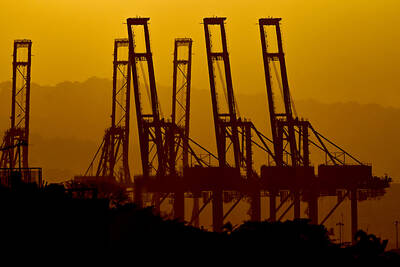
A subsidiary of a Hong Kong-based company that has lost control of two critical ports on the Panama Canal said it is seeking US$2 billion of compensation in damages from Panama over its “illegal” takeover of the ports. Panama Ports Co, a unit of Hong Kong’s CK Hutchison Holdings (長江和記實業), on Friday said in a statement that it is demanding the sum under international arbitration proceedings that it had already started. The Panamanian government last week seized control of the Balboa and Cristobal ports on each end of the Panama Canal, after the country’s Supreme Court declared earlier that a concession allowing
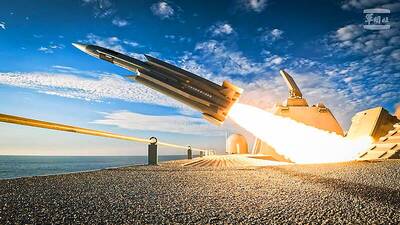
DETERRENCE: With 1,000 indigenous Hsiung Feng II and III missiles and 400 Harpoon missiles, the nation would boast the highest anti-ship missile density in the world With Taiwan wrapping up mass production of Hsiung Feng II and III missiles by December and an influx of Harpoon missiles from the US, Taiwan would have the highest density of anti-ship missiles in the world, a source said yesterday. Taiwan is to wrap up mass production of the indigenous anti-ship missiles by the end of year, as the Chungshan Institute of Science and Technology has been meeting production targets ahead of schedule, a defense official with knowledge of the matter said. Combined with the 400 Harpoon anti-ship missiles Taiwan expects to receive from the US by 2028, the nation would have

POSSIBILITIES EMERGE: With Taiwan’s victory and Japan’s narrow win over Australia, Taiwan now have a chance to advance if South Korea also beat the Aussies Taiwan has high hopes that the national baseball team would advance to the World Baseball Classic (WBC) quarter-finals after clinching a crucial 5-4 victory over South Korea in a nail-biting extra-inning game at the Tokyo Dome yesterday. Boosted by three home runs — two solo shots by Yu Chang (張育成) and Cheng Tsung-che (鄭宗哲) and a two-run homer by Stuart Fairchild — the triumph gave Taiwan a much-needed second victory in the five-team Pool C, where only the top two finishers would advance to the knockout stage in Miami, Florida. Entering extra innings with the game tied at four apiece, Taiwan scored
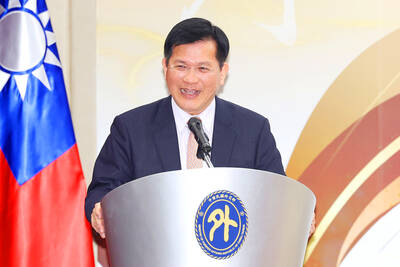
MISSION OF PEACE: The foreign minister urged Beijing to respect Taiwan’s existence as an independent nation, and work together to ensure peace and stability in the region Minister of Foreign Affairs Lin Chia-lung (林佳龍) yesterday rejected Chinese Minister of Foreign Affairs Wang Yi’s (王毅) comments about Taiwan, criticizing China as a “troublemaker” in the international community and a disruptor of cross-strait peace. Speaking at a news conference on the sidelines of the Chinese National People’s Congress, Wang said that Taiwan has always been a territory of China and that it would be impossible for it to become its own country. The “return” of Taiwan to China was the natural outcome of the Chinese people’s resistance against Japan in World War II, and that any pursuit of independence was “doomed


 RSS
RSS