


Democratic Progressive Party (DPP) lawmaker Lin I-chin (林宜瑾) yesterday said a petition has been completed for a proposed amendment to change the name of the Act Governing Relations Between the People of the Taiwan Area and the Mainland Area (臺灣地區與大陸地區人民關係條例) to Taiwan and the People’s Republic of China (PRC) Relations Act (台灣與中華人民共和國人民關係條例).
The concept that the two sides of the Taiwan Strait belong to two separate countries is basic international knowledge, she said, adding that the change hoped to clarify through law the equal, nation-to-nation relationship between Taiwan and China.
“This proposed amendment not only highlights our country’s stance against aggression and the internalization of the Taiwan Strait issue, but also serves as an important international statement,” she said. “We want to make it clear to Taiwan’s democratic allies that, although the opposition camps are causing chaos in the legislature, ‘pro-China’ and ‘selling out Taiwan’ is definitely not the mainstream opinion in our country.”

Photo: I-Hwa Cheng, Bloomberg
Lin said that in the face of the opposition camps blocking the defense budget, the general budget and proposed amendments related to national security issues, as a legislator from the DPP, she has a stronger duty than ever before to use her legislative powers “to counter aggression, oppose colonialism and prevent the internalization of the Taiwan Strait issue.”
“Taiwan and the PRC are two separate countries, and Taiwan has never been under the rule of the PRC,” she said. “However, some of our laws ignore this reality and continue to regulate the relationship between the two sides based on a one-sided, idealized worldview. The ‘cross-strait relations act’ is one such example.”
In addition to proposing to rename the law, Lin said she also proposed removing the phrase “before national unification” and the use of the term “region” to refer to the two sides “to make the provisions better aligned with the basic facts.”
Chinese Nationalist Party (KMT) Legislator Wang Hung-wei (王鴻薇) said that as Lin’s intention is to promote the concept of “one country on each side” and “two countries,” there was no need to go through all the trouble of revising the cross-strait relations act.
She should propose to abolish the act entirely, along with the Mainland Affairs Council (MAC), Wang said.
“DPP lawmakers want to take charge and stir up trouble, but they should not expect the opposition parties in the Legislative Yuan to be their brake pads,” she said.
The MAC said that a lawmaker’s proposal a matter for the legislative authority and that in respect of the Legislative Yuan’s autonomy, the executive branch would not express an opinion.
Additional reporting by Chung Li-hua
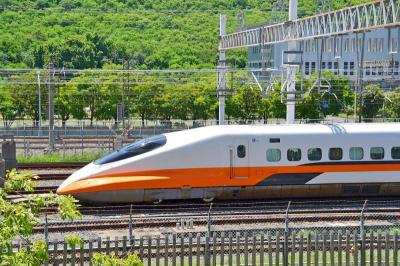
A signaling system malfunction disrupted high-speed rail (HSR) services beginning at 8am today, with trains temporarily reduced to three northbound and three southbound trains per hour as authorities conduct inspections. The malfunction occurred on a section of track in Miaoli County during pre-operation checks early this morning, forcing northbound and southbound trains to use a single track, the HSR operator said. The regular schedule has been replaced with three hourly trains offering only nonreserved seating in each direction, stopping at every station, it said, adding that business class cars would still have reserved seating. Departures from terminal stations are scheduled at the top

DRONE CENTRAL: Taiwan aims to become Asia’s democratic hub for drones, with most exports focused on high-quality military-grade models, an official said Taiwan’s drone industry is expected to expand significantly by 2030, producing 100,000 units per month and exporting half of them, the Ministry of Economic Affairs said yesterday. Current drone production capacity is about 15,000 units per month, but the industry can quickly scale up as demand increases, Industrial Development Administration Director-General Chiou Chyou-huey (邱求慧) told a news conference in Taipei. Taiwan’s drone output grew 2.5-fold last year to NT$12.9 billion (US$408.3 million) under a government program to develop the uncrewed vehicle sector, he said. The Executive Yuan in October last year approved plans to invest NT$44.2 billion into domestic production of uncrewed aerial

VERBOSE VESSELS: A CGA cutter and a China Coast Guard exchanged verbal barbs for more than a day in Taiwanese-controlled waters before the Chinese vessel left The Taiwanese and Chinese coast guards had a standoff near the strategically located Pratas Islands (Dongsha Islands, 東沙群島) in the north of the South China Sea, the Coast Guard Administration (CGA) said yesterday. The two sides engaged in intense radio exchanges over sovereignty claims during the 33-hour standoff. China Coast Guard vessel 3501 eventually left the restricted waters, 26.6 nautical miles (49.2km) west of the Pratas Islands, at 5pm yesterday, the CGA said. Lying approximately between southern Taiwan and Hong Kong, the Taiwan-controlled Pratas are seen by some security experts as vulnerable to Chinese attack due to their distance — more than
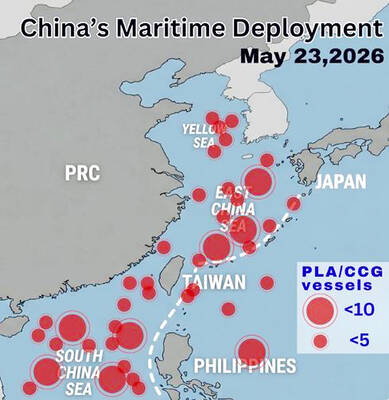
WARNING: China should stop engaging in actions that undermine regional peace and stability, as it would only build resentment among people across the Strait, the CGA said China has deployed more than 100 navy, coast guard and other vessels in waters from the Yellow Sea to the South China Sea and the western Pacific since US President Donald Trump and Chinese President Xi Jinping (習近平) met in Beijing, National Security Council Secretary-General Joseph Wu (吳釗燮) said yesterday. “In this part of the world, #China is the one & only PROBLEM wrecking the #StatusQuo & threatening regional peace & stability,” Wu wrote on X. In a separate post, he said Beijing was coercing Taiwan’s maritime domain, calling it illegal and provocative, after the Coast Guard Administration (CGA) expelled a


 RSS
RSS