


New birth subsidies offering NT$100,000 (US$3,181) per newborn that took effect yesterday would not be enough alone to boost the nation’s dramatically falling birthrate, an expert said.
For last year through the end of October, 98,785 babies were born, down 20 percent from the previous year, Taiwan Association of Obstetrics and Gynecology secretary-general Huang Chien-pei (黃建霈) said, citing Ministry of the Interior data.
By the same time this year, the number is expected to drop to 80,000, he said.

Photo courtesy of Hungchi Women and Children’s Hospital
One-time subsidies would not be a sufficient incentive for young couples to have children, he said.
The new subsidies would also be available to 7,144 people who are not covered by any government insurance program to ensure that everyone is guaranteed basic benefits, while addressing payout discrepancies for birth subsidies across government insurance programs, the Cabinet said.
Finance is not the only factor affecting young couples’ willingness to have children; education, career prospects and life planning are also worth considering, Huang said.
The government must provide support across different life stages, or by the time would-be parents feel ready, they would be older, facing more risk from pregnancy or requiring assisted reproduction, he said.
If the state invested NT$2 million to NT$3 million in the first 20 years of a child’s life, by the time the child enters the workforce, they would contribute an average of NT$160,000 in taxable income per year, which, over 45 years, would generate NT$7 million, Huang said.
With every child born, the nation would stand to increase its annual income by NT$4 million to NT$5 million, which is not factored into the potential economic benefits of the expenses these people incur, he said.
A policy like one that grants discharged vocational soldiers or those who have completed their mandatory military service a one-time bonus to exam scores of 3 to 25 percent could be implemented for people choosing to have children, Huang said.
Pregnancy often hinders a person’s attempts to get promoted in the workplace, but discrimination against pregnant women is due to a lack of ancillary measures from the government, which could include subsidies to businesses to hire extra people to compensate for employees on parental leave, he said.
Huang also highlighted a structural crisis in the medical system, saying that obstetrics and pediatrics departments see few patients and generate low revenue, leading to a talent shortage as younger doctors are unwilling to specialize in the departments.
The government should invest in bolstering these departments, as it would cost the nation more to restaff and retrain people when services are in demand, he said.
Subsidies for artificial fertilization also increased yesterday.
For women up to age 39, subsidies for the first attempt increased to NT$150,000 from NT$100,000, while subsidies for the second and third attempts rose to NT$100,000 from NT$60,000. Subsidies for attempts No. 4 to 6 remained NT$60,000. Women aged 39 to 44 are eligible for subsidies for three attempts, NT$130,000 for the first, NT$80,000 for the second and NT$60,000 for the third.
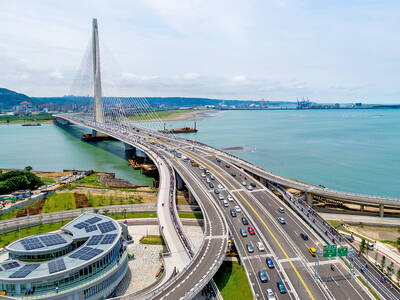
The Ministry of Transportation and Communications yesterday inaugurated the Danjiang Bridge across the Tamsui River in New Taipei City, saying that the structure would be an architectural icon and traffic artery for Taiwan. Feted as a major engineering achievement, the Danjiang Bridge is 920m long, 211m tall at the top of its pylon, and is the longest single-pylon asymmetric cable-stayed bridge in the world, the government’s Web site for the structure said. It was designed by late Iraqi-British architect Zaha Hadid. The structure, with a maximum deck of 70m, accommodates road and light rail traffic, and affords a 200m navigation channel for boats,
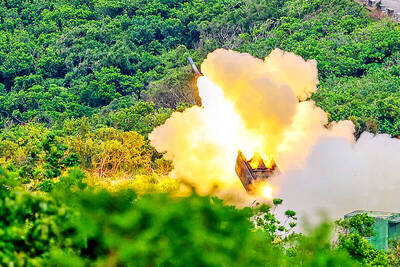
PRECISION STRIKES: The most significant reason to deploy HIMARS to outlying islands is to establish a ‘dead zone’ that the PLA would not dare enter, a source said A High Mobility Artillery Rocket System (HIMARS) would be deployed to Penghu County and Dongyin Island (東引) in Lienchiang County (Matsu) to force the Chinese military to retreat at least 100km from the coastline, a military source said yesterday. Taiwan has been procuring HIMARS and Army Tactical Missile Systems (ATACMS) from the US in batches. Once all batches have been delivered, Taiwan would possess 111 HIMARS units and 504 ATACMS, which have a range of 300km. Considering that “offense is the best defense,” the military plans to forward-deploy the systems to outlying islands such as Penghu and Dongyin so that

Taiwan Semiconductor Manufacturing Co (TSMC, 台積電), the world’s largest foundry service provider, yesterday said that global semiconductor revenue is projected to hit US$1.5 trillion in 2030, after the figure exceeds US$1 trillion this year, as artificial intelligence (AI) demand boosts consumption of token and compute power. “We are still at the beginning of the AI revolution, but we already see a significant impact across the whole semiconductor ecosystem,” TSMC deputy cochief operating officer Kevin Zhang (張曉強) said at the company’s annual technology symposium in Hsinchu City. “It is fair to say that in the past decade, smartphones and other mobile devices were
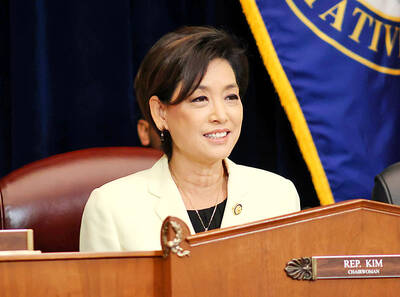
‘CLEAR MESSAGE’: The bill would set up an interagency ‘tiger team’ to review sanctions tools and other economic options to help deter any Chinese aggression toward Taiwan US Representative Young Kim has introduced a bill to deter Chinese aggression against Taiwan, calling for an interagency “tiger team” to preplan coordinated sanctions and economic measures in response to possible Chinese military or political action against Taiwan. “[Chinese President] Xi Jinping [習近平] has directed the People’s Liberation Army to be ready to invade Taiwan by 2027. China has a plan. America should have one too,” Kim said in a news release on Thursday last week. She introduced the “Deter PRC [People’s Republic of China] aggression against Taiwan act” to “ensure the US has a coordinated sanctions strategy ready should


 RSS
RSS