


The military exercises China launched yesterday have many purposes, including cognitive warfare against Taiwan, countering US-Japan military cooperation and the showcasing of coordination with Russia, an academic said yesterday.
Lin Ying-yu (林穎佑), an associate professor in Tamkang University’s Graduate Institute of International Affairs and Strategic Studies, said the drills were not solely a response to this month’s US arms sales to Taiwan, and other factors were also at play.
The drills were in part conducted in response to Japanese Prime Minister Sanae Takaichi’s statements on a potential “Taiwan contingency,” as well as Tokyo’s increasingly close military cooperation with the US, Lin said.

Photo: Reuters
Last month, Takaichi said a Chinese attack on Taiwan would constitute a threat to Japan’s survival and could warrant a military response from Tokyo, drawing an angry reaction from Beijing.
The Chinese People’s Liberation Army (PLA) launched a new series of exercises around Taiwan, code-named “Justice Mission 2025,” which it said were meant as a “stern warning to Taiwanese independence separatist forces.”
The drills were a form of cognitive warfare, aimed at undermining Taiwanese morale by signaling to Taiwan that US and Japanese support might not translate into real assistance, Lin said.
China’s decision to launch the drills just before the New Year sent a strong “China-Russia joint action” signal, given that Moscow announced starting on Thursday it would hold a two-month live-fire military exercise in the Northern Territories, also known in Russia as the Kurils.
The PLA’s tactical logic is to leverage Russia’s threat in the north to constrain Japan Self-Defense Forces (JSDF), preventing them from redeploying resources to Taiwan if tensions were to escalate in the Strait, Lin said.
Besides the pressure exerted by China and Russia, North Korea is also worth watching for any potential action, as this could be a way to constrain US forces stationed in South Korea, he said.
Lin said that if China, Russia, and North Korea were to act in coordination, it would align with a strategic concept the PLA has been developing in the past few years, known as the “five-sea integration.”
The concept envisions synchronized operations across the South China Sea, Taiwan Strait, and East China, Yellow and Philippine seas to challenge the defensive resilience of the first island chain, he said.
Former US Department of Defense senior director for China, Taiwan and Mongolia Tony Hu (胡振東) said that if a conflict were to break out in the Taiwan Strait, Russia would likely not intervene directly, but could constrain JSDF in the north, preventing them from reinforcing the south.
Other analysts said Beijing’s drills increasingly blur the line between routine military training exercises and what could be stage-setting for an attack, a strategy intended to give the US and its allies minimal warning of an assault.
Former Japanese vice minister of defense Yasuhide Nakayama yesterday in a social media post said that although China claims the drill is a “warning to pro-independence forces in Taiwan and external interference forces,” he believes the action is not just a military exercise, but a move with clear political and psychological messaging aimed at influencing Japanese society.
The Guardian yesterday quoted analysts as saying that it was the first time the PLA had explicitly said it was practicing deterring international involvement.
Also unusually, a number of PLA aircraft remained visible on radar platforms, it quoted the analysts as saying.
International Crisis Group’s senior northeast Asia analyst William Yang (楊晧暐) was quoted by the Financial Times as saying that the drills would “test” US President Donald Trump’s administration.
Beijing was likely to “take into account the response from the US and carefully determine how it should formulate and plan the PLA’s military operations, including regular training and more tactical shows of force to pressure Taiwan,” he was quoted as saying.
Additional reporting by Lin Tsuei-yi

LEVERAGE: China did not ‘need to fire a shot’ to deny Taiwan airspace over Africa when it owns ‘half the continent’s debt,’ a US official said, calling it economic warfare The EU has raised concerns about overflight rights following the delay of President William Lai’s (賴清德) planned state visit to the Kingdom of Eswatini after three African nations denied overflight clearance for his charter at the last minute. Taiwanese allies Paraguay and Saint Kitts and Nevis, as well as several US lawmakers and the Inter-Parliamentary Alliance on China (IPAC) condemned China for allegedly pressuring the countries. Lai was scheduled to fly directly to Taiwan’s only African ally from yesterday to Sunday to celebrate the 40th anniversary of King Mswati III’s accession and his 58th birthday, but Seychelles, Mauritius and Madagascar suddenly revoked
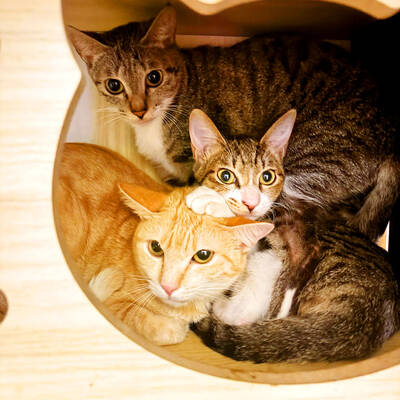
The number of pet cats in Taiwan surpassed that of pet dogs for the first time last year, reaching 1,742,033, a 32.8 percent increase from 2023, the Ministry of Agriculture said yesterday, citing a survey. By contrast, the number of pet dogs declined slightly by 1.2 percent over the same period to 1,462,528, the ministry said. Despite the shift, households with dogs still slightly outnumber those with cats by 1.2 percent. However, while the number of households with multiple dogs has remained relatively stable, households keeping more than two cats have increased, contributing to the overall rise in the feline population. The trend
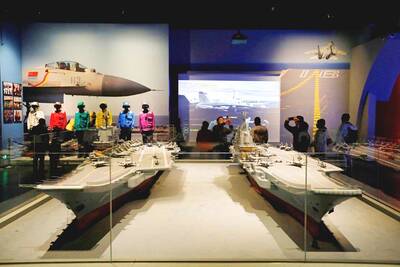
China on Wednesday teased in a video an aircraft carrier that could be its fourth, and the first using nuclear power, while making an allusion to Taiwan and vowing to further build up its islands, as it looks to boost maritime power, secure resources and bolster territorial claims. The video, issued on the eve of the 77th founding anniversary of the Chinese People’s Liberation Army Navy, featured fictional officers with names that are homophones of three commissioned aircraft carriers, the Liaoning (遼寧), Shandong (山東) and Fujian (福建). Titled Into the Deep, it showed a 19-year-old named “Hejian” (何劍) joining the group, sparking
BIG YEAR: The company said it would also release its A12 chip the same year to keep a ‘reliable stream of new silicon technologies’ flowing to its customers Taiwan Semiconductor Manufacturing Co (TSMC, 台積電) yesterday said its newest A13 chip is to enter volume production in 2029 as the chipmaker seeks to hold onto its tech leadership and demand for next-generation chips used in artificial intelligence (AI), high-performance-computing (HPC) and mobile applications. TSMC, the world’s biggest contract chipmaker, also unveiled its A12 chip at its annual technology symposium in Santa Clara, California. The A12 chip, which features TSMC’s super-power-rail technology to provide backside power delivery for AI and HPC applications, is also to enter volume production in 2029, a year after the scheduled release of the A14 chip. The technology moves


 RSS
RSS