


China passed a revised law that for the first time formally regulates uncrewed aircraft, a move set to reshape the country’s fast-growing drone and low-altitude economy sectors, state media said yesterday.
The Standing Committee of the National People’s Congress approved the changes to the Civil Aviation Law, adding a provision on airworthiness certification for drones that plugs a key regulatory gap.
The overhaul comes as China’s low-altitude economy — a national strategic initiative focusing on commercial activities below 3,000m — is forecast to grow to more than 2 trillion yuan (US$285 billion) by 2030, from 1.5 trillion yuan this year, according to estimates from the Chinese Academy of Sciences, Peking University and China’s Civil Aviation Administration (CAAC).
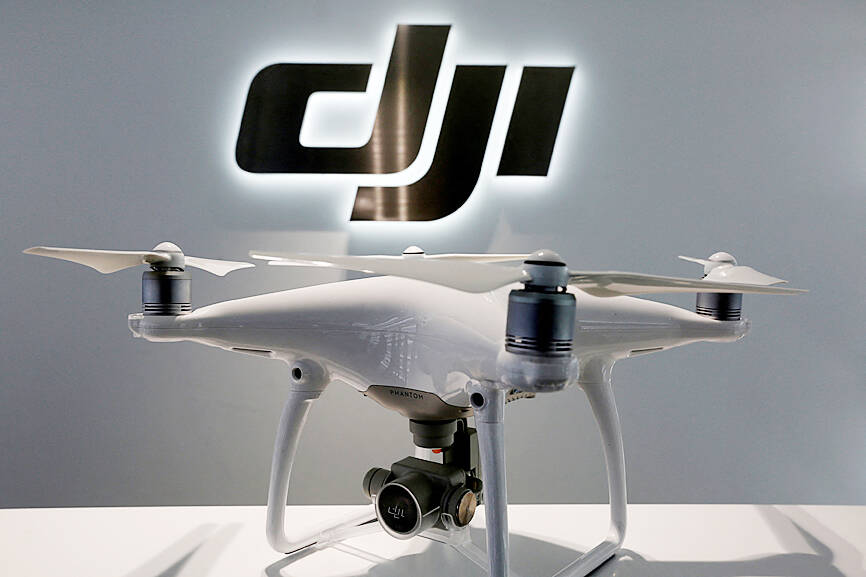
Photo: Reuters
Under the new rules, effective on July 1 next year, all entities involved in the design, production, import, maintenance and operation of drones must obtain airworthiness certification.
Drone manufacturers would also be required to assign a unique product identification code to each unit.
China has implemented “interim regulations” for uncrewed aircraft starting last year, which stipulate that civil uncrewed aircraft must be registered under real names. The regulations also specify that micro, light and small civil uncrewed aircraft do not require airworthiness certification, while medium and large ones must apply for airworthiness certification.
As China’s drone market has rapidly expanded, oversight has lagged. Over the past few years, several cities have reported flight delays caused by illegal drone operations, prompting fines and other penalties.
The tighter requirements would affect manufacturers such as DJI, the world’s largest consumer drone maker, and EHang, which produces passenger drones.
Drone logistics have become an important driver of China’s low-altitude economy, with 2.7 million packages containing everything from hamburger lunches to life-saving medicine delivered throughout last year, official data showed.
E-commerce and food delivery leaders such as JD.com and Meituan have long talked about investing in drone logistics to improve supply chain efficiency.
JD Logistics has tested drone delivery networks in Jiangsu, Shaanxi and Sichuan, and said drones could reduce shipping times for rural customers by up to 70 percent.

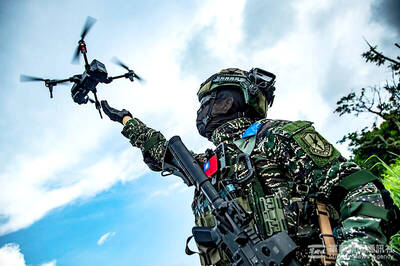
RESILIENCE: Taiwan plays a key role in semiconductors, energy, information infrastructure and advanced manufacturing, AIT Director Raymond Greene said Taiwan’s continued investment in deterrence and resilience remains vital, especially in uncrewed systems and other emerging technologies, American Institute in Taiwan (AIT) Director Raymond Greene said yesterday. Greene made the remarks at the annual National Strategic Summit on Supply Chain Resilience held by the Research Institute for Democracy, Society and Emerging Technology (DSET), a government-backed think tank. As Taiwan last year became the US’ fourth-largest trading partner and supply chain security is becoming more important, cooperation in emerging technologies continues to deepen between the two countries, he said. The US is committed to accelerating innovation, building key infrastructure, strengthening cooperation

The National Chungshan Institute of Science and Technology yesterday showcased its locally developed variants of the Vision 60 robotic patrol dog, which it plans to deploy on the nation’s outlying territories in the South China Sea. The variants were produced under the Joint Lab project — created by the institute and domestic companies — and assembled with domestically produced motors, lenses and artificial intelligence (AI) systems alongside licensed tech from the US, Missile and Rocket Systems Research Division deputy director Jen Kuo-kang (任國光) told the media event at a military base in Taipei’s Dazhi (大直) area. Taiwan has built up its strengths

RIGHT DIRECTION: Taiwan’s efforts to prevent forced labor include a proposal to ‘fully prohibit’ employers from withholding workers’ documents, an official said Taiwan is to establish a mechanism to restrict imports of goods linked to forced labor, the Executive Yuan said yesterday, after the US proposed imposing additional tariffs on Taiwanese goods over labor concerns. “The Ministry of Labor and the Ministry of Economic Affairs are to establish an interministerial review procedure,” Executive Yuan spokesperson Michelle Lee (李慧芝) said at a news briefing in Taipei. “The government is to use the Foreign Trade Act [貿易法] as the legal basis to restrict imports of goods produced with forced labor” and bring its supply chain governance more in line with international standards on human rights, resilience
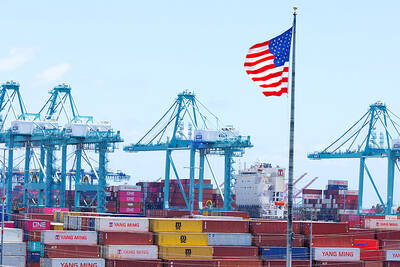
NOT IMMEDIATE: Taiwan has a chance to appeal the proposed 10 percent tariff before it starts, while other countries face a 12.5 percent tariff from the trade office Taiwan is among 60 economies determined by the US to have failed to impose or enforce a ban on the importation of goods produced with forced labor, according to a notice released on Tuesday by the Office of the US Trade Representative (USTR), which proposed imposing an additional 10 percent or more tariff on them. The USTR in a statement said that following an investigation, it had determined under Section 301 of the Trade Act of 1974 that the failure of the 60 economies to impose and effectively enforce a prohibition on the importation of goods produced with forced labor is


 RSS
RSS