


Four people were yesterday charged with contravening the National Security Act (國家安全法) and the Anti-Corruption Act (貪污治罪條例) for allegedly leaking classified information about then-president Tsai Ing-wen’s (蔡英文) visit to South and Central America in 2023, and other classified secrets to China.
The prosecution is seeking sentences of between four and 15 years imprisonment for the accused: former diabolo trainer Lu Chi-hsien (魯紀賢), and retired military personnel Ko Tsang-hao (葛倉豪), Chen Min-chi (陳旻琪) and Lin Chu-han (林楚?).
Lu, through Lin and Chen, allegedly obtained multiple classified air force documents, including a psychological education program for the Air Force Songshan Base Command on how the air force manages risks, and a compilation of the 2023 air force risk management and crisis management report, the indictment said.

Photo: Taipei Times
Lu also allegedly instructed Ko to photograph the list of airports Tsai was to visit and deliver that information to China, it said.
The prosecution indicted the four suspects, and sought 15 years imprisonment for for Lu, eight years for Lin, seven years for Chen and four years for Ko.
Lu, Ko, Chen and Lin were in July found guilty of contravening the National Security Act (國家安全法) for developing an underground spy organization for China.
Separately, South Korea’s Yonhap News Agency yesterday reported that a retired South Korean navy commander, known only as “A,” had been sentenced to two-and-a-half years in prison for leaking submarine blueprints to Taiwan without government approval.
“A” had in 2019 made a deal with Taiwan valued at US$110 million and provided the nation with torpedo launch tube blueprints from Hanwha Ocean Co, Yonhap reported.
The blueprints were reverse-engineered and supplementary or modified designs based on the original technology, “A” said.
The Masan Branch of the Changwon District Court dismissed his statements, saying Taiwan did not own the intellectual property rights to the reverse-engineered blueprints and that export of the original blueprints required authorization.
South Korean law states exports of items considered strategic goods must be approved by the Ministry of Trade and Industry, or relevant administrative agencies, while items considered military goods must be authorized by the Defense Acquisition Program Administration, its national arms sales regulator.
“This crime is a matter that could pose a significant threat to South Korea’s security, as strategic technology was exported without the approval of the Defense Acquisition Program Administration, and the export partner is Taiwan, which has a tense relationship with neighbors in East Asia,” the ruling said.
Additional reporting by CNA
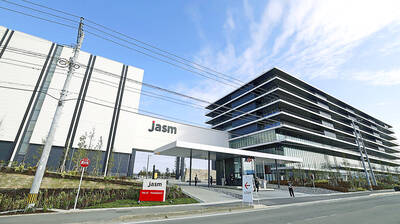
The subsidiary of Taiwan Semiconductor Manufacturing Co (TSMC, 台積電) in Kumamoto, Japan, turned a profit in the first quarter of this year, marking the first time the first fab of the unit has become profitable since mass production started at the end of 2024. According to the contract chipmaker’s financial statement released on Friday, Japan Advanced Semiconductor Manufacturing Inc (JASM), a joint venture running the fab in Kumamoto, posted NT$951 million (US$30.19 million) in profit in the January-to-March period, compared with a loss of NT$1.39 billion in the previous quarter, and a loss of NT$3.25 billion in the first quarter of
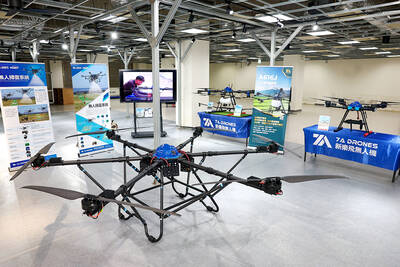
DRONE CENTRAL: Taiwan aims to become Asia’s democratic hub for drones, with most exports focused on high-quality military-grade models, an official said Taiwan’s drone industry is expected to expand significantly by 2030, producing 100,000 units per month and exporting half of them, the Ministry of Economic Affairs said yesterday. Current drone production capacity is about 15,000 units per month, but the industry can quickly scale up as demand increases, Industrial Development Administration Director-General Chiou Chyou-huey (邱求慧) told a news conference in Taipei. Taiwan’s drone output grew 2.5-fold last year to NT$12.9 billion (US$408.3 million) under a government program to develop the uncrewed vehicle sector, he said. The Executive Yuan in October last year approved plans to invest NT$44.2 billion into domestic production of uncrewed aerial
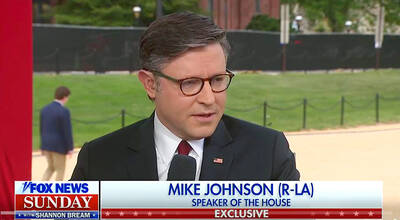
RESOLUTE BACKING: Two Republican senators are planning to introduce legislation that would impose immediate sanctions on China if it attempts to invade Taiwan US House of Representatives Speaker Mike Johnson on Sunday reaffirmed US congressional support for Taiwan, saying the US and “all freedom-loving people” have a stake in preventing China from seizing Taiwan by force. Johnson made the remarks in an interview with Fox News Sunday on US President Donald Trump’s summit with Chinese President Xi Jinping (習近平) last week. In an interview that aired on Friday on Fox News, just as Trump wrapped up a high-stakes visit to China, he said he has yet to green-light a new US$14 billion arms package to Taiwan and that it “depends on China.” “It’s a very good
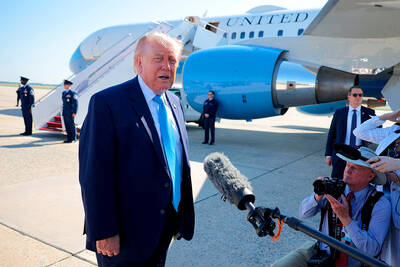
US President Donald Trump yesterday said he would speak to President William Lai (賴清德) as his administration considers whether to move ahead with a US$14 billion weapons sale to Taiwan — a potential arms deal that has drawn criticism from China. “Well, I’ll speak to him. I speak to everybody,” Trump told reporters yesterday when asked if he had any plans to call his counterpart, although he did not offer a time frame for when such a conversation could take place. Trump previously said he would speak to the person “that’s running Taiwan,” without specifying who he meant. “We have that situation very


 RSS
RSS