


Japan yesterday took the final step to allow the world’s largest nuclear power plant to resume operations with a regional vote, a watershed moment in the country’s return to nuclear energy nearly 15 years after the Fukushima Dai-ichi nuclear power plant disaster.
Kashiwazaki-Kariwa, about 220km northwest of Tokyo, was among 54 reactors shut after the 2011 earthquake and tsunami crippled the Fukushima plant in the worst nuclear disaster since Chernobyl.
Since then, Japan has restarted 14 of the 33 that remain operable, as it tries to wean itself off imported fossil fuels.
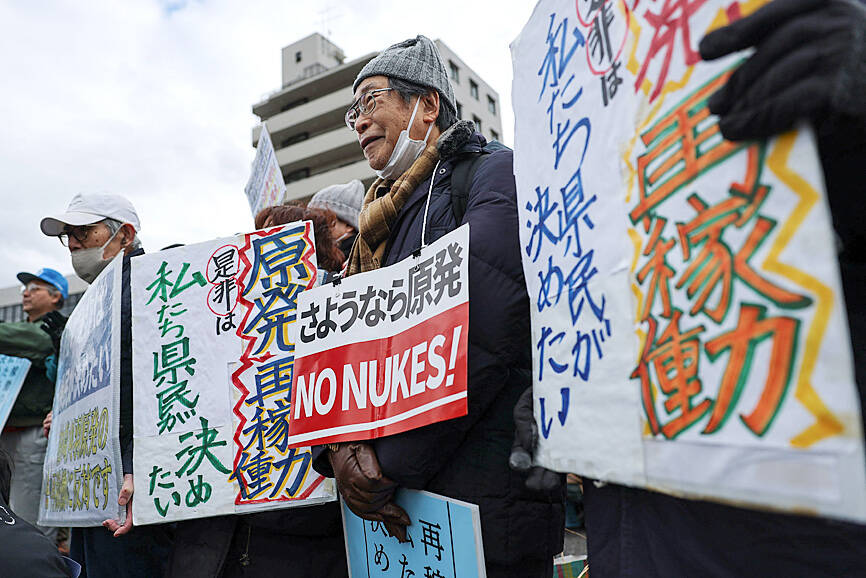
Photo: Reuters
Kashiwazaki-Kariwa is to be the first restarted plant operated by Tokyo Electric Power Co (TEPCO), which ran the doomed Fukushima plant.
The Niigata Prefectural Assembly yesterday passed a vote of confidence on Niigata Governor Hideyo Hanazumi, who backed the restart last month, effectively allowing the plant to begin operations again.
“This is a milestone, but this is not the end,” Hanazumi told reporters after the vote. “There is no end in terms of ensuring the safety of Niigata residents.”
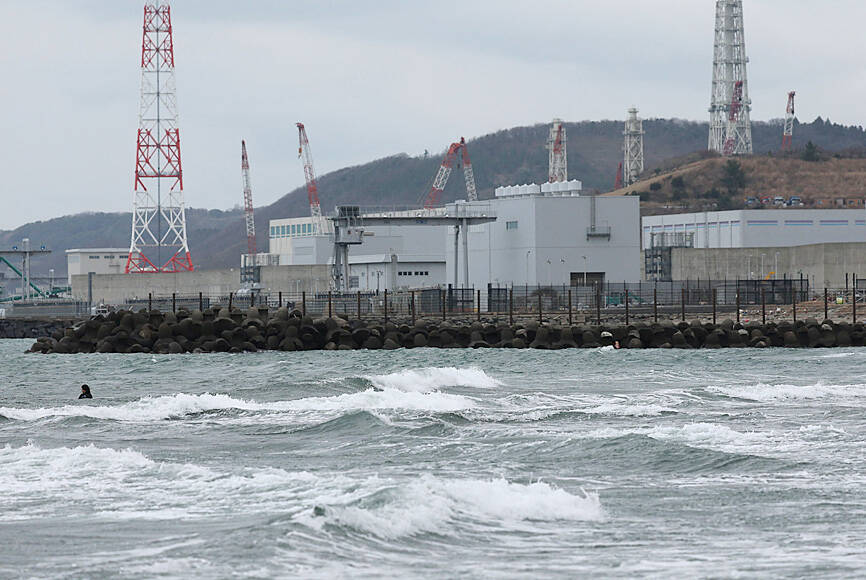
Photo: Reuters
While lawmakers voted in support of Hanazumi, the assembly session, the last for the year, exposed community divisions over the restart, despite new jobs and potentially lower electricity bills.
“This is nothing other than a political settlement that does not take into account the will of the Niigata residents,” an assembly member opposed to the restart told fellow lawmakers as the vote was about to begin.
Outside, about 300 protesters stood in the cold holding banners reading “No Nukes,” “We oppose the restart of Kashiwazaki-Kariwa” and “Support Fukushima.”
“I am truly angry from the bottom of my heart,” Kenichiro Ishiyama, a 77-year-old protester from Niigata city, said after the vote. “If something was to happen at the plant, we would be the ones to suffer the consequences.”
TEPCO is considering reactivating the first of seven reactors at the plant on Jan. 20, public broadcaster NHK reported.
Kashiwazaki-Kariwa’s total capacity is 8.2 gigawatts (GW), enough to power several million homes. One 1.36GW unit would be brought online next year and another with the same capacity in about 2030.

A signaling system malfunction disrupted high-speed rail (HSR) services beginning at 8am today, with trains temporarily reduced to three northbound and three southbound trains per hour as authorities conduct inspections. The malfunction occurred on a section of track in Miaoli County during pre-operation checks early this morning, forcing northbound and southbound trains to use a single track, the HSR operator said. The regular schedule has been replaced with three hourly trains offering only nonreserved seating in each direction, stopping at every station, it said, adding that business class cars would still have reserved seating. Departures from terminal stations are scheduled at the top

Taiwan is still in the process of assessing the possibility of recruiting workers from Eswatini, the Ministry of Foreign Affairs said yesterday, adding that its goal is to help Eswatini upgrade its vocational training centers. If there are plans to recruit workers from Eswatini, safeguarding national security, protecting public health and ensuring the employment rights of Taiwanese would be prerequisites, Department of West Asian and African Affairs Director-General Yen Chia-liang (顏嘉良) told a news conference. Key considerations would also include filling labor shortages in specific industries, and fostering bilateral professional and technical exchanges, he said. Yen was asked about the progress of labor

A US uncrewed surface vessel (USV) encountered multiple Chinese warships during an autonomous transit of the Taiwan Strait, US defense company Seasats said in a statement on Wednesday. Seasats announced that a Lightfish USV had completed the first autonomous transit of the Taiwan Strait. Over five days, the USV traversed the entire length of the Strait while constantly monitoring surface vessel traffic, the company said. The Lightfish encountered multiple Chinese warships, one of which was a Chinese People’s Liberation Army Navy (PLAN) Type 056 corvette, it said. The Chinese vessels were operating “well within Taiwan’s exclusive economic zone without transmitting their identity via the

VERBOSE VESSELS: A CGA cutter and a China Coast Guard exchanged verbal barbs for more than a day in Taiwanese-controlled waters before the Chinese vessel left The Taiwanese and Chinese coast guards had a standoff near the strategically located Pratas Islands (Dongsha Islands, 東沙群島) in the north of the South China Sea, the Coast Guard Administration (CGA) said yesterday. The two sides engaged in intense radio exchanges over sovereignty claims during the 33-hour standoff. China Coast Guard vessel 3501 eventually left the restricted waters, 26.6 nautical miles (49.2km) west of the Pratas Islands, at 5pm yesterday, the CGA said. Lying approximately between southern Taiwan and Hong Kong, the Taiwan-controlled Pratas are seen by some security experts as vulnerable to Chinese attack due to their distance — more than


 RSS
RSS