

The US seized another oil tanker off Venezuela on Saturday, a move Caracas deemed a “theft and kidnapping,” in the latest salvo of a pressure campaign by Washington, the US government said.
It was the second time in two weeks that US forces have interdicted a tanker in the region, and comes days after US President Donald Trump announced a blockade of “sanctioned oil vessels” heading to and leaving Venezuela.
“In a pre-dawn action early this morning on Dec. 20, the US Coast Guard with the support of the Department of War apprehended an oil tanker that was last docked in Venezuela,” US Secretary of Homeland Security Kristi Noem wrote on social media.
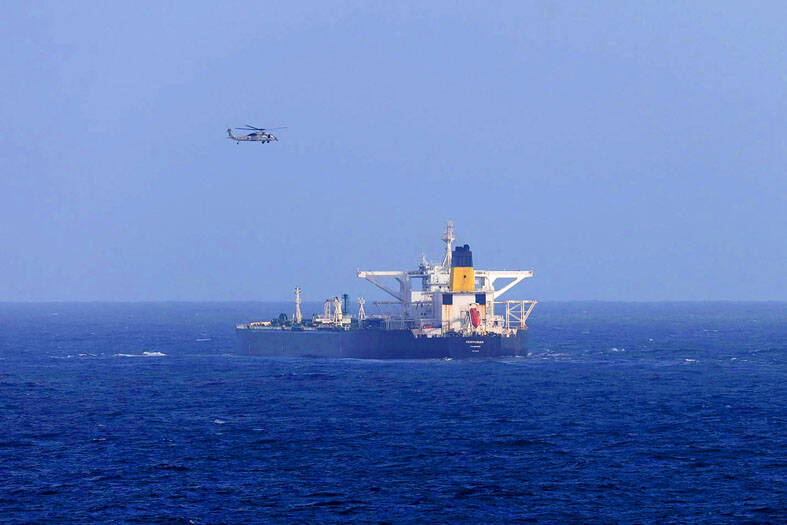
Photo: DHS/Handout via REUTERS
The post was accompanied by a nearly eight-minute video of aerial footage that showed a helicopter hovering just above the deck of a large tanker at sea.
Caracas slammed the seizure as theft and kidnapping, saying that “those responsible for these serious events will answer to justice and to history for their criminal conduct.”
A post from the US Department of Homeland Security identified the vessel as the Centuries and said it was “suspected of carrying oil subject to US sanctions.”
Centuries is a Chinese-owned, Panama-flagged oil tanker, according to TankerTrackers, an online service monitoring oil shipments and storage.
It said that Centuries loaded 1.8 million barrels of crude oil at a Venezuelan port earlier this month before being escorted out of Venezuela’s exclusive economic zone on Thursday last week. The VesselFinder database also listed the ship’s last recorded location as off the Venezuelan coast.
An AFP review found that Centuries does not appear on the US Department of the Treasury’s list of sanctioned companies and individuals.
White House deputy spokeswoman Anna Kelly wrote on social media that the tanker “contained sanctioned PDVSA oil,” in reference to Venezuela’s state oil company, and charged the ship as being “a falsely flagged vessel operating as part of the Venezuelan shadow fleet.”
On Dec. 10, US forces seized a large oil tanker off the coast of Venezuela, which the US attorney general said was involved in carrying sanctioned oil from Venezuela to Iran.
The US has for months been building a major military deployment in the Caribbean with the stated goal of combating Latin American drug trafficking, taking particular aim at Venezuela.
Venezuelan Minister of Defense Vladimir Padrino Lopez voiced defiance in comments at a public event in Caracas broadcast Saturday on state TV — although he made no mention of the interdicted ship.
“We are waging a battle against lies, manipulation, interference, military threats, and psychological warfare,” he said, adding that it “will not intimidate us.”
There are currently 11 US warships in the Caribbean: the world’s largest aircraft carrier, an amphibious assault ship, two amphibious transport dock ships, two cruisers and five destroyers.
Caracas views the operation as a campaign to push out Venezuelan President Nicolas Maduro — whom Washington and many nations view as an illegitimate president — and to “steal” Venezuelan oil.
GEOPOLITICAL SIGNIFICANCE: The CGA’s nonmilitary role makes it a tool to avert diplomatic issues, an official said, while confirming the donation of a ship to Manila Coast Guard Administration (CGA) ships are scheduled to sail to the Philippines bearing the words “Taiwan Coast Guard” in a high-profile visit in October next year, the first such visit by a Taiwanese maritime law enforcement vessel to the Southeast Asian nation, the agency said yesterday. The CGA also confirmed that it had donated one of its decommissioned patrol vessels to the Philippines in a rare transfer of a retired ship to a nondiplomatic ally. The Republic of China (ROC) Navy last made such a visit in 1974, shortly before the Philippines switched diplomatic recognition to the People’s Republic of China in

‘GLOBAL WARNING’: The infiltration is not just a local problem, as Beijing has been deploying the same tactics worldwide against Western democracies, a report said Between 50,000 and 100,000 Chinese spies are operating in Taiwan, far more than the National Security Bureau’s previous estimate of 5,000, German journalist and author Jurgen Kremb said on Monday. Kremb presented his research, titled “The War of Spies: How China’s Intelligence Services Are Infiltrating Taiwan — and What Europe Must Learn from It,” at a joint event held by the Taiwan offices of the Friedrich Naumann Foundation and the European Values Center for Security Policy. The report was published in June in the Ministry of Justice Investigation Bureau’s Prospect & Exploration Monthly (展望與探索月刊). By spies, he said he was referring to informants,
PRICE STABILIZATION: The Ministry of Economic Affairs has urged the legislature to support the Cabinet’s supplementary budget for state-owned energy companies State-owned oil supplier CPC Corp, Taiwan (CPC, 台灣中油) on Saturday announced that it would raise domestic gasoline prices by NT$0.7 (US$0.02) per liter and diesel prices by NT$0.6 per liter this week after international crude oil prices rose above US$100 per barrel last week. Formosa Petrochemical Corp (台塑石化) yesterday said that it matched CPC’s price adjustments for this week. The decisions end a six-week period during which CPC and Formosa kept fuel prices in Taiwan unchanged. Retail gasoline prices this week would rise to NT$31.2, NT$32.7 and NT$34.7 per liter for 92, 95 and 98-octane unleaded gasoline respectively at CPC
WASHINGTON MEETING: Japan’s Hirofumi Takinami said participants rejected the idea that the US should limit its defensive perimeter to the Second Island Chain US and Japanese lawmakers agree that the US must defend the First Island Chain, including Taiwan, and should not fall back to the Second Island Chain, while “a Taiwan contingency is a Japan contingency and therefore a US-Japan alliance contingency,” media reported after a meeting between officials of the two nations in Washington on Tuesday. A delegation of Japanese lawmakers from the Liberal Democratic Party met with US Senator Thom Tillis, co-chair of the Senate Taiwan Caucus, and US Representative Ami Bera, co-chair of the US Congressional Taiwan caucus, to discuss issues concerning East Asia and the Taiwan Strait. The Japanese and


 RSS
RSS