


More than 20 civic groups, 160 academics and 130 lawyers yesterday issued a joint statement supporting the Constitutional Court’s ruling on Friday that amendments to the Constitutional Court Procedure Act (憲法訴訟法) passed last year were unconstitutional, saying it was the first step to restoring the nation’s constitutional democracy.
The Legislative Yuan on Dec. 20 last year passed amendments stipulating that at least 10 justices must take part in constitutional deliberations, and at least nine justices must agree to find a bill or law unconstitutional. The amendments took effect on Jan. 25.
Seven of the 15 justices ended their term on Oct. 31 last year. Opposition lawmakers twice rejected President William Lai’s (賴清德) nominees to fill the vacancies, first in December last year and again in July. Lai has not nominated anyone nominees since.
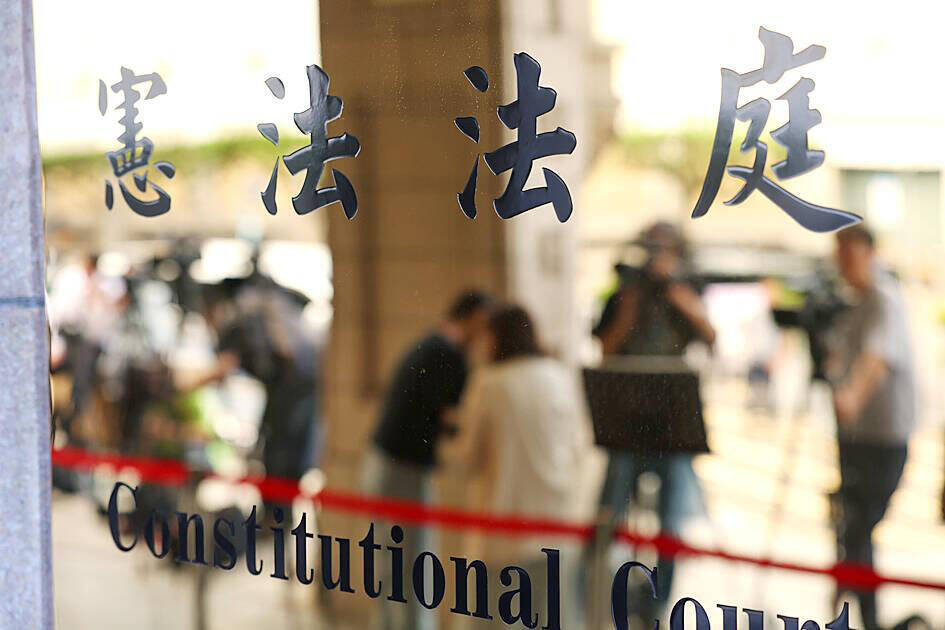
Photo: CNA
Five of the remaining justices on Friday found the law unconstitutional, saying its legislative process contained “obvious and significant defects,” contravened legislative procedure and breached the constitutional principle of the separation of powers.
Three justices from the eight-member court dissented and were not counted toward the total number of justices presiding over the case.
The civic groups in the statement said that the first Constitutional Court judgement made this year has brought the court back to life, ending 328 days of paralysis since the amendments were passed.
“As people who are concerned about the development of Taiwan’s constitutional democracy, we firmly support this judgement,” it said, adding that it is the first step toward “getting out of the mud” and “back on track” to solving constitutional disputes, including fundamental rights protections and the separation of powers.
The conflict between the Cabinet and the legislature has intensified in the past year, but when there was a need to clarify the separation of powers, the court, which plays the role of an objective mediator, could not make judgements, the statement said.
“More importantly, the justices cited ‘serious procedural irregularities’ in their judgement, pointing out that the Legislative Yuan violated the principles of openness and transparency when they passed the amendments, which is why they were unconstitutional,” it added.
This compels lawmakers to avoid using the “tyranny of the majority” to pass bills, ensuring the legislative process returns to the right track with transparency, open communications and thorough deliberation, it said.
Meanwhile, the statement said that by utilizing the principle of separation of powers and the procedural autonomy granted by the Constitution, the judgement also established that the court is only bound by a Constitutional Court Procedure Act that is constitutional.
It draws a clear line between judicial and legislative powers, ensuring that the Legislative Yuan could not paralyze the Constitutional Court again, it said.
“We commend the efforts made in this judgement, allowing us to look forward to a healthier, functioning constitutional democracy,” it said.
“We respect the three justices’ criticisms of this judgement based on legal theory raised through extrajudicial journal articles,” the statement said, adding that, however, “the Constitutional Court that rendered this judgement was by no means ‘illegally constituted.’”
Over the past year, the prolonged absence of these three justices from deliberations and their choice to issue public statements outside their duties have damaged public trust in the court, and so should be regarded as having recused themselves, the statement said.
Therefore, the current total number of justices for this case should be five, and the two-thirds threshold for making a judgement should be four, so the judgement made by five justices is constitutionally valid, the statement said.
Even as the Constitutional Court resumes operations, the unavoidable reality is that the court has become an unprecedentedly “divided court” through this judgement, and that the divided court might have stemmed from Taiwan’s divided society, it added.
“We sincerely hope that continued public discussion will lead us out of this constitutional dilemma as we collectively seek the ‘greatest common factor’ for a free and democratic constitutional system,” it said.
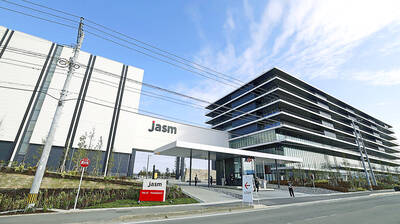
The subsidiary of Taiwan Semiconductor Manufacturing Co (TSMC, 台積電) in Kumamoto, Japan, turned a profit in the first quarter of this year, marking the first time the first fab of the unit has become profitable since mass production started at the end of 2024. According to the contract chipmaker’s financial statement released on Friday, Japan Advanced Semiconductor Manufacturing Inc (JASM), a joint venture running the fab in Kumamoto, posted NT$951 million (US$30.19 million) in profit in the January-to-March period, compared with a loss of NT$1.39 billion in the previous quarter, and a loss of NT$3.25 billion in the first quarter of

DRONE CENTRAL: Taiwan aims to become Asia’s democratic hub for drones, with most exports focused on high-quality military-grade models, an official said Taiwan’s drone industry is expected to expand significantly by 2030, producing 100,000 units per month and exporting half of them, the Ministry of Economic Affairs said yesterday. Current drone production capacity is about 15,000 units per month, but the industry can quickly scale up as demand increases, Industrial Development Administration Director-General Chiou Chyou-huey (邱求慧) told a news conference in Taipei. Taiwan’s drone output grew 2.5-fold last year to NT$12.9 billion (US$408.3 million) under a government program to develop the uncrewed vehicle sector, he said. The Executive Yuan in October last year approved plans to invest NT$44.2 billion into domestic production of uncrewed aerial
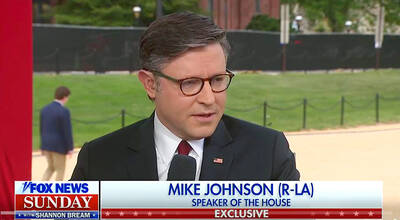
RESOLUTE BACKING: Two Republican senators are planning to introduce legislation that would impose immediate sanctions on China if it attempts to invade Taiwan US House of Representatives Speaker Mike Johnson on Sunday reaffirmed US congressional support for Taiwan, saying the US and “all freedom-loving people” have a stake in preventing China from seizing Taiwan by force. Johnson made the remarks in an interview with Fox News Sunday on US President Donald Trump’s summit with Chinese President Xi Jinping (習近平) last week. In an interview that aired on Friday on Fox News, just as Trump wrapped up a high-stakes visit to China, he said he has yet to green-light a new US$14 billion arms package to Taiwan and that it “depends on China.” “It’s a very good
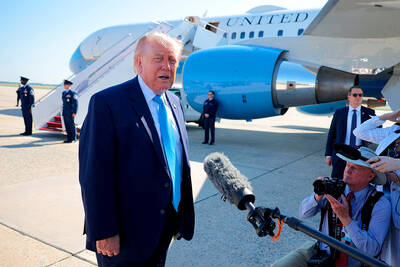
US President Donald Trump yesterday said he would speak to President William Lai (賴清德) as his administration considers whether to move ahead with a US$14 billion weapons sale to Taiwan — a potential arms deal that has drawn criticism from China. “Well, I’ll speak to him. I speak to everybody,” Trump told reporters yesterday when asked if he had any plans to call his counterpart, although he did not offer a time frame for when such a conversation could take place. Trump previously said he would speak to the person “that’s running Taiwan,” without specifying who he meant. “We have that situation very


 RSS
RSS