


Hundreds of people across Japan yesterday sued the central government, seeking damages for “unconstitutional” inaction on climate change in the country’s first such litigation.
The landmark lawsuit criticizes Japan’s “grossly inadequate” fight against the climate crisis, saying it jeopardizes the health and livelihoods of the approximately 450 plaintiffs.
“We just submitted our complaint and evidence to the court and our lawsuit has been officially accepted,” lead lawyer Akihiro Shima said.
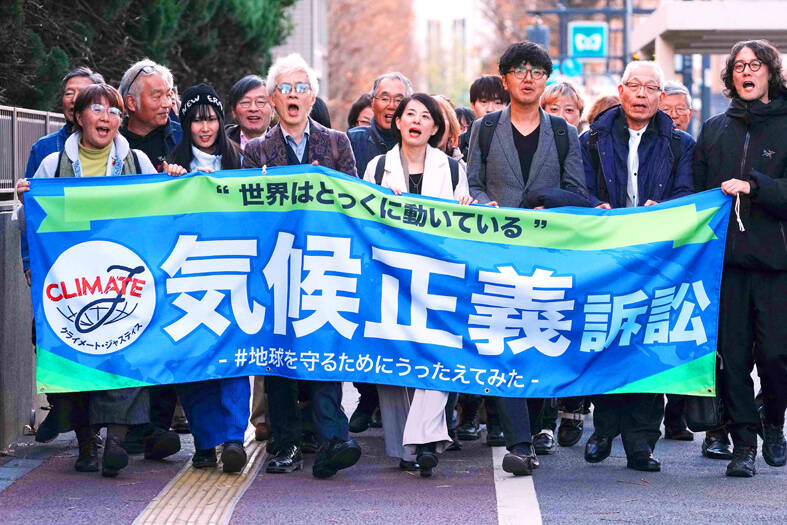
Photo: AFP
Plaintiff Kiichi Akiyama, a construction worker, said that relentless heat forced his team to work slower, causing “huge losses” to his business.
There have also been cases where “people collapse out in the field, or have dropped dead after they return home,” the 57-year-old said.
Five climate-related lawsuits have previously been filed with Japanese courts, including against coal-fired power plants, Kyoto University assistant professor Masako Ichihara said.
However, Ichihara — as well as lawyers working on the suit — say yesterday’s suit is the first compensation claim against the state over climate change.
“The defendant’s climate change measures are grossly inadequate, and as a result, the plaintiffs’ rights to a peaceful life and to the enjoyment of a stable climate are being violated,” the complaint summary says.
This year, Japan sweltered through its hottest summer since records began in 1898, and the plaintiffs argue that such heat waves cause economic losses, ruin crops and put many at risk of crippling heatstroke.
Akiyama, who frequently works outside in the searing heat, said it now takes his team triple the estimated time to finish their projects.
“I can barely dig with a shovel for 10 minutes without sitting down to rest,” he added. “We wouldn’t be in this terrible situation if the government had taken more initiative in implementing policies.”
Similar legal moves are under way globally, including in South Korea where young environmental activists won the first such case in Asia.
Last year, a South Korean court ruled that much of the country’s climate goals were unconstitutional. In Germany, climate targets were also ruled insufficient and unconstitutional in 2021.
The suit in Japan is seeking ¥1,000 (US$6.42)in damages per plaintiff.
Shima said plaintiffs wanted to focus on “the issue of the country’s responsibility” rather than on money.
Japan’s case is bolder than previous lawsuits in the country in that it seeks to directly hold the state accountable for climate inaction, Ichihara said.
Chances of a legal win are slim, but “if the purpose ... is to raise public awareness, then it may succeed” because of its “very relatable” messaging, she said.
Another plaintiff, who only gave her surname, Saito, was spurred into action by concerns over her six-year-old son.
She said that record temperatures were robbing him of opportunities to play outdoors, with public pools sometimes declared off-limits due to heatstroke alerts.
“Not just in pools, but playing outside generally is becoming difficult in summer. The playground equipment is burning hot and that scares me,” Saito said.
Japanese Chief Cabinet Secretary Minoru Kihara declined to comment directly on the lawsuit, but said the country had approved “ambitious” emissions reduction targets that were compatible with the Paris Agreement’s 1.5°C goal.
Japan’s nationally determined contributions aspire to cut its greenhouse gas emissions by 60 percent by 2035 and 73 percent by 2040 compared with 2013 levels.
However, yesterday’s lawsuit criticizes the latest targets, saying they “fall significantly short” of the global reduction aims outlined by the UN Intergovernmental Panel on Climate Change.
They are also not legally binding, the complaint summary says.
“This legislative omission is unmistakably unconstitutional,” it adds.

A signaling system malfunction disrupted high-speed rail (HSR) services beginning at 8am today, with trains temporarily reduced to three northbound and three southbound trains per hour as authorities conduct inspections. The malfunction occurred on a section of track in Miaoli County during pre-operation checks early this morning, forcing northbound and southbound trains to use a single track, the HSR operator said. The regular schedule has been replaced with three hourly trains offering only nonreserved seating in each direction, stopping at every station, it said, adding that business class cars would still have reserved seating. Departures from terminal stations are scheduled at the top

Taiwan is still in the process of assessing the possibility of recruiting workers from Eswatini, the Ministry of Foreign Affairs said yesterday, adding that its goal is to help Eswatini upgrade its vocational training centers. If there are plans to recruit workers from Eswatini, safeguarding national security, protecting public health and ensuring the employment rights of Taiwanese would be prerequisites, Department of West Asian and African Affairs Director-General Yen Chia-liang (顏嘉良) told a news conference. Key considerations would also include filling labor shortages in specific industries, and fostering bilateral professional and technical exchanges, he said. Yen was asked about the progress of labor

A US uncrewed surface vessel (USV) encountered multiple Chinese warships during an autonomous transit of the Taiwan Strait, US defense company Seasats said in a statement on Wednesday. Seasats announced that a Lightfish USV had completed the first autonomous transit of the Taiwan Strait. Over five days, the USV traversed the entire length of the Strait while constantly monitoring surface vessel traffic, the company said. The Lightfish encountered multiple Chinese warships, one of which was a Chinese People’s Liberation Army Navy (PLAN) Type 056 corvette, it said. The Chinese vessels were operating “well within Taiwan’s exclusive economic zone without transmitting their identity via the

VERBOSE VESSELS: A CGA cutter and a China Coast Guard exchanged verbal barbs for more than a day in Taiwanese-controlled waters before the Chinese vessel left The Taiwanese and Chinese coast guards had a standoff near the strategically located Pratas Islands (Dongsha Islands, 東沙群島) in the north of the South China Sea, the Coast Guard Administration (CGA) said yesterday. The two sides engaged in intense radio exchanges over sovereignty claims during the 33-hour standoff. China Coast Guard vessel 3501 eventually left the restricted waters, 26.6 nautical miles (49.2km) west of the Pratas Islands, at 5pm yesterday, the CGA said. Lying approximately between southern Taiwan and Hong Kong, the Taiwan-controlled Pratas are seen by some security experts as vulnerable to Chinese attack due to their distance — more than


 RSS
RSS