


The Cabinet yesterday unveiled draft changes to the National Security Act (國家安全法) and three other laws, including fines of up to NT$1 million (US$31,729) for advocating the end of Taiwan’s sovereignty through non-peaceful means.
Under the draft, the fines would be levied on those whose public speech, writing, artwork or digital records call for Taiwan’s forcible annexation by a foreign power.
The proposal comes after authorities in March issued deportation notices for three Chinese women married to Taiwanese spouses for posting online videos that either advocated or alluded to a potential military takeover of Taiwan by China.
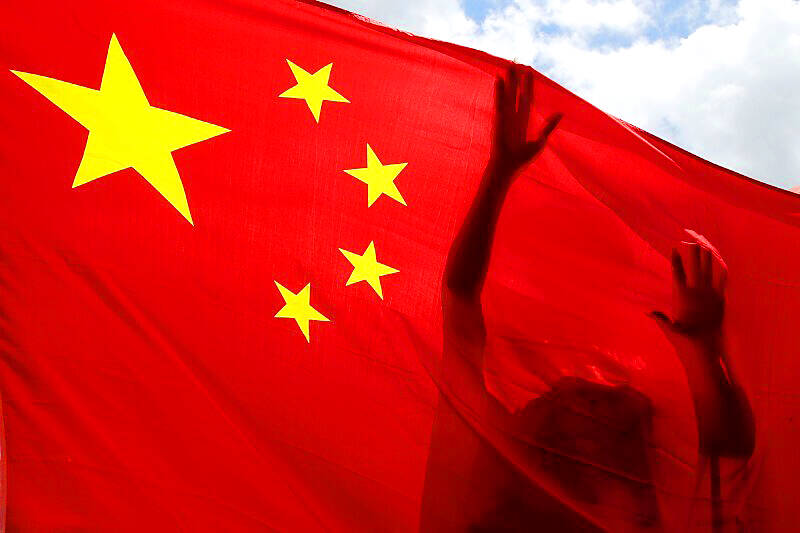
Photo: AP
The move sparked a debate over freedom of speech.
Minister Without Portfolio Lin Ming-hsin (林明昕) told a news conference that the proposal is based on the UN’s International Covenant on Civil and Political Rights, which stipulates that “any propaganda for war shall be prohibited by law.”
Furthermore, the proposal does not impose any restrictions on one-to-one conversations, whether in person or online, so it should not be deemed an encroachment on freedom of speech, he said.
However, repeatedly making such statements in a public manner accessible to everyone or in large group chats could be problematic, Lin said.
The provisions targeting online speech primarily aim to prevent ongoing dissemination, he added.
The amendments focus on online content in which the perpetrator is outside Taiwan, making it difficult to apprehend or penalize them, he said.
Disseminated illegal statements could still be restricted by the Ministry of Digital Affairs, he added.
The ministry would take corresponding measures such as restricting access or removing content, similar to existing mechanisms under laws covering child and youth protection and tobacco hazard prevention, Lin said.
Depending on the severity of an offense, the Ministry of the Interior might independently or in consultation with relevant agencies order Internet service providers to remove or block such content, and delete or limit access to noncompliant user accounts, the amendment says.
Penalties would vary depending on whether offenses are committed on behalf of China, Hong Kong, Macau or other foreign hostile forces, with new provisions holding intermediaries accountable.
The proposed revision also seeks to lengthen the minimum sentence for those who leak state secrets to a “foreign hostile force,” its representative or an entity it controls to seven years, up from five years. The maximum would remain 12 years.
It would also significantly raise the fine to NT$10 million to NT$300 million, up from NT$5 million to NT$100 million.
Prison terms for active-duty military personnel found to have contravened the act would be extended by 1.5 times, the amendment says.
They also include new provisions targeting the development or participation in organizations that could endanger national security or social stability.
Participating in organizations that affect national security would be added as an offense, the Ministry of Justice said.
Meanwhile, a proposed amendment to the Criminal Code of the Armed Forces (陸海空軍刑法) seeks to increase prison terms for active military personnel who surrender to enemies to three to 10 years, up from one to seven years.
Those who pledge allegiance to enemies through speech, actions, text, pictures or digital records would face a prison term of one to seven years, the draft says.
Those who prepare or conspire to defect to the enemy, including those who fail to defect, would face six months to five years in prison.
Amendments to the Act of Military Service for Officers and Non-commissioned Officers of the Armed Forces (陸海空軍軍官士官服役條例) and the Veterans Assistance Act (國軍退除役官兵輔導條例) would clarify loss of pension rights for officers convicted of treason or sedition, and allow suspension of benefits for retired veterans who breach loyalty obligations, proportional to the fine imposed.
The proposals would be sent to the legislature for review.
Asked if the timing of advancing the proposed amendments was considered sensitive and might escalate tensions between the ruling and opposition parties, Executive Yuan spokeswoman Michelle Lee (李慧芝) said that there was no timing issue.
The move came shortly after Premier Cho Jung-tai (卓榮泰) refused to countersign the Legislative Yuan’s version of the Act Governing the Allocation of Government Revenues and Expenditures (財政收支劃分法).
The amendments are in line with President William Lai’s (賴清德) directives aimed at countering five major national security threats and China’s “united front” efforts against the nation, Lee said.
In March, Lai announced 17 strategies to counter increasing infiltration efforts against Taiwan, calling for national unity and concerted efforts against social division, she said.
The proposed amendments aim to reinforce national security and prevent infiltration, and should receive bipartisan support regardless of party affiliation, she said.
Additional reporting by Wang Ting-chuan, Chung Li-hua and Hollie Younger

SILENCING CRITICS: In addition to blocking Taiwan, China aimed to prevent rights activists from speaking out against authoritarian states, a Cabinet department said The Ministry of Foreign Affairs (MOFA) yesterday condemned transnational repression by Beijing after RightsCon, a major digital human rights conference scheduled to be held in Zambia this week, was abruptly canceled due to Chinese pressure over Taiwanese participation. This year’s RightsCon, the world’s largest conference discussing issues “at the intersection of human rights and technology,” was scheduled to take place from tomorrow to Friday in Lusaka, and expected to draw 2,600 in-person attendees from 150 countries, along with 1,100 online participants. However, organizers were forced to cancel the event due to behind-the-scenes pressure from China, the ministry said, expressing its “strongest condemnation”
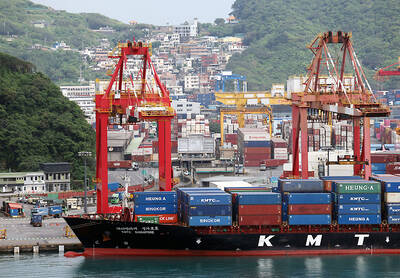
Taiwan’s economy grew far faster than expected in the first quarter, as booming demand for artificial intelligence (AI) applications drove a surge in exports, spilling over into investment and consumption, the Directorate-General of Budget, Accounting and Statistics (DGBAS) said yesterday. GDP growth was 13.69 percent year-on-year during the January-to-March period, beating the DGBAS’ February forecast by 2.23 percentage points and marking the most robust growth in nearly four decades, DGBAS senior official Chiang Hsin-yi (江心怡) told a news conference in Taipei. The result was powered by exports, which remain the backbone of Taiwan’s economy, Chiang said. Outbound shipments jumped 51.12 percent year-on-year to
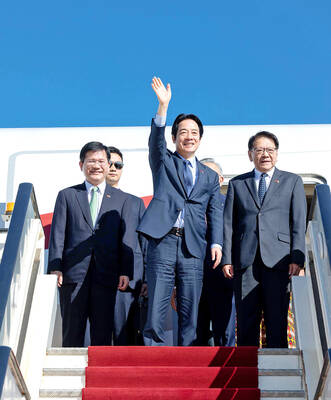
DELAYED BUT DETERMINED: The president’s visit highlights Taiwan’s right to international engagement amid regional pressure from China President Willaim Lai (賴清德) yesterday arrived in Eswatini, more than a week after his planned visit to Taiwan’s sole African ally was suspended because of revoked overflight permits. “The visit, originally scheduled for April 22, was postponed due to unforeseen external factors,” Lai wrote on social media. “After several days of careful arrangements by our diplomatic and national security teams, we successfully arrived today.” Lai said he looked forward to further deepening Taiwan-Eswatini relations through closer cooperation in the economy, agriculture, culture and education, as well as advancing the nation’s international partnerships. The president was initially scheduled to arrive in time to celebrate
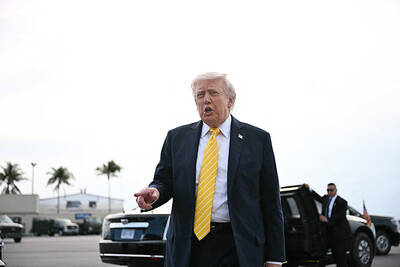
Iran’s Islamic Revolutionary Guard Corp (IRGC) yesterday said the US faced a choice between an “impossible” military operation or a “bad deal” with Tehran, after US President Donald Trump disparaged Iran’s latest peace proposal. Negotiations between the two countries have been deadlocked since a ceasefire came into effect on April 8, with only one round of direct peace talks held so far. Iran’s Tasnim and Fars news agencies reported that Tehran had submitted a 14-point proposal to mediator Pakistan, but Trump was quick to cast doubt on it. “I will soon be reviewing the plan that Iran has just sent to us, but


 RSS
RSS