


The Chungshan Institute of Science and Technology-developed Sea Oryx missile system, which passed combat trials in October, is to enter mass production.
Sea Oryx, one of the few infrared homing short-range air defense systems, intercepted drones and anti-ship missiles in the trials, a source within the military said.
Modified Hsiung Feng II (Brave Wind, 雄風二型) subsonic anti-ship missiles were used in the trials for greater authenticity, the source said, adding that the modification process provided further insight on the Hsiung Feng II missiles.
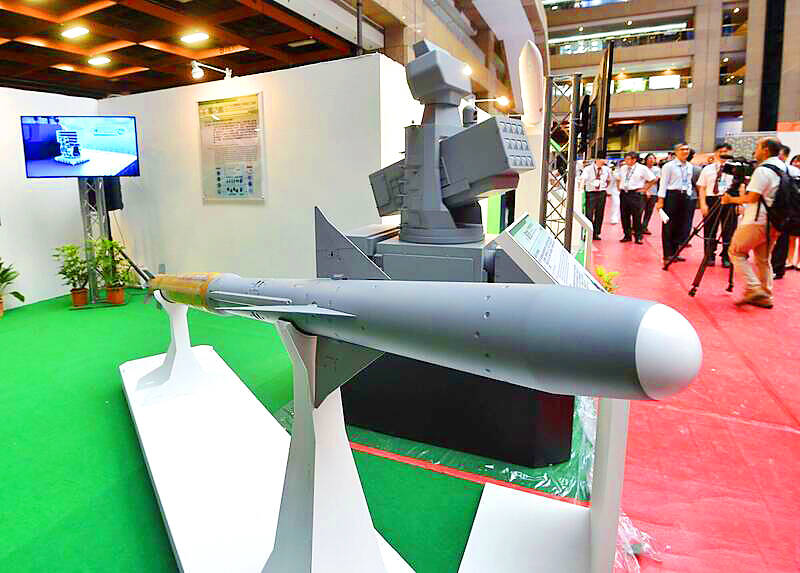
Photo: Fang Bin-chao, Taipei Times
The Sea Oryx, which has a 15km range, is equipped with a warhead containing the polycyclic nitroamine explosive CL-20, widely regarded as the most powerful non-nuclear explosive, they said.
Following the US Navy’s decision to replace MK 15 Phalanx systems on Arleigh Burke-class destroyers with the longer-range RIM-116 Rolling Airframe Missile systems, Taiwan would outfit its newer ships with Sea Oryx systems, they said.
One of the three types of Sea Oryx systems is mounted on a stand-alone launcher that can hold 12 missiles, with a small active phased array radar, developed by the institute, which is more suitable for smaller combat vessels, the source said.
The “combat series,” which has 24 launch tubes, but not its own antennae or radar system, must be plugged into a vessel’s targeting system and fed coordinates and firing commands from the ship’s bridge, they said.
It is more suited for mid-sized to large ships, they added.
A 24-tube version mounted on a land-based launcher vehicle would work in tandem with a mobile radar truck, they said.
The version tested in October was the stand-alone system with built-in radar, the source said.
Separately, during a question-and-answer session in the legislature on Monday, Chungshan Institute of Science and Technology president Lee Shih-chiang (李世強) said the institute was investigating the use of CL-20 on loitering munitions drones, adding that it is also looking into adapting its use across drones for all military units.
In other news, China’s newest and most advanced aircraft carrier, the Fujian (福建), sailed through the Taiwan Strait on Tuesday, the Ministry of National Defense said yesterday, its first transit of the waterway since formally entering service last month.
The ministry in a statement said that Taiwan’s forces had monitored the ship.
It provided a grainy, black-and-white picture of the carrier with no aircraft on its deck. It did not say where the picture was taken and offered no other details.
The Chinese Ministry of National Defense did not immediately respond to a request for comment.
Minister of National Defense Wellington Koo (顧立雄) told lawmakers that the ship was probably on its way to Shanghai’s Changxing Island, which is home to China’s main naval shipbuilding yard, and that the ministry had not observed it carrying out any military activities.
In a separate statement later in the day, the ministry said that China had been carrying out a “joint combat readiness patrol” near the island, involving 23 aircraft and warships, since the morning.
The aircraft included J-10 fighters and nuclear weapon-capable H-6K bombers, it added.
In September, the Fujian sailed through the Taiwan Strait and into the disputed South China Sea during trials.
The Fujian is China’s third aircraft carrier, with a flat flight deck and electromagnetic catapults to launch aircraft, which make it a potentially far more powerful naval weapon than China’s first two Russian-designed carriers.
The deployment of a third aircraft carrier by the PLA is just another indicator of its military build-up and campaign to intimidate Taiwan and deter intervention in maneuvers in the Western Pacific and East and South China Seas.
As of the end of November, PLA aircraft, including jet fighters, had flown 4,935 sorties in Taiwan’s vicinity, and the full year total was likely to surpass the previous record of 5,107 flown in 2024, up from 2,799 in 2022, according to CommonWealth Magazine figures based on publicly available MND data.
Of the sorties in 2025 through November, 3,467 had crossed the median line of the Taiwan Strait, already topping the previous full year record of 3,074 set in 2024, signaling a further ratcheting up of pressure by the PLA on Taiwan, the data showed.

‘NO SECURITY RISK’: The Railway Bureau reassured the public that the technicians’ activities were limited to technical guidance and did not involve sensitive systems The Railway Bureau yesterday said it had invited eight Chinese technicians to assist with an airport MRT construction project. The bureau issued the confirmation after an Internet user said Chinese nationals had entered the construction zone of Taiwan Taoyuan International Airport’s Terminal 3 project. They asked why “individuals from an enemy state” were allowed access to such a major national infrastructure project, which raised serious concerns over Taiwan’s industrial safety, sensitive systems and information security. The bureau’s Northern Region Engineering Branch Office said subcontractor Taiwan Handle Industrial Co (台灣手把工業) of the Taoyuan airport MRT’s “Contract No. CU05 Project A14 Station Civil, MEP &

A US uncrewed surface vessel (USV) encountered multiple Chinese warships during an autonomous transit of the Taiwan Strait, US defense company Seasats said in a statement on Wednesday. Seasats announced that a Lightfish USV had completed the first autonomous transit of the Taiwan Strait. Over five days, the USV traversed the entire length of the Strait while constantly monitoring surface vessel traffic, the company said. The Lightfish encountered multiple Chinese warships, one of which was a Chinese People’s Liberation Army Navy (PLAN) Type 056 corvette, it said. The Chinese vessels were operating “well within Taiwan’s exclusive economic zone without transmitting their identity via the
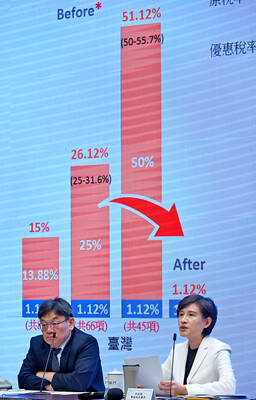
GREATER REACH? Auto parts and wood products would face tariffs of up to 15%, matching those targeting the EU, Japan and South Korea, Vice Premier said The US has announced that preferential tariff treatment for Taiwan’s non-semiconductor Section 232 goods would take effect retroactively from May 1, the Executive Yuan said yesterday. The US government yesterday posted a notice on the Federal Register’s public inspection Web site previewing tariff concessions for Taiwan under a memorandum of understanding (MOU) on Taiwan-US investment after two months of negotiations. The MOU signed on Jan. 15 stipulated three major preferential tariff arrangements: a 15 percent “reciprocal” tariff rate for Taiwan without stacking most-favored nation (MFN) rates; preferential Section 232 treatment for semiconductors and related products; and preferential Section 232 treatment for non-semiconductor

The National Chungshan Institute of Science and Technology yesterday showcased its locally developed variants of the Vision 60 robotic patrol dog, which it plans to deploy on the nation’s outlying territories in the South China Sea. The variants were produced under the Joint Lab project — created by the institute and domestic companies — and assembled with domestically produced motors, lenses and artificial intelligence (AI) systems alongside licensed tech from the US, Missile and Rocket Systems Research Division deputy director Jen Kuo-kang (任國光) told the media event at a military base in Taipei’s Dazhi (大直) area. Taiwan has built up its strengths


 RSS
RSS