


The Legislative Yuan yesterday approved punitive sentences of up to seven years in prison for people convicted of intentionally damaging undersea cables or pipelines, while the vessels involved could be confiscated.
Earlier this year, the captain of the Chinese-crewed freighter Hong Tai 58 (宏泰58) was sentenced to three years in prison under the Telecommunications Management Act (電信管理法) for intentionally damaging the Taiwan-Penghu No. 3 undersea cable.
Prosecutors said the law should be amended to increase the severity of the punishment for the crime.
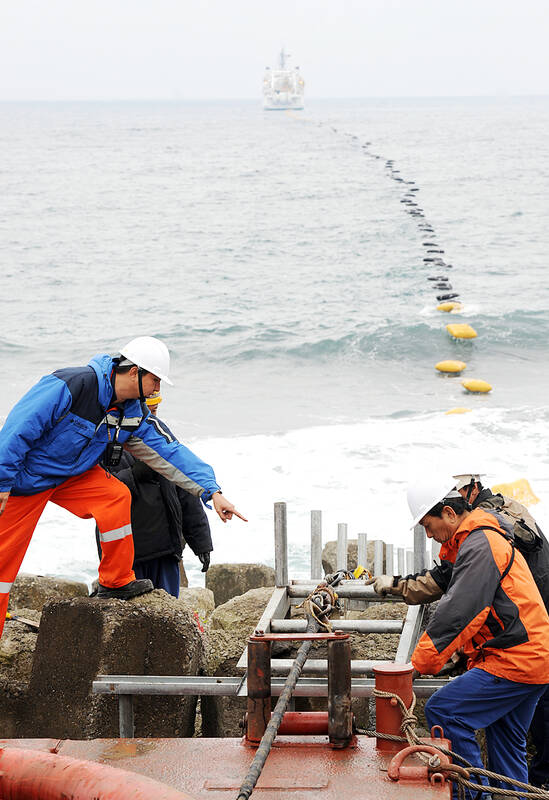
Photo: Lo Pei-de, Taipei Times
The Executive Yuan on Sept. 18 put forth amendments to seven laws to protect critical underwater infrastructure: the Telecommunications Management Act, the Water Supply Act (自來水法), the Electricity Act (電業法), the Natural Gas Enterprise Act (天然氣事業法), the Meteorological Act (氣象法), the Commercial Port Law (商港法) and the Law of Ships (船舶法).
The penalties would apply to damage to water and natural gas pipelines, and submarine cables.
They also include provisions for confiscating vessels used in such crimes, and requiring all ships to keep their automatic identification systems on or face penalties.
The legislature approved part of the Executive Yuan’s proposed amendments to the Electricity Act, the Natural Gas Enterprise Act and the Water Supply Act.
The amendments stipulate that unlawfully damaging undersea water pipes or power cables that ensure normal water supply and electricity is punishable by one to seven years in prison and a fine of up to NT$10 million (US$320,359).
Negligent offenses would be handled according to the Telecommunications Management Act, and are punishable by up to six months in prison, detention or a fine of up to NT$2 million.
In addition, any tools, vessels or equipment used in committing an offense could be confiscated and disposed of, regardless of ownership, to prevent repeat offenses.
The legislature also passed a resolution requiring the Ministry of the Interior to publish maps of undersea pipes and cables before changes to the seven laws take effect.
This is to ensure information transparency to avoid offenders from claiming they were not aware of cable and pipeline locations, clarify intent or negligence, improve public understanding to avoid contraventions, and support law-enforcement and investigative efforts, legislators said.
In other news, opposition lawmakers yesterday again blocked the Executive Yuan’s proposed special defense budget and amendments to the Act Governing the Allocation of Government Revenues and Expenditures (財政收支劃分法) from moving forward.
The Cabinet on Nov. 27 proposed a NT$1.25 trillion special defense budget, but Chinese Nationalist Party (KMT) and Taiwan People’s Party lawmakers at a meeting of the Procedure Committee on Tuesday last week prevented it from being sent to committees for review.
The Democratic Progressive Party (DPP) caucus suggested including the bills on the Legislative Yuan’s agenda on Friday.
The opposition is blocking the funding allocation bill simply to “grab funds” and weaken national governance, DPP Legislator Fan Yun (范雲) said, adding that the proposed changes had been discussed with local governments.
Moreover, contrary to the opposition’s claims of overspending, the proposed NT$1.25 trillion defense budget would be spread over eight years, or slightly more than NT$150 billion per year, Fan said..
If the opposition has any serious objections, they should be discussed in committee meetings, instead of effectively denying the bills even a first reading, she said.
The DPP is the one blocking the defense budget, and President William Lai (賴清德) does not even have the courage to report or answer questions in the legislature, KMT caucus secretary-general Lo Chih-chiang (羅智強) said.
Lai has said that he is open to presenting a report in the legislature as long as it conforms with the law.
The DPP has said that the opposition’s demands for an impromptu question-and-answer session are unconstitutional given the separation of powers among the branches of government.

SILENCING CRITICS: In addition to blocking Taiwan, China aimed to prevent rights activists from speaking out against authoritarian states, a Cabinet department said The Ministry of Foreign Affairs (MOFA) yesterday condemned transnational repression by Beijing after RightsCon, a major digital human rights conference scheduled to be held in Zambia this week, was abruptly canceled due to Chinese pressure over Taiwanese participation. This year’s RightsCon, the world’s largest conference discussing issues “at the intersection of human rights and technology,” was scheduled to take place from tomorrow to Friday in Lusaka, and expected to draw 2,600 in-person attendees from 150 countries, along with 1,100 online participants. However, organizers were forced to cancel the event due to behind-the-scenes pressure from China, the ministry said, expressing its “strongest condemnation”
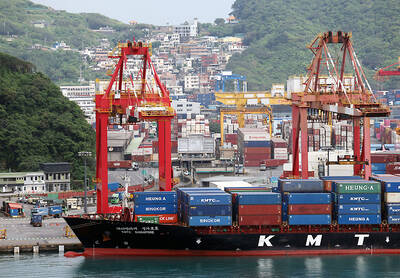
Taiwan’s economy grew far faster than expected in the first quarter, as booming demand for artificial intelligence (AI) applications drove a surge in exports, spilling over into investment and consumption, the Directorate-General of Budget, Accounting and Statistics (DGBAS) said yesterday. GDP growth was 13.69 percent year-on-year during the January-to-March period, beating the DGBAS’ February forecast by 2.23 percentage points and marking the most robust growth in nearly four decades, DGBAS senior official Chiang Hsin-yi (江心怡) told a news conference in Taipei. The result was powered by exports, which remain the backbone of Taiwan’s economy, Chiang said. Outbound shipments jumped 51.12 percent year-on-year to
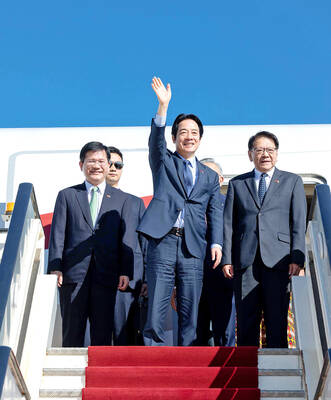
DELAYED BUT DETERMINED: The president’s visit highlights Taiwan’s right to international engagement amid regional pressure from China President Willaim Lai (賴清德) yesterday arrived in Eswatini, more than a week after his planned visit to Taiwan’s sole African ally was suspended because of revoked overflight permits. “The visit, originally scheduled for April 22, was postponed due to unforeseen external factors,” Lai wrote on social media. “After several days of careful arrangements by our diplomatic and national security teams, we successfully arrived today.” Lai said he looked forward to further deepening Taiwan-Eswatini relations through closer cooperation in the economy, agriculture, culture and education, as well as advancing the nation’s international partnerships. The president was initially scheduled to arrive in time to celebrate
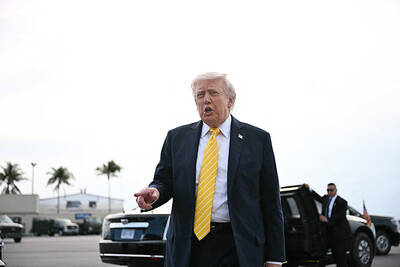
Iran’s Islamic Revolutionary Guard Corp (IRGC) yesterday said the US faced a choice between an “impossible” military operation or a “bad deal” with Tehran, after US President Donald Trump disparaged Iran’s latest peace proposal. Negotiations between the two countries have been deadlocked since a ceasefire came into effect on April 8, with only one round of direct peace talks held so far. Iran’s Tasnim and Fars news agencies reported that Tehran had submitted a 14-point proposal to mediator Pakistan, but Trump was quick to cast doubt on it. “I will soon be reviewing the plan that Iran has just sent to us, but


 RSS
RSS