


Democratic Progressive Party Legislator Puma Shen (沈伯洋), whom China has listed as “wanted” for promoting Taiwanese independence, on Wednesday addressed a hearing of a German parliamentary committee, speaking about his efforts to combat disinformation.
Shen was one of six experts invited to speak at a hearing of the Bundestag’s Committee on Human Rights and Humanitarian Aid on the topic “Disinformation by Autocratic States Aiming to Undermine Democracy and Threaten Human Rights,” information posted online by the lower house of the German federal parliament showed.
After the hearing, Shen told reporters that he was invited to address the committee in his role as a lawmaker and an expert on combating disinformation.
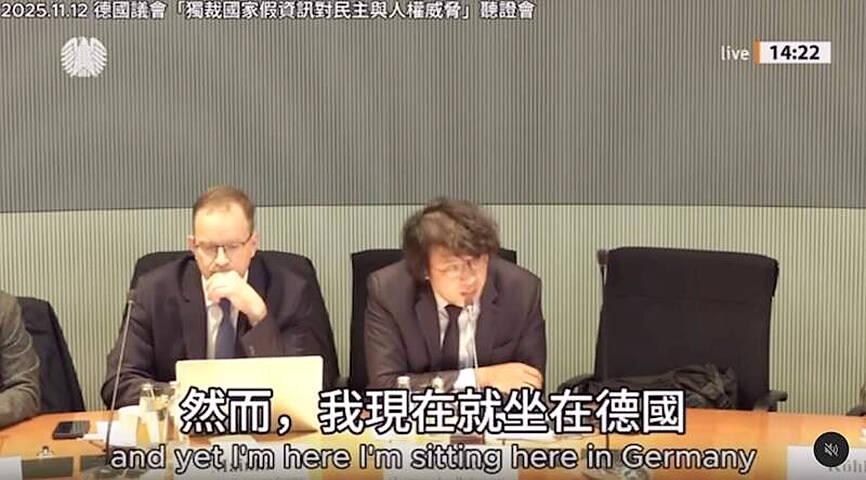
Photo: Screen grab from the online stream of a Bundestag hearing
He told the hearing about how China’s disinformation campaign has affected Taiwan and Europe, and how Russia and Hungary have been spreading disinformation across Europe.
Shen said that he was pleased to see that Europe has been raising awareness about the spread of disinformation and cognitive warfare, and expressed frustration that some people in Taiwan do not share the same concerns.
Shen is a former associate professor at National Taipei University and obtained a doctorate in law from the University of California, Irvine, specializing in white-collar and financial crime, as well as disinformation campaigns.
He has been listed as “wanted” by China and is being investigated by the Chongqing Municipal Public Security Bureau on allegations of “secession-related criminal activities” in Taiwan, including the launch of a civil defense organization called the Kuma Academy, China’s state-run Xinhua news agency reported last month.
The investigation is being carried out under the terms of China’s criminal law and its judicial guidelines, introduced last year, on how to penalize “Taiwan independence separatists,” Xinhua reported.
On Sunday, a legal expert on state-run China Central Television (CCTV) said that Shen should be pursued through Interpol and other international mutual judicial assistance bodies.
The statement on CCTV raised public concern in Taiwan about whether Shen could be arrested and extradited to China if he traveled outside Taiwan.
On Tuesday, Shen said in a video clip on Facebook that he was not afraid of China’s threat “to hunt him down worldwide.”
“For a very long time, China has been deploying coercive actions to try to silence Taiwanese, but I am here in front of the Bundestag and will soon be speaking at a hearing as a Taiwanese lawmaker,” he said in the video recorded in front of the building in Berlin.
“As a brave Taiwanese, I will never draw back in fear,” he said. “I am here today to safeguard not only Taiwan’s democracy, but also global democracy and freedom.”
Separately, Minister of Foreign Affairs Lin Chia-lung (林佳龍) yesterday said that it was safe for Shen to visit Germany, as all Taiwanese lawmakers are protected by the ministry and its overseas offices during overseas trips.
Taiwan and Germany are both democratic countries guided by the rule of law, Lin said in a radio interview.
It is not as easy as Beijing claims to extradite someone from a foreign country to China, as such a move would require judicial cooperation and an extradition treaty with the host country, he said.
Furthermore, the host country would have to examine the extradition request to ensure that it is in line with its country’s legal requirements, Lin said.
The government thinks that China’s threat against Shen was meant to project an illusion of “long-arm jurisdiction” over Taiwan, in a bid to sow division and fear among Taiwanese, he added.

‘NO SECURITY RISK’: The Railway Bureau reassured the public that the technicians’ activities were limited to technical guidance and did not involve sensitive systems The Railway Bureau yesterday said it had invited eight Chinese technicians to assist with an airport MRT construction project. The bureau issued the confirmation after an Internet user said Chinese nationals had entered the construction zone of Taiwan Taoyuan International Airport’s Terminal 3 project. They asked why “individuals from an enemy state” were allowed access to such a major national infrastructure project, which raised serious concerns over Taiwan’s industrial safety, sensitive systems and information security. The bureau’s Northern Region Engineering Branch Office said subcontractor Taiwan Handle Industrial Co (台灣手把工業) of the Taoyuan airport MRT’s “Contract No. CU05 Project A14 Station Civil, MEP &

A US uncrewed surface vessel (USV) encountered multiple Chinese warships during an autonomous transit of the Taiwan Strait, US defense company Seasats said in a statement on Wednesday. Seasats announced that a Lightfish USV had completed the first autonomous transit of the Taiwan Strait. Over five days, the USV traversed the entire length of the Strait while constantly monitoring surface vessel traffic, the company said. The Lightfish encountered multiple Chinese warships, one of which was a Chinese People’s Liberation Army Navy (PLAN) Type 056 corvette, it said. The Chinese vessels were operating “well within Taiwan’s exclusive economic zone without transmitting their identity via the

Taiwan is still in the process of assessing the possibility of recruiting workers from Eswatini, the Ministry of Foreign Affairs said yesterday, adding that its goal is to help Eswatini upgrade its vocational training centers. If there are plans to recruit workers from Eswatini, safeguarding national security, protecting public health and ensuring the employment rights of Taiwanese would be prerequisites, Department of West Asian and African Affairs Director-General Yen Chia-liang (顏嘉良) told a news conference. Key considerations would also include filling labor shortages in specific industries, and fostering bilateral professional and technical exchanges, he said. Yen was asked about the progress of labor
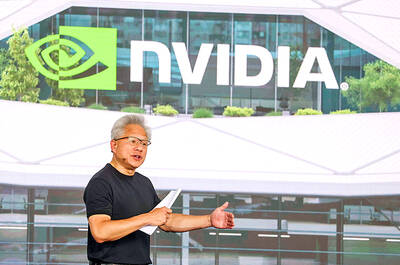
‘BOOMING’: ’ The number of partners we have here is incredible. You can see from their stock prices. They’re doing so well, they’re so happy,’ Jensen Huang said Nvidia Corp’s spending in Taiwan has ballooned to about US$150 billion a year, 10 times the US$10 billion to US$15 billion the company spent five years ago, Nvidia chief executive officer Jensen Huang (黃仁勳) said yesterday, suggesting Taiwan’s strategic importance in the global artificial intelligence (AI) supply chain. “Taiwan is the epicenter of the AI revolution. This is where the chips come, packaging comes. This is where the systems are made. This is where AI supercomputers were created,” Huang said at a meeting for the company’s employees in Beitou-Shilin Technology Park (北投士林科技園區) in Taipei, the planned site of Nvidia’s Taipei headquarters. “Taiwan


 RSS
RSS