


Canadian lawmakers on Sunday urged the International Civil Aviation Organization (ICAO) to include Taiwan in its general assembly, which opened yesterday in Montreal.
Liberal Party lawmaker and Canada-Taiwan Parliamentary Friendship Group cochair Judy Sgro and Conservative Party lawmaker and Shadow Minister for Democratic Reform Michael Cooper made the call at a news conference held by Taiwan in Ottawa.
The Canadian lawmakers said that the Taipei Flight Information Region (FIR) is an inseparable part of global aviation safety, adding that there was cross-party support on the issue in the Canadian parliament.
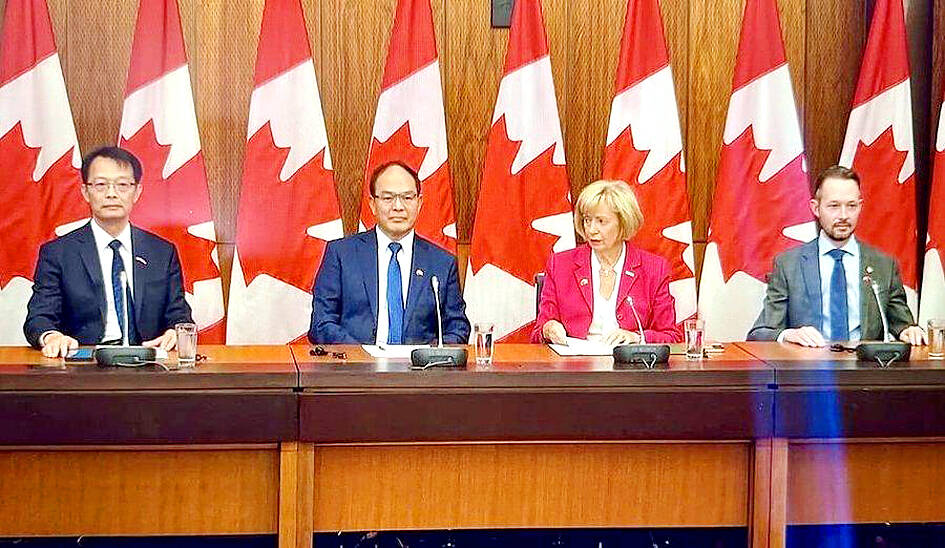
Photo: CNA
Taiwan’s exclusion from the ICAO “endangers not only regional stability, but the safety and security of global air travel,” Sgro said.
Excluding the democratic nation was “bending to Beijing’s bullying,” Cooper said, adding that Taiwan is a “major player in global aviation,” as an international hub with “tens of millions of passengers and cargo” transiting through the nation.
As host of the 42nd ICAO Assembly, Canada should send a clear message to the global body that Taiwan’s participation is essential to global aviation safety, he added.
Representative to Canada Harry Tseng (曾厚仁) said China’s military exercises over the past few years have threatened regional air safety, disrupting international flight routes in the Taipei FIR and putting passenger safety at risk.
Since August 2022, China has conducted at least four large-scale military exercises, none of which were announced seven days in advance as required under ICAO regulations, he said.
“We must not allow political maneuvers to take precedence over aviation safety,” he said. “I urge Canada and all our friends around the world to stand with Taiwan and keep politics out of aviation safety.”
Civil Aviation Administration Deputy Director-General Lin Jiunn-liang (林俊良) said that Taiwan’s exclusion from the ICAO blocks the nation from accessing crucial safety information, forcing his agency to rely on incomplete sources and preventing real-time international coordination.
Only through Taiwan’s meaningful participation can the ICAO’s mission of “no one left behind” be truly realized, he said.
The news conference was broadcast live on Canada’s Cable Public Affairs Channel, which invited Lin for a separate interview explaining the importance of the Taipei FIR to Canadian travelers and global aviation safety.
The American Institute in Taiwan yesterday wrote on Facebook that the US “strongly supports Taiwan’s meaningful participation in international organizations, including the International Civil Aviation Organization.”
The US also urges ICAO Secretary-General Juan Carlos Salazar and President Salvatore Sciacchitano “to facilitate Taiwan’s participation as a guest of the council president at the 42nd ICAO Assembly,” it said.
“Taiwan’s participation in ICAO enhances global aviation safety and security,” it added.
The assembly runs until Friday next week. Taiwan is not a UN member and therefore not part of the ICAO, a specialized UN agency.
Taiwan last attended the ICAO Assembly in 2013 as a guest of the council president, amid warmer cross-strait relations under the then-Chinese Nationalist Party (KMT) administration.
Despite not receiving an invitation, Taiwan’s ICAO action team traveled to Montreal, where it is to meet with delegations from other countries to explain the necessity of Taiwan’s participation in the ICAO.

A signaling system malfunction disrupted high-speed rail (HSR) services beginning at 8am today, with trains temporarily reduced to three northbound and three southbound trains per hour as authorities conduct inspections. The malfunction occurred on a section of track in Miaoli County during pre-operation checks early this morning, forcing northbound and southbound trains to use a single track, the HSR operator said. The regular schedule has been replaced with three hourly trains offering only nonreserved seating in each direction, stopping at every station, it said, adding that business class cars would still have reserved seating. Departures from terminal stations are scheduled at the top

Taiwan is still in the process of assessing the possibility of recruiting workers from Eswatini, the Ministry of Foreign Affairs said yesterday, adding that its goal is to help Eswatini upgrade its vocational training centers. If there are plans to recruit workers from Eswatini, safeguarding national security, protecting public health and ensuring the employment rights of Taiwanese would be prerequisites, Department of West Asian and African Affairs Director-General Yen Chia-liang (顏嘉良) told a news conference. Key considerations would also include filling labor shortages in specific industries, and fostering bilateral professional and technical exchanges, he said. Yen was asked about the progress of labor

VERBOSE VESSELS: A CGA cutter and a China Coast Guard exchanged verbal barbs for more than a day in Taiwanese-controlled waters before the Chinese vessel left The Taiwanese and Chinese coast guards had a standoff near the strategically located Pratas Islands (Dongsha Islands, 東沙群島) in the north of the South China Sea, the Coast Guard Administration (CGA) said yesterday. The two sides engaged in intense radio exchanges over sovereignty claims during the 33-hour standoff. China Coast Guard vessel 3501 eventually left the restricted waters, 26.6 nautical miles (49.2km) west of the Pratas Islands, at 5pm yesterday, the CGA said. Lying approximately between southern Taiwan and Hong Kong, the Taiwan-controlled Pratas are seen by some security experts as vulnerable to Chinese attack due to their distance — more than

A US uncrewed surface vessel (USV) encountered multiple Chinese warships during an autonomous transit of the Taiwan Strait, US defense company Seasats said in a statement on Wednesday. Seasats announced that a Lightfish USV had completed the first autonomous transit of the Taiwan Strait. Over five days, the USV traversed the entire length of the Strait while constantly monitoring surface vessel traffic, the company said. The Lightfish encountered multiple Chinese warships, one of which was a Chinese People’s Liberation Army Navy (PLAN) Type 056 corvette, it said. The Chinese vessels were operating “well within Taiwan’s exclusive economic zone without transmitting their identity via the


 RSS
RSS