


The US, Japan and South Korea on Monday emphasized the importance of maintaining peace and stability across the Taiwan Strait, and voiced concern over “increasingly frequent destabilizing actions” around Taiwan, a joint statement issued by the US Department of State said.
The three governments encouraged the peaceful resolution of cross-strait issues and opposed “any attempts to unilaterally change the status quo,” the statement said, alluding to Beijing’s threat of annexing Taiwan by force, but without naming China.
They also said they support Taiwan’s meaningful participation in appropriate international organizations, the statement said.
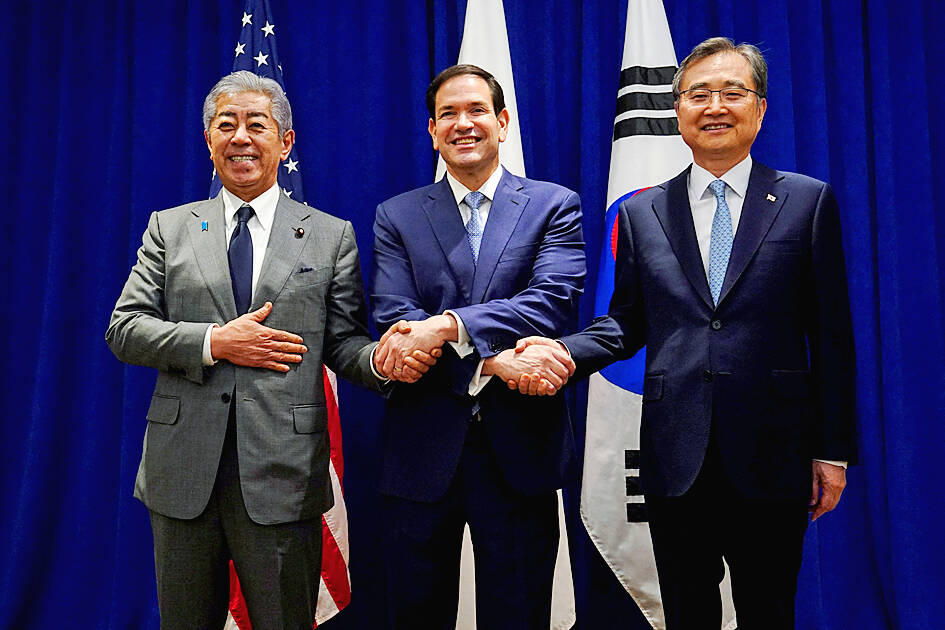
Photo: Reuters
The joint statement came after US Secretary of State Marco Rubio, Japanese Minister of Foreign Affairs Takeshi Iwaya and South Korean Minister of Foreign Affairs Cho Hyun met in New York during the UN General Assembly to discuss security and economic issues in the Indo-Pacific region.
The US reaffirmed in the statement what it called its “ironclad commitments to the defense of Japan” and South Korea, pledging extended deterrence supported by “America’s unmatched military strength, including its nuclear capabilities.”
In remarks implicitly aimed at China, they also rejected “unlawful maritime claims in the South China Sea, as well as attempts to enforce such claims,” and opposed “any attempts to change the status quo including dangerous and destabilizing actions in the waters of the Indo-Pacific, including the South China Sea.”
They underscored their commitment to a “free and open Indo-Pacific” and to international law as reflected in the UN Convention on the Law of the Sea, including “freedoms of navigation and overflight and other lawful uses of the sea.”
The statement also addressed cooperation in other areas, including potential trilateral coast guard exchanges, strengthened coordination on arctic issues, and encouraging Russia and Ukraine toward “a durable negotiated settlement.”
It reaffirmed the governments’ commitment to North Korea’s complete denuclearization under UN Security Council resolutions and urged an immediate end to Pyongyang’s “increasing military cooperation with Russia.”
The statement further highlighted efforts to bolster energy security — citing US liquefied natural gas and other resources — while pledging to diversify critical supply chains and to accelerate joint development of advanced civil nuclear reactors.
In Taipei, Ministry of Foreign Affairs spokesman Hsiao Kuangwei (蕭光偉) yesterday said that the meeting was the third time this year the US, Japan and South Korea had “reaffirmed their support for maintaining peace and stability in the Taiwan Strait.”
Hsiao said the ministry welcomed the international community’s “continued attention” to cross-strait issues.
“Taiwan would continue to enhance its national defense capabilities, strengthen its economic resilience, and work with like-minded partners such as the United States, Japan and South Korea to ensure peace, stability and prosperity in the Taiwan Strait and the Indo-Pacific region,” he said.

A signaling system malfunction disrupted high-speed rail (HSR) services beginning at 8am today, with trains temporarily reduced to three northbound and three southbound trains per hour as authorities conduct inspections. The malfunction occurred on a section of track in Miaoli County during pre-operation checks early this morning, forcing northbound and southbound trains to use a single track, the HSR operator said. The regular schedule has been replaced with three hourly trains offering only nonreserved seating in each direction, stopping at every station, it said, adding that business class cars would still have reserved seating. Departures from terminal stations are scheduled at the top

Taiwan is still in the process of assessing the possibility of recruiting workers from Eswatini, the Ministry of Foreign Affairs said yesterday, adding that its goal is to help Eswatini upgrade its vocational training centers. If there are plans to recruit workers from Eswatini, safeguarding national security, protecting public health and ensuring the employment rights of Taiwanese would be prerequisites, Department of West Asian and African Affairs Director-General Yen Chia-liang (顏嘉良) told a news conference. Key considerations would also include filling labor shortages in specific industries, and fostering bilateral professional and technical exchanges, he said. Yen was asked about the progress of labor

A US uncrewed surface vessel (USV) encountered multiple Chinese warships during an autonomous transit of the Taiwan Strait, US defense company Seasats said in a statement on Wednesday. Seasats announced that a Lightfish USV had completed the first autonomous transit of the Taiwan Strait. Over five days, the USV traversed the entire length of the Strait while constantly monitoring surface vessel traffic, the company said. The Lightfish encountered multiple Chinese warships, one of which was a Chinese People’s Liberation Army Navy (PLAN) Type 056 corvette, it said. The Chinese vessels were operating “well within Taiwan’s exclusive economic zone without transmitting their identity via the

VERBOSE VESSELS: A CGA cutter and a China Coast Guard exchanged verbal barbs for more than a day in Taiwanese-controlled waters before the Chinese vessel left The Taiwanese and Chinese coast guards had a standoff near the strategically located Pratas Islands (Dongsha Islands, 東沙群島) in the north of the South China Sea, the Coast Guard Administration (CGA) said yesterday. The two sides engaged in intense radio exchanges over sovereignty claims during the 33-hour standoff. China Coast Guard vessel 3501 eventually left the restricted waters, 26.6 nautical miles (49.2km) west of the Pratas Islands, at 5pm yesterday, the CGA said. Lying approximately between southern Taiwan and Hong Kong, the Taiwan-controlled Pratas are seen by some security experts as vulnerable to Chinese attack due to their distance — more than


 RSS
RSS