


US Senator Roger Wicker in Taipei yesterday said he expects the US and Taiwan to jointly produce weapons, something Taipei has pushed for.
Wicker, chairman of the US Senate Armed Services Committee, made the remarks when asked by local media how the US would enhance cooperation with Taiwan through the joint production of weapons, as well as whether ongoing tariff negotiations would affect Taiwan-US defense cooperation.
“I think there’s going to be joint production and joint efforts, and that will depend on the skills present both on this side of the Pacific Ocean and ours, and actually we’re open to suggestion and innovation in that regard,” Wicker said at a brief media session at the Taipei Guest House before leaving Taiwan yesterday afternoon.
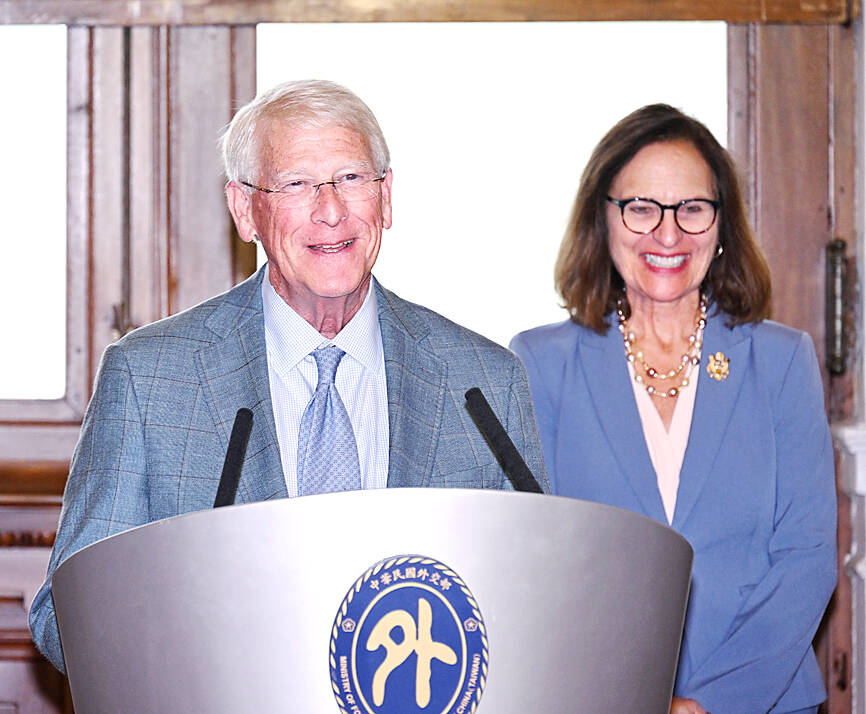
Photo: Fang Pin-chao, Taipei Times
Wicker and US Senator Deb Fischer, who also serves on the committee, arrived in Taiwan on Friday. They met with President William Lai (賴清德) on Friday and had a luncheon with Vice President Hsiao Bi-khim (蕭美琴) earlier yesterday.
The visit came at a time when Taiwan is facing a 20 percent tariff on exports to the US, as part of US President Donald Trump’s sweeping new trade policy on many countries.
Wicker said that there were talks on trade going on around the world.
“That in no way affects the defense alliance and friendship and determination that the United States has to be a friend to the sovereign rights of the Taiwanese people to enjoy their democracy and to make their own decisions,” he said.
Wicker said the relationship between Taiwan and the US has been long-standing and filled with resolve, and a reason for his visit is to send a firm and strong message of friendship and determination that Taiwan “is separate, free and entitled to make its own decisions.”
“This trip has been very meaningful, and I can’t tell you how warmly we’ve been received,” Wicker said, adding that the trip was too short, but was packed, including a comprehensive conversation with Lai, and meetings with various ministers and members of the military.
“The friendship, the alliance, the great relationship that the United States and Taiwan have had spans for decades. It’s long-standing, permanent and filled with resolve,” he said.
The US has stood by Taiwan for many years, Wicker said, adding that its support is stated in the Taiwan Relations Act, included in the “six assurances,” and reiterated almost every year when the US publishes proposals that would go in its National Defense Authorization Act.
“We are separated from a great distance, but we are united by the principles that have kept the Taiwanese people and the American people free and independent for years and years and years,” said Wicker, one of the fiercest supporters of Taiwan in the US Congress.
“We stand by that, and we cannot adequately express our great love and friendship for the Taiwanese people,” he added.
Asked how Taiwan should strengthen defense capability and weaponry in the face of Chinese pressure, he said the steps would be a decision made by “an independent sovereign democracy, by their own leadership,” while there are consultations between Taiwan and the US.
“The US’ and Taiwan’s militaries are working together every day, and we understand each other,” he said.
There are forces in the region that believe they can impose their will on a separate nation, but those forces are mistaken, and the US would continue to develop the weapons necessary to make that point, he said.
Beijing, which regularly denounces any shows of support for Taipei from Washington, has criticized Wicker’s visit, saying it “undermines China’s sovereignty and territorial integrity, and sends a gravely wrong signal to the separatist Taiwan independence forces.”
The senators’ two-day visit to Taiwan followed stops in Hawaii, Guam, Palau and the Philippines.
Additional reporting by AP

SILENCING CRITICS: In addition to blocking Taiwan, China aimed to prevent rights activists from speaking out against authoritarian states, a Cabinet department said The Ministry of Foreign Affairs (MOFA) yesterday condemned transnational repression by Beijing after RightsCon, a major digital human rights conference scheduled to be held in Zambia this week, was abruptly canceled due to Chinese pressure over Taiwanese participation. This year’s RightsCon, the world’s largest conference discussing issues “at the intersection of human rights and technology,” was scheduled to take place from tomorrow to Friday in Lusaka, and expected to draw 2,600 in-person attendees from 150 countries, along with 1,100 online participants. However, organizers were forced to cancel the event due to behind-the-scenes pressure from China, the ministry said, expressing its “strongest condemnation”
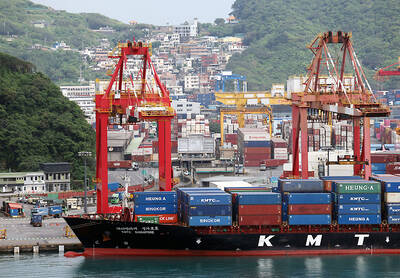
Taiwan’s economy grew far faster than expected in the first quarter, as booming demand for artificial intelligence (AI) applications drove a surge in exports, spilling over into investment and consumption, the Directorate-General of Budget, Accounting and Statistics (DGBAS) said yesterday. GDP growth was 13.69 percent year-on-year during the January-to-March period, beating the DGBAS’ February forecast by 2.23 percentage points and marking the most robust growth in nearly four decades, DGBAS senior official Chiang Hsin-yi (江心怡) told a news conference in Taipei. The result was powered by exports, which remain the backbone of Taiwan’s economy, Chiang said. Outbound shipments jumped 51.12 percent year-on-year to
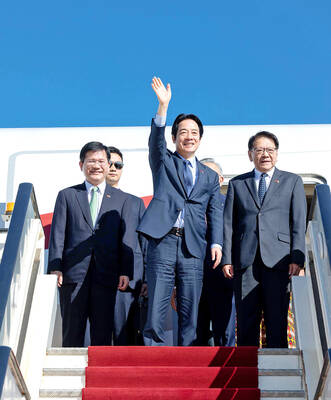
DELAYED BUT DETERMINED: The president’s visit highlights Taiwan’s right to international engagement amid regional pressure from China President Willaim Lai (賴清德) yesterday arrived in Eswatini, more than a week after his planned visit to Taiwan’s sole African ally was suspended because of revoked overflight permits. “The visit, originally scheduled for April 22, was postponed due to unforeseen external factors,” Lai wrote on social media. “After several days of careful arrangements by our diplomatic and national security teams, we successfully arrived today.” Lai said he looked forward to further deepening Taiwan-Eswatini relations through closer cooperation in the economy, agriculture, culture and education, as well as advancing the nation’s international partnerships. The president was initially scheduled to arrive in time to celebrate
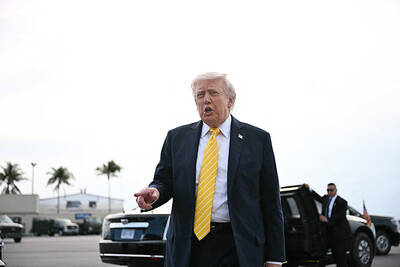
Iran’s Islamic Revolutionary Guard Corp (IRGC) yesterday said the US faced a choice between an “impossible” military operation or a “bad deal” with Tehran, after US President Donald Trump disparaged Iran’s latest peace proposal. Negotiations between the two countries have been deadlocked since a ceasefire came into effect on April 8, with only one round of direct peace talks held so far. Iran’s Tasnim and Fars news agencies reported that Tehran had submitted a 14-point proposal to mediator Pakistan, but Trump was quick to cast doubt on it. “I will soon be reviewing the plan that Iran has just sent to us, but


 RSS
RSS