


Three 8U cube satellites (CubeSats) are to be launched in tandem with the Formosat-8 satellite project in October, providing further opportunities for Taiwanese industries to join the international satellite supply chain, the Taiwan Space Agency (TASA) said.
Backed by the National Science and Technology Council, the agency in 2002, then operating as the National Space Organization, launched a project to foster domestic capabilities in satellite systems integrations and in-orbit operations, culminating in last year’s launches of the 3U CubeSats Nightjar and Toro.
CubeSats are measured by units, with 1U being a block measuring 10cm on each side.
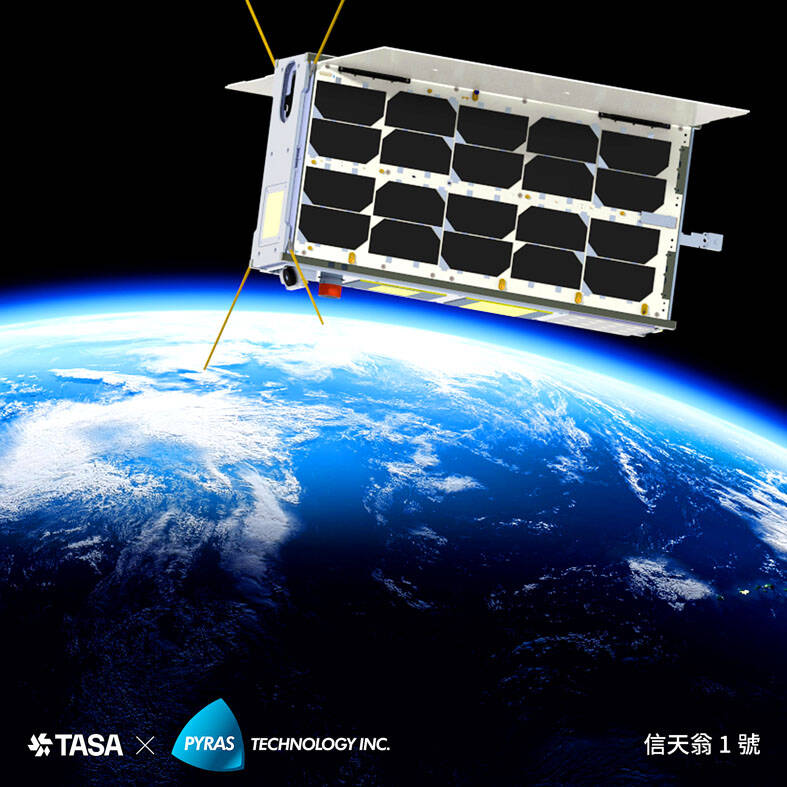
Photo courtesy of the Taiwan Space Agency
The agency’s announcement marked the commencement of the project’s second phase, which Hsinchu City-based Tron Future Tech (創未來科技) would join, as TASA seeks to launch four 8U CubeSats this year and next year.
Tron Future’s satellite would focus on providing broadband services and trialing the delivery of high-speed communications and the capacity to “hand off” from one satellite to another on the Ka-band microwave frequency.
The second satellite, developed by New Taipei City’s Rapidtek Technologies Inc (鐳洋科技), would take over the duties of Nightjar, which has completed two-way communications and has proven capable of stable reception of Ku-band microwave signals, the agency said.
Pyras Technology Inc (芳興科技), also based in New Taipei City, manufactured the Toro 1 satellite, which is expected to build on services provided by Toro and also contain an ocean color imager remote sensing instrument, the agency said.
Project head Chen Chia-jui (陳嘉瑞) said TASA is focused on missions that would provide better opportunities for commercial applications to allow more Taiwanese companies to become part of the global satellite supply chain.
Network provision on the Ka-band range offers great potential, while the implementation of Internet of Things technology could provide environmental monitoring applications, he said, adding that ocean color readings would help the fishing industry.
Along with the three 8U CubeSats and Formosat-8, the Lilium-2 and Lilium-3 satellites, jointly developed by National Cheng Kung University, National Taiwan University, National Taiwan University of Science and Technology and Tamkang University, would also be launched on Space Exploration Technologies Corp’s Transporter 15 rocket.

‘NO SECURITY RISK’: The Railway Bureau reassured the public that the technicians’ activities were limited to technical guidance and did not involve sensitive systems The Railway Bureau yesterday said it had invited eight Chinese technicians to assist with an airport MRT construction project. The bureau issued the confirmation after an Internet user said Chinese nationals had entered the construction zone of Taiwan Taoyuan International Airport’s Terminal 3 project. They asked why “individuals from an enemy state” were allowed access to such a major national infrastructure project, which raised serious concerns over Taiwan’s industrial safety, sensitive systems and information security. The bureau’s Northern Region Engineering Branch Office said subcontractor Taiwan Handle Industrial Co (台灣手把工業) of the Taoyuan airport MRT’s “Contract No. CU05 Project A14 Station Civil, MEP &

The National Chungshan Institute of Science and Technology yesterday showcased its locally developed variants of the Vision 60 robotic patrol dog, which it plans to deploy on the nation’s outlying territories in the South China Sea. The variants were produced under the Joint Lab project — created by the institute and domestic companies — and assembled with domestically produced motors, lenses and artificial intelligence (AI) systems alongside licensed tech from the US, Missile and Rocket Systems Research Division deputy director Jen Kuo-kang (任國光) told the media event at a military base in Taipei’s Dazhi (大直) area. Taiwan has built up its strengths

NOT IMMEDIATE: Taiwan has a chance to appeal the proposed 10 percent tariff before it starts, while other countries face a 12.5 percent tariff from the trade office Taiwan is among 60 economies determined by the US to have failed to impose or enforce a ban on the importation of goods produced with forced labor, according to a notice released on Tuesday by the Office of the US Trade Representative (USTR), which proposed imposing an additional 10 percent or more tariff on them. The USTR in a statement said that following an investigation, it had determined under Section 301 of the Trade Act of 1974 that the failure of the 60 economies to impose and effectively enforce a prohibition on the importation of goods produced with forced labor is

TIT-FOR-TAT: The US allegedly revoked the visa of a Chinese national working at Xinhua News Agency in the US in response to Beijing’s expulsion of Vivian Wang The Presidential Office yesterday condemned China for expelling a New York Times correspondent from Beijing following the newspaper’s interview with President William Lai (賴清德), saying the move highlighted Beijing’s suppression of press freedom and its threat to international news media. Taiwan has noted a series of recent incidents in which Beijing used similar tactics to “threaten and pressure international media outlets and journalists,” Presidential Office spokeswoman Karen Kuo (郭雅慧) said in a statement. “This concerns not only press freedom and freedom of expression, but also the safety of journalists, and Taiwan and relevant partners are paying close attention to the situation,” she


 RSS
RSS