


The Taiwan Economic and Cultural Representative Office in Japan condemned China for its political interference with Taiwanese choirs participating in the Tokyo International Choir Competition.
Six Taiwanese choirs — Nibun Chorus, a choir from Sinapalan Elementary School in Nantou County, Bukulav Kids Troupe from Xingzhong Elementary School in Kaohsiung, Ching-Yun Choir, Hngzyang na Nahuy & Mary Children’s Choir and the Octangle Male Choir — were part of the competition held from Friday to yesterday.
The office said that Chinese authorities had pressured the event organizers to remove Taiwan’s national flag and change the participants’ name from “Taiwan” to “Chinese Taipei.”
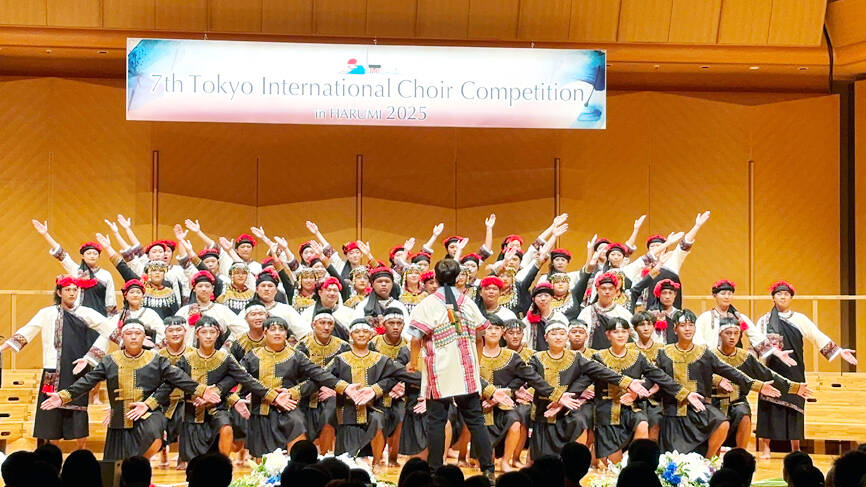
Photo: CNA
The office was notified of the situation on Saturday evening and promptly asked Democratic Progressive Party (DPP) Legislator Chiu Yi-ying (邱議瑩), who had accompanied the choirs, to assist in communicating with the competition organizers.
Japan-ROC Diet Members’ Consultative Council Chairman Keiji Furuya also voiced support in defense of Taiwan, but the organizers ultimately yielded to China’s demands, unilaterally changing the name to “Chinese Taipei” and deciding not to display any national flags for the participating countries.
Music transcends national borders and is a universal art enjoyed by all people, the office said, adding that for the past six years, Taiwanese choirs have always used the name “Taiwan” in the competition.
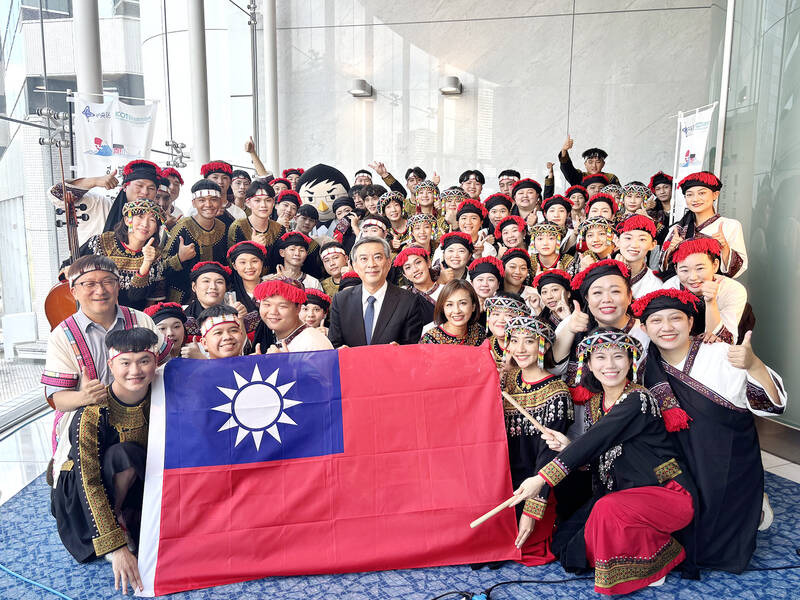
Photo: CNA
However, this year, China intervened politically, distorting the art of music and offending Taiwanese, the office said, adding that it strongly condemned such actions, which it called despicable.
It also expressed deep regret over the organizer’s partial acquiescence to China’s demands, making unauthorized changes to Taiwan’s name, and has lodged a stern protest.
To support the Taiwanese choirs, the office sent Deputy Representative to Japan Chou Shyue-yow (周學佑) and 16 colleagues to cheer them on and prevent further interference by China.
Representative to Japan Lee Yi-yang (李逸洋) said that recent polls show 88 percent of Taiwanese feel close to or trust Japan, while nearly 90 percent of Japanese hold a negative view of China, and Japan’s annual defense white paper also highlighted China’s growing military activity, labeling it the greatest strategic threat.
The Japanese public knows that Taiwan and China are two distinct countries, he said, adding that China’s brutal political tactics to suppress Taiwan’s choirs are likely to trigger anger among Japanese, escalating the situation and backfiring by revealing China’s shortcomings.
Taiwan, known for its high-tech industry, freedom and democracy, is a country liked globally, with its choirs winning numerous international competitions, achievements which have allowed the world to experience Taiwan’s art and culture, Lee said.
While Taiwan is increasingly gaining worldwide attention and recognition, China’s arrogant suppression cannot change the fact that “Taiwan is Taiwan, and China is China,” he said, adding that China would not succeed in its attempts to suppress Taiwan.
Lee also voiced his sympathy for the Taiwanese teams and athletes who, in addition to competing, have to bear the burden of Chinese political interference.
However, he said that Taiwanese and the global Taiwanese community would continue to offer unwavering support.
Taiwan is confident that it would grow stronger and garner more international backing, Lee said, adding that Taiwanese teams would continue to deliver their best performances, allowing the world to embrace Taiwan even more.

A signaling system malfunction disrupted high-speed rail (HSR) services beginning at 8am today, with trains temporarily reduced to three northbound and three southbound trains per hour as authorities conduct inspections. The malfunction occurred on a section of track in Miaoli County during pre-operation checks early this morning, forcing northbound and southbound trains to use a single track, the HSR operator said. The regular schedule has been replaced with three hourly trains offering only nonreserved seating in each direction, stopping at every station, it said, adding that business class cars would still have reserved seating. Departures from terminal stations are scheduled at the top

DRONE CENTRAL: Taiwan aims to become Asia’s democratic hub for drones, with most exports focused on high-quality military-grade models, an official said Taiwan’s drone industry is expected to expand significantly by 2030, producing 100,000 units per month and exporting half of them, the Ministry of Economic Affairs said yesterday. Current drone production capacity is about 15,000 units per month, but the industry can quickly scale up as demand increases, Industrial Development Administration Director-General Chiou Chyou-huey (邱求慧) told a news conference in Taipei. Taiwan’s drone output grew 2.5-fold last year to NT$12.9 billion (US$408.3 million) under a government program to develop the uncrewed vehicle sector, he said. The Executive Yuan in October last year approved plans to invest NT$44.2 billion into domestic production of uncrewed aerial

VERBOSE VESSELS: A CGA cutter and a China Coast Guard exchanged verbal barbs for more than a day in Taiwanese-controlled waters before the Chinese vessel left The Taiwanese and Chinese coast guards had a standoff near the strategically located Pratas Islands (Dongsha Islands, 東沙群島) in the north of the South China Sea, the Coast Guard Administration (CGA) said yesterday. The two sides engaged in intense radio exchanges over sovereignty claims during the 33-hour standoff. China Coast Guard vessel 3501 eventually left the restricted waters, 26.6 nautical miles (49.2km) west of the Pratas Islands, at 5pm yesterday, the CGA said. Lying approximately between southern Taiwan and Hong Kong, the Taiwan-controlled Pratas are seen by some security experts as vulnerable to Chinese attack due to their distance — more than
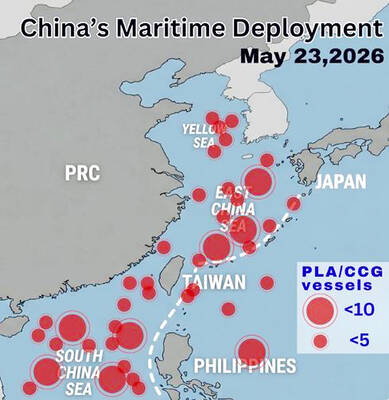
WARNING: China should stop engaging in actions that undermine regional peace and stability, as it would only build resentment among people across the Strait, the CGA said China has deployed more than 100 navy, coast guard and other vessels in waters from the Yellow Sea to the South China Sea and the western Pacific since US President Donald Trump and Chinese President Xi Jinping (習近平) met in Beijing, National Security Council Secretary-General Joseph Wu (吳釗燮) said yesterday. “In this part of the world, #China is the one & only PROBLEM wrecking the #StatusQuo & threatening regional peace & stability,” Wu wrote on X. In a separate post, he said Beijing was coercing Taiwan’s maritime domain, calling it illegal and provocative, after the Coast Guard Administration (CGA) expelled a


 RSS
RSS