


Taiwan and Europe should forge closer ties to jointly tackle critical security issues, including strengthening societal resilience against disinformation and hybrid threats, President William Lai (賴清德) said during a meeting with members of the Special Committee on the European Democracy Shield (EUDS) at the Presidential Office in Taipei yesterday.
While Taiwan and the EU have close trade and economic relations, and share the values of freedom and democracy, both have been subjected to information manipulation and infiltration by foreign forces that seek to interfere in democratic elections, foment societal divisions and shake people’s faith in democracy, Lai said.
Lai said those challenges prompted him to establish the Whole-of-Society Defense Resilience Committee, with the goal of defending the nation against new forms of threat, pinpointing external and internal vulnerabilities, and bolstering overall resilience and security.
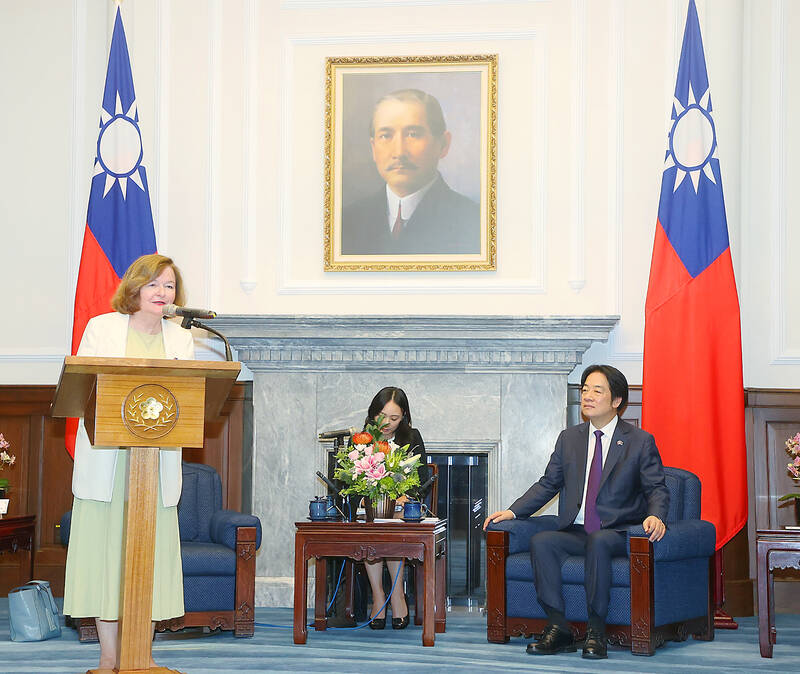
Photo: CNA
“The efforts that democracies make are not for opposing anyone else; they are for safeguarding the way of life that we cherish — just as Europe has endeavored to promote diversity and human rights,” Lai said.
“Taiwan stands at the very front line of the democratic world. We are determined to protect democracy, peace and prosperity worldwide. We also hope to share our experiences with Europe, and deepen cooperation in such fields as cybersecurity, media literacy and societal resilience,” he said.
That the EUDS committee, which was established at the beginning of this year, has chosen to visit Taiwan for its first trip to Asia demonstrates the close ties between Taiwan and Europe, and the unlimited possibilities for deepening cooperation on issues of concern, he added.
EUDS Special Committee Chair Nathalie Loiseau said the delegation she is leading consists of European parliament members from France, Germany, the Czech Republic, Poland and Belgium, all of whom advocate strengthening Taiwan-EU relations.
Having many things in common, the EU and Taiwan should work together more, Loiseau said.
Members of the delegation are interested in learning about Taiwan’s whole-of-society approach to bolster societal resilience, while they can share their experiences of regulating social media that combines freedom of expression and responsibility, she said.
China on Monday confirmed that it is to hold a summit with the EU in Beijing on Thursday marking 50 years of diplomatic ties, as both sides seek to navigate trade disputes amid broader global trade uncertainties.
Taiwan has repeatedly accused China of interfering in its democracy, spreading fake news and undermining public trust in the government.
China denies the accusations, but says Taiwan’s government is seeking foreign support to push its “separatist” agenda.
Many European nations say that Russia has similarly been seeking to discredit European governments and destabilize the EU. Moscow rejects the allegations.
Additional reporting by Reuters

South Korea has adjusted its electronic arrival card system to no longer list Taiwan as a part of China, a move that the Ministry of Foreign Affairs said would help facilitate exchanges between the two sides. South Korea previously listed “Taiwan” as “Taiwan (China)” in the drop-down menus of its online arrival card system, where people had to fill out where they came from and their next destination. The ministry had requested South Korea make a revision and said it would change South Korea’s name on Taiwan’s online immigration system from “Republic of Korea” to “Korea (South),” should the issue not be

Tainan, Taipei and New Taipei City recorded the highest fines nationwide for illegal accommodations in the first quarter of this year, with fines issued in the three cities each exceeding NT$7 million (US$220,639), Tourism Administration data showed. Among them, Taipei had the highest number of illegal short-term rental units, with 410. There were 3,280 legally registered hotels nationwide in the first quarter, down by 14 properties, or 0.43 percent, from a year earlier, likely indicating operators exiting the market, the agency said. However, the number of unregistered properties rose to 1,174, including 314 illegal hotels and 860 illegal short-term rental
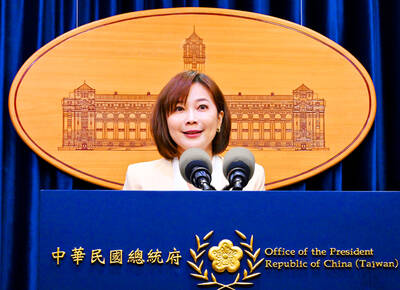
ECONOMIC COERCION: Such actions are often inconsistently applied, sometimes resumed, and sometimes just halted, the Presidential Office spokeswoman said The government backs healthy and orderly cross-strait exchanges, but such arrangements should not be made with political conditions attached and never be used as leverage for political maneuvering or partisan agendas, Presidential Office spokeswoman Karen Kuo (郭雅慧) said yesterday. Kuo made the remarks after China earlier in the day announced 10 new “incentive measures” for Taiwan, following a landmark meeting between Chinese President Xi Jinping (習近平) and Chinese Nationalist Party (KMT) Chairwoman Cheng Li-wun (鄭麗文) in Beijing on Friday. The measures, unveiled by China’s Xinhua news agency, include plans to resume individual travel by residents of Shanghai and China’s Fujian

Chinese President Xi Jinping (習近平) and Chinese Nationalist Party (KMT) Chairwoman Cheng Li-wun (鄭麗文) met in Beijing yesterday, where they vowed to bring people on both sides of the Taiwan Strait closer to facilitate the “great rejuvenation of the Chinese nation.” The meeting was held in the East Hall of the Great Hall of the People, a venue typically reserved for meetings between Xi and foreign heads of state. In public remarks prior to a closed-door meeting, Xi, in his role as head of the Chinese Communist Party (CCP), said that Taiwan is historically part of China, and remains an “inalienable” and


 RSS
RSS