


The Dalai Lama yesterday assured his followers that upon his death he would be reincarnated as the next spiritual leader of Tibetan Buddhism and spelled out a succession process that sets up a renewed clash with China.
The eagerly awaited statement, made days before the frail Nobel peace laureate turns 90, puts to rest speculation, started by the Dalai Lama himself, that he might be the last of Tibet’s spiritual leaders, ending a line that stretches back centuries.
Speaking during a week of celebrations in the northern Indian hill town of Dharamshala to mark his birthday, the Dalai Lama said a nonprofit institution he has set up would have the sole authority to identify his reincarnation, countering China’s insistence that it would choose his successor.
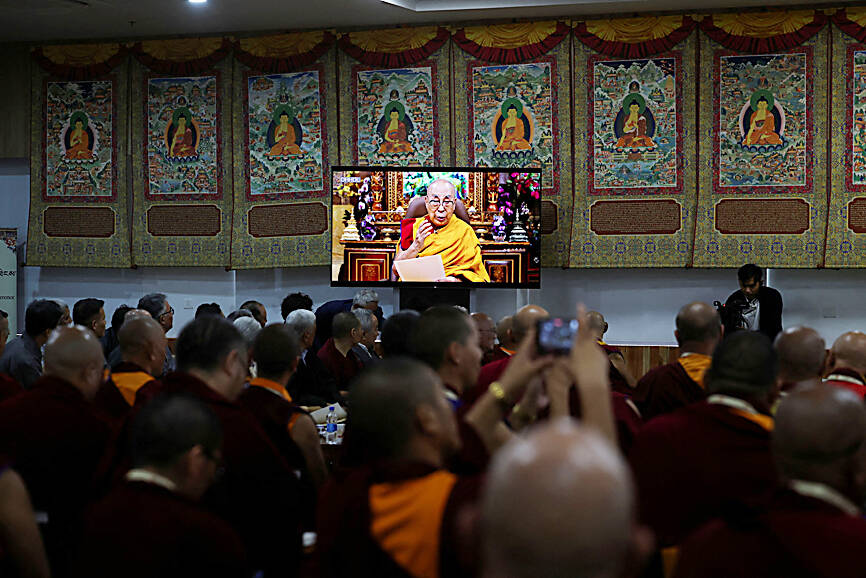
Photo: Reuters
Beijing yesterday reiterated that it had to approve the reincarnation and that it had to be done in China through a centuries-old ritual.
Beijing views the Dalai Lama, who fled to India from Tibet in 1959 after a failed uprising against Chinese rule, as a separatist.
The Dalai Lama has said his successor would be born outside China and urged his followers to reject anyone chosen by Beijing. In previous years, he had also said it was possible that there might be no successor at all.
“I am affirming that the institution of the Dalai Lama will continue,” the Dalai Lama said in a video message, setting off cheers and applause from more than 100 monks in maroon robes who had gathered in a library in Dharamshala.
The event was also attended by journalists from around the world and long-time supporters including Hollywood star Richard Gere.
He added that the Gaden Phodrang Trust, the nonprofit organization that he set up to maintain and support the tradition and institution of the Dalai Lama, has the sole authority to recognize his reincarnation in consultation with the heads of Tibetan Buddhist traditions.
“They should accordingly carry out the procedures of search and recognition in accordance with past tradition ... no one else has any such authority to interfere in this matter,” the Dalai Lama said.
Meanwhile, US President Donald Trump’s administration has lifted aid cuts for Tibetans in exile and would provide US$7 million in financing for projects such as those supporting health and education, Central Tibetan Administration leader Penpa Tsering said.
The Trump administration started cutting foreign aid after taking office in January as part of its “America First” policy, which has had an impact on programs including those aimed at securing food supplies and preventing the spread of HIV in some of the poorest parts of the world.
Tsering said he believed Tibetans became “collateral damage” in foreign assistance cuts and that their leadership had worked hard to restore US funding.
“I’m happy to inform you that the US government has decided to lift the termination,” Tsering told reporters on the sidelines of the Dalai Lama’s 90th birthday celebrations. “We received this communication just day before yesterday.”
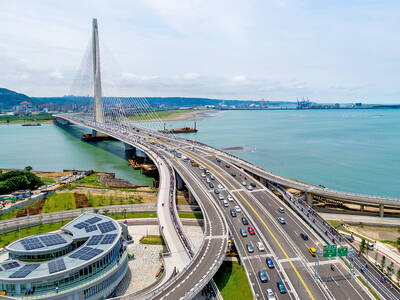
The Ministry of Transportation and Communications yesterday inaugurated the Danjiang Bridge across the Tamsui River in New Taipei City, saying that the structure would be an architectural icon and traffic artery for Taiwan. Feted as a major engineering achievement, the Danjiang Bridge is 920m long, 211m tall at the top of its pylon, and is the longest single-pylon asymmetric cable-stayed bridge in the world, the government’s Web site for the structure said. It was designed by late Iraqi-British architect Zaha Hadid. The structure, with a maximum deck of 70m, accommodates road and light rail traffic, and affords a 200m navigation channel for boats,
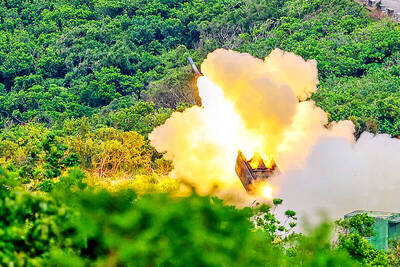
PRECISION STRIKES: The most significant reason to deploy HIMARS to outlying islands is to establish a ‘dead zone’ that the PLA would not dare enter, a source said A High Mobility Artillery Rocket System (HIMARS) would be deployed to Penghu County and Dongyin Island (東引) in Lienchiang County (Matsu) to force the Chinese military to retreat at least 100km from the coastline, a military source said yesterday. Taiwan has been procuring HIMARS and Army Tactical Missile Systems (ATACMS) from the US in batches. Once all batches have been delivered, Taiwan would possess 111 HIMARS units and 504 ATACMS, which have a range of 300km. Considering that “offense is the best defense,” the military plans to forward-deploy the systems to outlying islands such as Penghu and Dongyin so that

WHAT WAS ALL THAT FOR? Jaw Shaw-kong said that Cheng Li-wen had pushed for more drastic cuts and attacked him, just for the outcome to be nearly identical to his bill The legislature yesterday passed a supplementary budget bill to fund the purchase of separate packages of US military equipment, with the combined amount of spending capped at NT$780 billion (US$24.8 billion). The Chinese Nationalist Party (KMT) and Taiwan People’s Party (TPP) used their legislative majority to pass the bill, which runs until 2033 and has two main funding provisions. One was for NT$300 billion of arms sales already approved by the US for Taiwan on Dec. 17 last year, the other was for NT$480 billion for another arms package expected to be announced by Washington. The bill, which fell short of the NT$1.25

‘CLEAR MESSAGE’: The bill would set up an interagency ‘tiger team’ to review sanctions tools and other economic options to help deter any Chinese aggression toward Taiwan US Representative Young Kim has introduced a bill to deter Chinese aggression against Taiwan, calling for an interagency “tiger team” to preplan coordinated sanctions and economic measures in response to possible Chinese military or political action against Taiwan. “[Chinese President] Xi Jinping [習近平] has directed the People’s Liberation Army to be ready to invade Taiwan by 2027. China has a plan. America should have one too,” Kim said in a news release on Thursday last week. She introduced the “Deter PRC [People’s Republic of China] aggression against Taiwan act” to “ensure the US has a coordinated sanctions strategy ready should


 RSS
RSS