


New Mongolian Prime Minister Gombojav Zandanshatar has pledged to address the economic demands of protesters, after their daily rallies led to the fall of his predecessor.
Lawmakers approved former parliament speaker Zandanshatar as prime minister by an overwhelming majority in a vote late Thursday night.
His election appeared to mark the end of several weeks of political uncertainty in a still-young democracy of 3.4 million people that is sandwiched between much larger China and Russia. The new leader faces multiple challenges, including high inflation, a looming government budget deficit and fears of power shortages this winter.
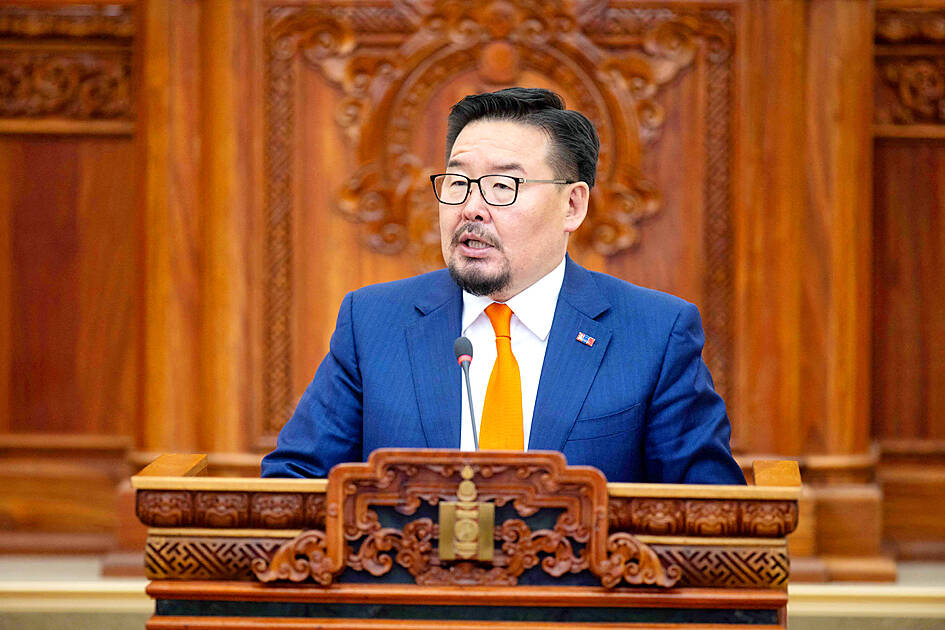
Photo: AFP
Speaking ahead of the vote in parliament, Zandanshatar said this year’s government spending needs to be reduced by about US$640 million to avoid a significant revenue shortfall.
“Revision of the budget has become inevitable,” he said, adding that he would submit a revised budget to parliament next week.
Zandanshatar, 45, studied economics at university in Russia and was vice director of one of the largest commercial banks in Mongolia. He was parliament speaker from 2020 to last year and was named head of the president’s office after he lost his seat in an election last year. From 2014 to 2016, he was a visiting scholar at Stanford University in California.
His predecessor, Luvsannamsrai Oyun-Erdene, resigned on Tuesday last week after losing a vote of confidence in parliament.
The protests against Oyun-Erdene’s rule were sparked by reports of lavish spending by his son.
Many Mongolians feel the nation’s mineral wealth has benefited politicians and their business friends rather than the general population. The poverty rate remains high in the sparsely populated country.
Zandanshatar said he would ensure that economic growth is inclusive and reached all Mongolians. He also promised to launch a tax reform to reduce the burden on the middle class, and increase taxes on luxury consumption and those with ultra-high incomes.
He won election by a vote of 108 to 9 in the 126-member parliament. The other nine members were absent.

A signaling system malfunction disrupted high-speed rail (HSR) services beginning at 8am today, with trains temporarily reduced to three northbound and three southbound trains per hour as authorities conduct inspections. The malfunction occurred on a section of track in Miaoli County during pre-operation checks early this morning, forcing northbound and southbound trains to use a single track, the HSR operator said. The regular schedule has been replaced with three hourly trains offering only nonreserved seating in each direction, stopping at every station, it said, adding that business class cars would still have reserved seating. Departures from terminal stations are scheduled at the top

Taiwan is still in the process of assessing the possibility of recruiting workers from Eswatini, the Ministry of Foreign Affairs said yesterday, adding that its goal is to help Eswatini upgrade its vocational training centers. If there are plans to recruit workers from Eswatini, safeguarding national security, protecting public health and ensuring the employment rights of Taiwanese would be prerequisites, Department of West Asian and African Affairs Director-General Yen Chia-liang (顏嘉良) told a news conference. Key considerations would also include filling labor shortages in specific industries, and fostering bilateral professional and technical exchanges, he said. Yen was asked about the progress of labor

A US uncrewed surface vessel (USV) encountered multiple Chinese warships during an autonomous transit of the Taiwan Strait, US defense company Seasats said in a statement on Wednesday. Seasats announced that a Lightfish USV had completed the first autonomous transit of the Taiwan Strait. Over five days, the USV traversed the entire length of the Strait while constantly monitoring surface vessel traffic, the company said. The Lightfish encountered multiple Chinese warships, one of which was a Chinese People’s Liberation Army Navy (PLAN) Type 056 corvette, it said. The Chinese vessels were operating “well within Taiwan’s exclusive economic zone without transmitting their identity via the

VERBOSE VESSELS: A CGA cutter and a China Coast Guard exchanged verbal barbs for more than a day in Taiwanese-controlled waters before the Chinese vessel left The Taiwanese and Chinese coast guards had a standoff near the strategically located Pratas Islands (Dongsha Islands, 東沙群島) in the north of the South China Sea, the Coast Guard Administration (CGA) said yesterday. The two sides engaged in intense radio exchanges over sovereignty claims during the 33-hour standoff. China Coast Guard vessel 3501 eventually left the restricted waters, 26.6 nautical miles (49.2km) west of the Pratas Islands, at 5pm yesterday, the CGA said. Lying approximately between southern Taiwan and Hong Kong, the Taiwan-controlled Pratas are seen by some security experts as vulnerable to Chinese attack due to their distance — more than


 RSS
RSS