


A delegation led by US Senator Tammy Duckworth met with President William Lai (賴清德) at the Presidential Office yesterday.
Lai welcomed the delegation and thanked the US Congress and government for its long-term bipartisan support for Taiwan.
Taiwan would continue to boost cooperation with the US to maintain peace and stability in the region, he said.
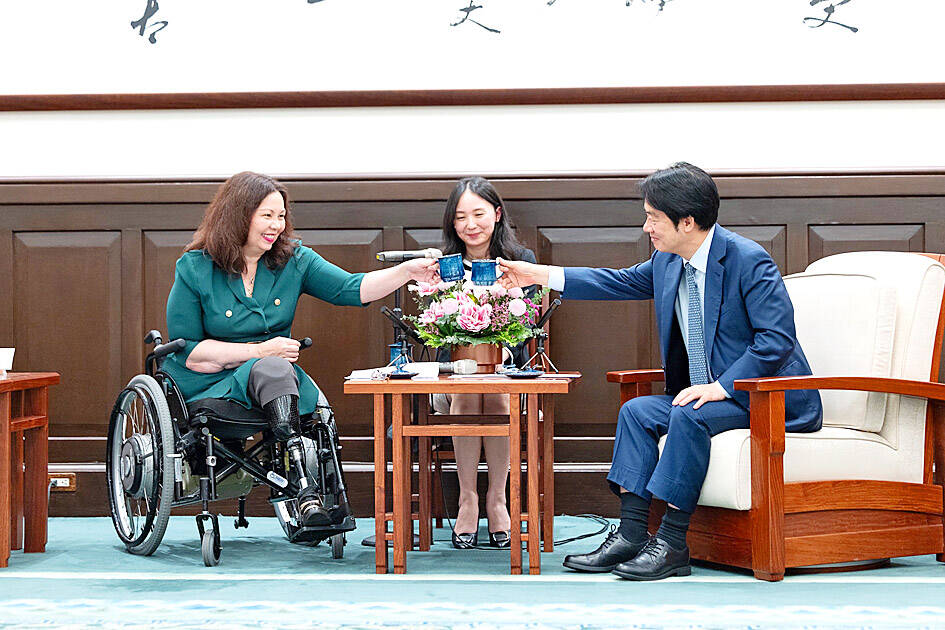
Photo courtesy of the Presidential Office
Taipei has mapped out a pathway for Taiwan-US trade relations, and encourages companies in both nations to invest more in the markets, Lai said, adding that he looks forward to deepening ties and creating a mutual niche.
Duckworth said that aside from military cooperation, Taiwan and the US have many other development opportunities, including in semiconductor chip production, agricultural investments, the shipbuilding industry and healthcare.
Two-way investment would benefit the stability and development of the two sides, she said, adding that she would continue to promote Taiwan-US relations.
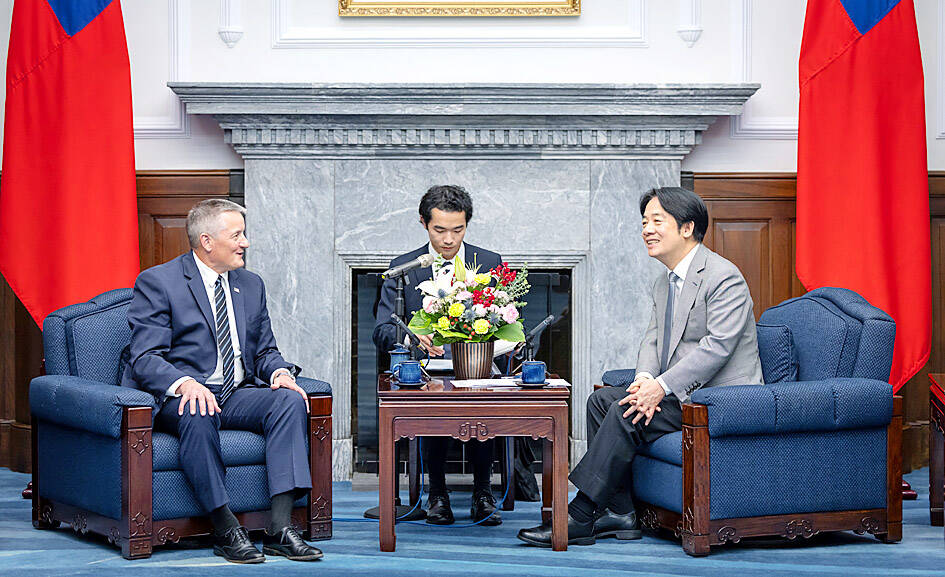
Photo courtesy of the Presidential Office
Duckworth’s delegation, which arrived yesterday and is to depart today, was also to meet with Vice President Hsiao Bi-khim (蕭美琴) and Minister of Foreign Affairs Lin Chia-lung (林佳龍), and visit agencies to discuss defense, economic and cross-strait issues, the Ministry of Foreign Affairs said in a statement.
Duckworth last visited Taiwan in May last year, soon after Lai and Hsiao were sworn in, the statement said.
She announced a US donation of COVID-19 vaccines to Taiwan during her June 2021 visit, when Taiwan was in need of vaccines at the height of the pandemic, it said, adding that she is a staunch supporter of Taiwan.
There are three US delegations in Taiwan, the others being a group from the US House of Representatives led by US Representative Bruce Westerman, chairman of the House Committee on Natural Resources, and a group led by Guam Governor Lourdes Leon Guerrero.
The American Institute in Taiwan (AIT) said in a separate statement that Duckworth’s delegation was also to visit other places in the Indo-Pacific region.
“The delegation will engage in a series of high-level meetings with senior Taiwan leaders to discuss US-Taiwan relations, regional security, trade and investment, and other significant issues of mutual interest,” the AIT said.
“The visit underscores the United States’ commitment to its partnership with Taiwan and reaffirms our shared commitment to strengthening a free and open Indo-Pacific,” it said.
Taiwan faces 32 percent tariffs announced by the administration of US President Donald Trump, a figure that Taipei is attempting to negotiate downward without angering sectors such as agriculture, which fear that lower tariffs could open their markets to heightened competition from abroad.
Separately, Lai on Tuesday reiterated Taiwan’s commitment to deepening economic ties with the US, highlighting the nation’s desire to work with Washington in building a “non-red” supply chain.
During a meeting with Westerman’s delegation in Taipei, Lai said that Taiwan would continue to purchase US goods, including energy, agricultural and industrial products, as well as military equipment.
Such purchases would help balance bilateral trade and bolster Taiwan’s economic security, and also boost its energy autonomy and resilience, he said.
Lai said that Taiwan is willing to play a role in supporting US efforts to “reindustrialize” and become a global leader in artificial intelligence.
Taiwan hopes to boost industrial cooperation with the US and jointly develop a “non-red” supply chain, referring to manufacturing networks free from Chinese influence, he said.
Westerman said his delegation was keenly interested in the outcome of trade negotiations over tariffs between Taipei and Washington, and expressed optimism about expanding collaboration.

‘NO SECURITY RISK’: The Railway Bureau reassured the public that the technicians’ activities were limited to technical guidance and did not involve sensitive systems The Railway Bureau yesterday said it had invited eight Chinese technicians to assist with an airport MRT construction project. The bureau issued the confirmation after an Internet user said Chinese nationals had entered the construction zone of Taiwan Taoyuan International Airport’s Terminal 3 project. They asked why “individuals from an enemy state” were allowed access to such a major national infrastructure project, which raised serious concerns over Taiwan’s industrial safety, sensitive systems and information security. The bureau’s Northern Region Engineering Branch Office said subcontractor Taiwan Handle Industrial Co (台灣手把工業) of the Taoyuan airport MRT’s “Contract No. CU05 Project A14 Station Civil, MEP &

A US uncrewed surface vessel (USV) encountered multiple Chinese warships during an autonomous transit of the Taiwan Strait, US defense company Seasats said in a statement on Wednesday. Seasats announced that a Lightfish USV had completed the first autonomous transit of the Taiwan Strait. Over five days, the USV traversed the entire length of the Strait while constantly monitoring surface vessel traffic, the company said. The Lightfish encountered multiple Chinese warships, one of which was a Chinese People’s Liberation Army Navy (PLAN) Type 056 corvette, it said. The Chinese vessels were operating “well within Taiwan’s exclusive economic zone without transmitting their identity via the

Taiwan is still in the process of assessing the possibility of recruiting workers from Eswatini, the Ministry of Foreign Affairs said yesterday, adding that its goal is to help Eswatini upgrade its vocational training centers. If there are plans to recruit workers from Eswatini, safeguarding national security, protecting public health and ensuring the employment rights of Taiwanese would be prerequisites, Department of West Asian and African Affairs Director-General Yen Chia-liang (顏嘉良) told a news conference. Key considerations would also include filling labor shortages in specific industries, and fostering bilateral professional and technical exchanges, he said. Yen was asked about the progress of labor
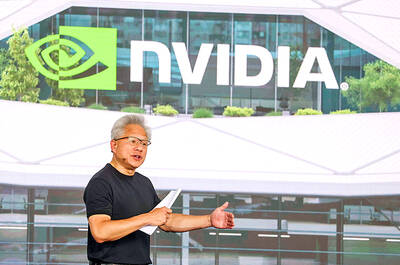
‘BOOMING’: ’ The number of partners we have here is incredible. You can see from their stock prices. They’re doing so well, they’re so happy,’ Jensen Huang said Nvidia Corp’s spending in Taiwan has ballooned to about US$150 billion a year, 10 times the US$10 billion to US$15 billion the company spent five years ago, Nvidia chief executive officer Jensen Huang (黃仁勳) said yesterday, suggesting Taiwan’s strategic importance in the global artificial intelligence (AI) supply chain. “Taiwan is the epicenter of the AI revolution. This is where the chips come, packaging comes. This is where the systems are made. This is where AI supercomputers were created,” Huang said at a meeting for the company’s employees in Beitou-Shilin Technology Park (北投士林科技園區) in Taipei, the planned site of Nvidia’s Taipei headquarters. “Taiwan


 RSS
RSS