


Harvard University yesterday sued the administration of US President Donald Trump after his decision to revoke the Ivy League school’s ability to enroll international students.
In a complaint filed in a Boston federal court, Harvard called the revocation a “blatant violation” of the US Constitution’s First Amendment and other federal laws.
It also said the revocation had an “immediate and devastating effect” on the university and more than 7,000 visa holders.
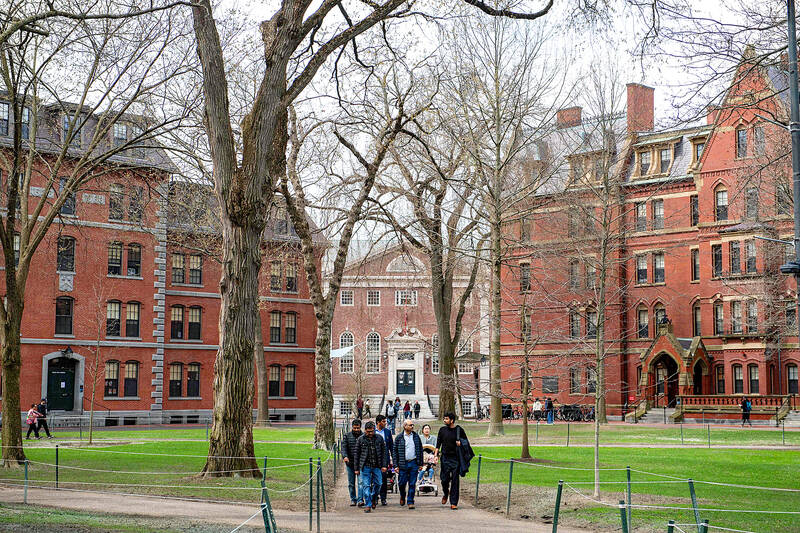
Photo: AFP
The Trump administration’s decision on Thursday to revoke Harvard University’s ability to enroll foreign nationals has put the future of thousands of students at risk and threatens the prestigious university with a huge financial blow.
“With the stroke of a pen, the government has sought to erase a quarter of Harvard’s student body, international students who contribute significantly to the university and its mission,” Harvard said.
“It is the latest act by the government in clear retaliation for Harvard exercising its First Amendment rights to reject the government’s demands to control Harvard’s governance, curriculum and the ‘ideology’ of its faculty and students,” it added.
Trump is furious that Harvard rejected his demand that it submit to oversight on admissions and hiring over his claims that it is a hotbed of anti-Semitism and “woke” ideology.
US Secretary of Homeland Security Kristi Noem on Thursday ordered the termination of Harvard’s Student and Exchange Visitor Program certification, effective for the 2025 to 2026 academic year.
She said Harvard is “fostering violence, antisemitism and coordinating with the Chinese Communist Party.”
In Taipei, the Ministry of Education (MOE) yesterday said that 52 Taiwanese students, including those who have just been accepted, are expected to be affected by the ban.
The MOE said it welcomed students whose studies at Harvard would be affected to complete their studies in Taiwan and would help facilitate the transfer process.
The ministry can arrange for additional rounds of college entrance exams should students about to commence their studies at Harvard wish to study in Taiwan due to US policies, it said.
It also urged domestic universities with a memorandum of understanding with Harvard to discuss measures that would help Taiwanese students complete their studies.
For students who have not yet obtained their student visas, the ministry suggested that they continue their studies in Taiwan.
Any students in need of assistance could contact the Taipei Economic and Cultural Office Boston branch’s education division via email at boston@mail.moe.gov.tw, the ministry said.
Additional reporting by Rachel Lin

A signaling system malfunction disrupted high-speed rail (HSR) services beginning at 8am today, with trains temporarily reduced to three northbound and three southbound trains per hour as authorities conduct inspections. The malfunction occurred on a section of track in Miaoli County during pre-operation checks early this morning, forcing northbound and southbound trains to use a single track, the HSR operator said. The regular schedule has been replaced with three hourly trains offering only nonreserved seating in each direction, stopping at every station, it said, adding that business class cars would still have reserved seating. Departures from terminal stations are scheduled at the top

Taiwan is still in the process of assessing the possibility of recruiting workers from Eswatini, the Ministry of Foreign Affairs said yesterday, adding that its goal is to help Eswatini upgrade its vocational training centers. If there are plans to recruit workers from Eswatini, safeguarding national security, protecting public health and ensuring the employment rights of Taiwanese would be prerequisites, Department of West Asian and African Affairs Director-General Yen Chia-liang (顏嘉良) told a news conference. Key considerations would also include filling labor shortages in specific industries, and fostering bilateral professional and technical exchanges, he said. Yen was asked about the progress of labor

VERBOSE VESSELS: A CGA cutter and a China Coast Guard exchanged verbal barbs for more than a day in Taiwanese-controlled waters before the Chinese vessel left The Taiwanese and Chinese coast guards had a standoff near the strategically located Pratas Islands (Dongsha Islands, 東沙群島) in the north of the South China Sea, the Coast Guard Administration (CGA) said yesterday. The two sides engaged in intense radio exchanges over sovereignty claims during the 33-hour standoff. China Coast Guard vessel 3501 eventually left the restricted waters, 26.6 nautical miles (49.2km) west of the Pratas Islands, at 5pm yesterday, the CGA said. Lying approximately between southern Taiwan and Hong Kong, the Taiwan-controlled Pratas are seen by some security experts as vulnerable to Chinese attack due to their distance — more than

A US uncrewed surface vessel (USV) encountered multiple Chinese warships during an autonomous transit of the Taiwan Strait, US defense company Seasats said in a statement on Wednesday. Seasats announced that a Lightfish USV had completed the first autonomous transit of the Taiwan Strait. Over five days, the USV traversed the entire length of the Strait while constantly monitoring surface vessel traffic, the company said. The Lightfish encountered multiple Chinese warships, one of which was a Chinese People’s Liberation Army Navy (PLAN) Type 056 corvette, it said. The Chinese vessels were operating “well within Taiwan’s exclusive economic zone without transmitting their identity via the


 RSS
RSS