


The latest data from the Ministry of the Interior showed that single-person and two-people households accounted for almost half of all households nationwide last year, suggesting a growing trend of singles and elderly people living alone, and couples with double income and no children.
As of the fourth quarter of last year, of the more than 7.73 million households nationwide, about 2.28 million, or nearly 30 percent, were single-person households, the data showed.
Combined with the more than 1.52 million two-people households, the figure surpassed 3.8 million, meaning that one in every 2.03 households was single-person or two-people household.
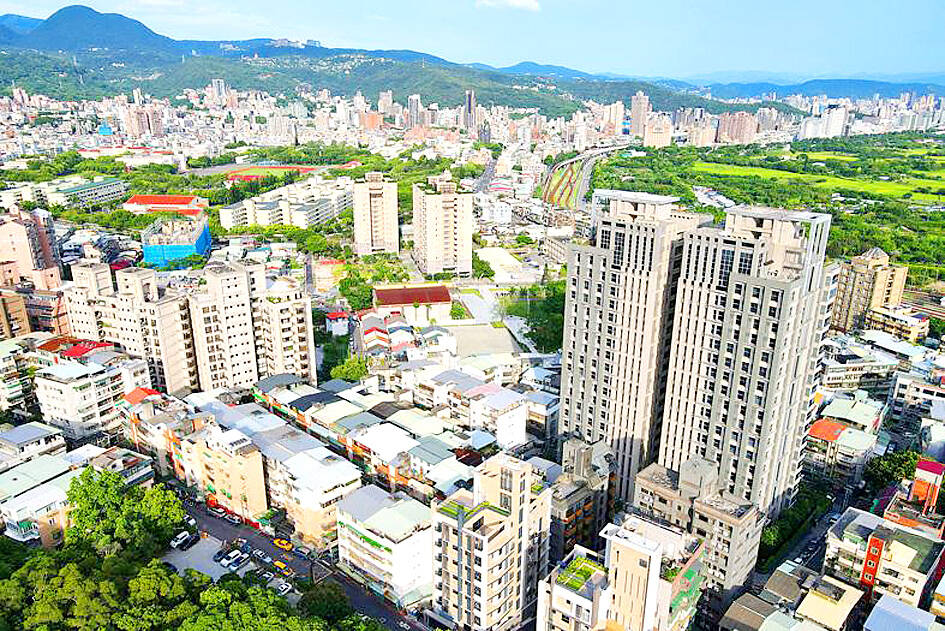
Photo: CNA
The percentages of single-person households in Taipei, New Taipei City and Kaohsiung have all exceeded 30 percent.
New Taipei City had the most single-person households, with 470,300, followed by Kaohsiung’s 296,400 households and Taipei’s and Taichung’s more than 250,000 households each.
Tainan was the only special municipality that had fewer than 200,000 single-person households.
Two-person households in Taipei, New Taipei City and Kaohsiung all accounted for more than half of the total, while they accounted for more than 46 percent in Taoyuan, Taichung and Tainan, the data showed.
That means smaller households have become common in the six special municipalities.
The data also showed that there were about 746,600 households comprising only elderly people as of the first quarter of last year. The number rose to 803,600 in the fourth quarter.
The number of households with elderly people living alone reached 611,700 as of the fourth quarter last year, surpassing 600,000 for the first time since statistics began in 2009, the data showed.
Housing researcher Ho Shih-chang (何世昌) yesterday said that the problem of low birthrates has been aggravated by the trend of staying unmarried and childless, and has become a national security concern.
The government should offer subsidies to encourage people to get married and have children, he said.
That could counteract the trend of people staying unmarried and childless, and reduce the number of single-person households, Ho said.
Newly emerging industrial clusters have replaced traditional municipalities to offer employment and housing opportunities, and resulted in more single-person households, Colliers International Taiwan’s Landlord Representation Services director Andy Huang (黃舒衛) said.
Rising divorce rates, the trend of not getting married and women’s financial independence have impacted demographic trends and family structures, Huang said.
Labor migration due to unstable employment and the Taiwanese custom to spend retirement years at home also led to the trend of elderly people living alone, he said.
Such households result from an aging population and high divorce rate, Ho said.
While providing proper care and mental counseling for elderly people is important at the present stage, the issue of abandoned housing would ensue in 20 to 30 years when the elderly people pass away and leave their housing behind uninherited and unattended, he said.

A signaling system malfunction disrupted high-speed rail (HSR) services beginning at 8am today, with trains temporarily reduced to three northbound and three southbound trains per hour as authorities conduct inspections. The malfunction occurred on a section of track in Miaoli County during pre-operation checks early this morning, forcing northbound and southbound trains to use a single track, the HSR operator said. The regular schedule has been replaced with three hourly trains offering only nonreserved seating in each direction, stopping at every station, it said, adding that business class cars would still have reserved seating. Departures from terminal stations are scheduled at the top

Taiwan is still in the process of assessing the possibility of recruiting workers from Eswatini, the Ministry of Foreign Affairs said yesterday, adding that its goal is to help Eswatini upgrade its vocational training centers. If there are plans to recruit workers from Eswatini, safeguarding national security, protecting public health and ensuring the employment rights of Taiwanese would be prerequisites, Department of West Asian and African Affairs Director-General Yen Chia-liang (顏嘉良) told a news conference. Key considerations would also include filling labor shortages in specific industries, and fostering bilateral professional and technical exchanges, he said. Yen was asked about the progress of labor

A US uncrewed surface vessel (USV) encountered multiple Chinese warships during an autonomous transit of the Taiwan Strait, US defense company Seasats said in a statement on Wednesday. Seasats announced that a Lightfish USV had completed the first autonomous transit of the Taiwan Strait. Over five days, the USV traversed the entire length of the Strait while constantly monitoring surface vessel traffic, the company said. The Lightfish encountered multiple Chinese warships, one of which was a Chinese People’s Liberation Army Navy (PLAN) Type 056 corvette, it said. The Chinese vessels were operating “well within Taiwan’s exclusive economic zone without transmitting their identity via the

VERBOSE VESSELS: A CGA cutter and a China Coast Guard exchanged verbal barbs for more than a day in Taiwanese-controlled waters before the Chinese vessel left The Taiwanese and Chinese coast guards had a standoff near the strategically located Pratas Islands (Dongsha Islands, 東沙群島) in the north of the South China Sea, the Coast Guard Administration (CGA) said yesterday. The two sides engaged in intense radio exchanges over sovereignty claims during the 33-hour standoff. China Coast Guard vessel 3501 eventually left the restricted waters, 26.6 nautical miles (49.2km) west of the Pratas Islands, at 5pm yesterday, the CGA said. Lying approximately between southern Taiwan and Hong Kong, the Taiwan-controlled Pratas are seen by some security experts as vulnerable to Chinese attack due to their distance — more than


 RSS
RSS