


Former vice president Chen Chien-jen (陳建仁) attended Pope Leo XIV’s inaugural Mass at the Vatican yesterday morning as President William Lai’s (賴清德) special envoy to see the new pope installed as leader of 1.4 billion Roman Catholics.
Chen joined more than 100 world leaders and top church officials in St Peter’s Square to witness the event, including US Vice President J.D. Vance, Ukrainian President Volodymyr Zelenskiy, Canadian Prime Minister Mark Carney and Australian Prime Minister Anthony Albanese.
The Vatican is one of 12 states in the world to have formal diplomatic relations with Taiwan.
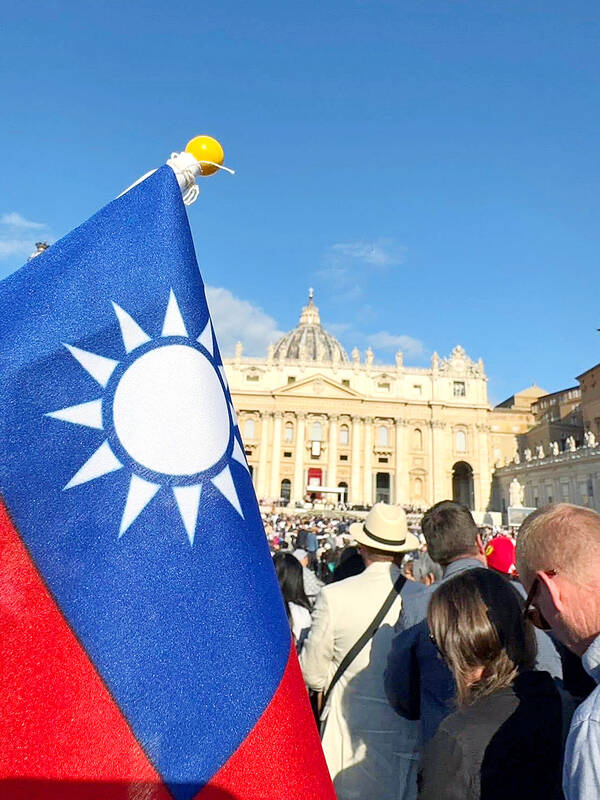
Photo: Screen grab from the Taiwanese Embassy to the Holy See’s Facebook page
Before attending yesterday’s ceremony, Chen, who arrived in Rome on Saturday afternoon along with Deputy Minister of Foreign Affairs Francois Wu (吳志中), said that he was instructed by Lai to extend the president’s sincere congratulations to Leo on his papacy.
Lai wishes that Taiwan and the Vatican can continue to strengthen their friendship and together work toward world peace and social justice, and provide better care for minority groups, Chen said.
Lai also wanted to express his wish to the pope that Taiwan and the Vatican can have more cooperation in humanitarian aid, and together cherish the universal values of freedom, democracy and rule of law, Chen said.
Chen and Wu also attended a Mass at Sant’Anselmo all’Aventino on Saturday focused on peace and prosperity in Taiwan.
The Mass was presided over by Bishop of Hsinchu John Lee (李克勉), Bishop of Taichung Martin Su (蘇耀文), Auxiliary Bishop of Taipei Peter Chao (趙永吉), Taiwanese priests in Italy Hsu Chien-bon (徐千邦) and Wu Men-che (吳孟哲), and Japanese priest Masatomo Yamaguchi, who lived in Taiwan for many years.
Chen, a Catholic, said the Mass first prayed for Leo, expressing hopes that he would lead the Vatican, Catholic churches around the world and friendly countries to work together to take care of workers, migrants, refugees and minorities.
He said he hoped the Vatican would be valued by the world under Leo’s guidance, becoming a guiding force for morality and peace.
The second focus of the Mass prayed for Taiwan’s peace and stability, hoping everyone in Taiwan would get along with each other and help each other to make the nation more prosperous and play a critical role in the stability and peace in the Asia-Pacific region, as well as for mutual prosperity of like-minded countries, he said.
The Mass also prayed for all bishops, clergy and church members, hoping that Catholicism would flourish in Taiwan, and for improvements in education, culture, healthcare and care for the less priviledged, he said.
The last part of the Mass prayed for diplomats at the Vatican, hoping they can serve as a bridge between Taiwan and the Holy See to strengthen friendship and enhance communications, he said.
“Of course, we hope one day the pope could visit Taiwan so that all Catholics in Taiwan can feel the love the pope has toward Taiwan,” he said.
While attending the Mass, Chen and Wu wore a pin that read: “Team Taiwan” on their suits, while Chen’s wife, Lo Feng-ping (羅鳳蘋), wore a jacket with the word “Taiwan” printed on it.
Showing his pin, Chen said Taiwan needs to become a very strong team and all parties should become united as a team in international events.
Taiwan also hopes to become a democratic team with other friendly countries, and work toward world peace, economic prosperity, and take care of the underprivileged together, he added.
Wu said he believes Taiwan has always been blessed by God, and although he has always felt that Taiwan faced many challenges in maintaining friendship with its ally, the Vatican, they have overcome all of them so far.
Taiwan should be more confident of itself, as the nation’s image in the world has become very different in the past few years, he said, adding that just as Catholic church was suppressed during the Roman Empire, but became accepted by more people, Taiwan is becoming a legend as a small country that has survived the Chinese Communist Party’s suppression and is now thriving.

A signaling system malfunction disrupted high-speed rail (HSR) services beginning at 8am today, with trains temporarily reduced to three northbound and three southbound trains per hour as authorities conduct inspections. The malfunction occurred on a section of track in Miaoli County during pre-operation checks early this morning, forcing northbound and southbound trains to use a single track, the HSR operator said. The regular schedule has been replaced with three hourly trains offering only nonreserved seating in each direction, stopping at every station, it said, adding that business class cars would still have reserved seating. Departures from terminal stations are scheduled at the top

Taiwan is still in the process of assessing the possibility of recruiting workers from Eswatini, the Ministry of Foreign Affairs said yesterday, adding that its goal is to help Eswatini upgrade its vocational training centers. If there are plans to recruit workers from Eswatini, safeguarding national security, protecting public health and ensuring the employment rights of Taiwanese would be prerequisites, Department of West Asian and African Affairs Director-General Yen Chia-liang (顏嘉良) told a news conference. Key considerations would also include filling labor shortages in specific industries, and fostering bilateral professional and technical exchanges, he said. Yen was asked about the progress of labor

A US uncrewed surface vessel (USV) encountered multiple Chinese warships during an autonomous transit of the Taiwan Strait, US defense company Seasats said in a statement on Wednesday. Seasats announced that a Lightfish USV had completed the first autonomous transit of the Taiwan Strait. Over five days, the USV traversed the entire length of the Strait while constantly monitoring surface vessel traffic, the company said. The Lightfish encountered multiple Chinese warships, one of which was a Chinese People’s Liberation Army Navy (PLAN) Type 056 corvette, it said. The Chinese vessels were operating “well within Taiwan’s exclusive economic zone without transmitting their identity via the

VERBOSE VESSELS: A CGA cutter and a China Coast Guard exchanged verbal barbs for more than a day in Taiwanese-controlled waters before the Chinese vessel left The Taiwanese and Chinese coast guards had a standoff near the strategically located Pratas Islands (Dongsha Islands, 東沙群島) in the north of the South China Sea, the Coast Guard Administration (CGA) said yesterday. The two sides engaged in intense radio exchanges over sovereignty claims during the 33-hour standoff. China Coast Guard vessel 3501 eventually left the restricted waters, 26.6 nautical miles (49.2km) west of the Pratas Islands, at 5pm yesterday, the CGA said. Lying approximately between southern Taiwan and Hong Kong, the Taiwan-controlled Pratas are seen by some security experts as vulnerable to Chinese attack due to their distance — more than


 RSS
RSS