


Israel’s security Cabinet approved the expansion of military operations in Gaza, including the “conquest” of the Palestinian territory, an official said yesterday, after the army called up tens of thousands of reservists for the offensive.
It comes as the UN and aid organizations have repeatedly warned of the humanitarian catastrophe on the ground, with famine again looming after more than two months of a total Israeli blockade.
The plan, approved by the Cabinet overnight, includes the holding of territories in the besieged Gaza Strip, the official said, and comes amid a push by Israel for Gaza’s people to leave the territory.

Photo: AP
Israel resumed major operations across Gaza on March 18 amid deadlock over how to proceed with a two-month ceasefire that had largely halted the war with Hamas, which was sparked by the militants’ October 2023 attack.
Israel has since carried out intensive aerial bombardments and expanded ground operations across the Palestinian territory, with Gaza rescuers yesterday saying Israeli airstrikes killed at least 19 people in the north.
The Israeli official said the plan for expanded operations “will include, among other things, the conquest of the Gaza Strip and the holding of the territories, moving the Gaza population south for their protection.”
The majority of Gaza’s population had resided in the north of the territory, particularly Gaza City, and nearly all have been displaced at least once since the war began.
The Cabinet, which includes Israeli Prime Minister Benjamin Netanyahu and several ministers, “unanimously approved” the plan aimed at defeating Gaza’s rulers Hamas and securing the return of hostages held in the territory.
The official source said the plan included “powerful strikes against Hamas,” without specifying their nature.
Israeli Chief of the General Staff Lieutenant General Eyal Zamir on Sunday said the military was calling up “tens of thousands” of reservists to expand its offensive.
Israeli media reported that the plan would not be implemented before US President Donald Trump’s visit to the region next week.
The health ministry in Hamas-run Gaza on Sunday said that at least 2,436 people had been killed since Israel resumed its campaign on March 18, bringing the overall death toll from the war to 52,535.
Israel’s security Cabinet also approved overnight the “possibility of humanitarian distribution, if necessary” in Gaza, “to prevent Hamas from taking control of the supplies and to destroy its governance capabilities.”
The Axios news Web site on Friday reported that representatives from the US, Israel and a new international humanitarian foundation were discussing a mechanism for resuming aid delivery to Gaza “without it being controlled by Hamas.”
A grouping of UN entities and non-governmental organizations in the Palestinian territory accused Israel of seeking to “shut down the existing aid distribution system ... and have us agree to deliver supplies through Israeli hubs under conditions set by the Israeli military.”
The plan “contravenes fundamental humanitarian principles and appears designed to reinforce control over life-sustaining items as a pressure tactic — as part of a military strategy,” the Humanitarian Country Team of the Occupied Palestinian Territory said in a statement.
“The UN Secretary-General and the Emergency Relief Coordinator have made clear that we will not participate in any scheme,” it added.
Hamas said a new Israeli framework for aid delivery amounted to “political blackmail” and blamed Israel for the territory’s “humanitarian catastrophe.”
Israel’s Cabinet said there was “currently enough food” in Gaza, although humanitarian organizations and UN agencies have warned of the blockade’s dire consequences for Gaza’s 2.4 million people.
Crowds of desperate Gazans were seen piling up at a charity kitchen in the territory at the weekend, in photos published by AFP.
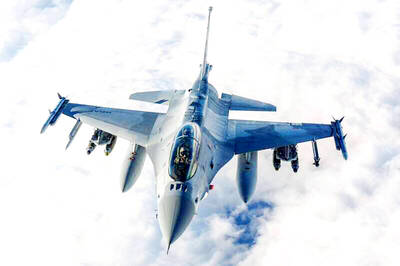
LONG FLIGHT: The jets would be flown by US pilots, with Taiwanese copilots in the two-seat F-16D variant to help familiarize them with the aircraft, the source said The US is expected to fly 10 Lockheed Martin F-16C/D Block 70/72 jets to Taiwan over the coming months to fulfill a long-awaited order of 66 aircraft, a defense official said yesterday. Word that the first batch of the jets would be delivered soon was welcome news to Taiwan, which has become concerned about delays in the delivery of US arms amid rising military tensions with China. Speaking on condition of anonymity, the official said the initial tranche of the nation’s F-16s are rolling off assembly lines in the US and would be flown under their own power to Taiwan by way

CHIP WAR: The new restrictions are expected to cut off China’s access to Taiwan’s technologies, materials and equipment essential to building AI semiconductors Taiwan has blacklisted Huawei Technologies Co (華為) and Semiconductor Manufacturing International Corp (SMIC, 中芯), dealing another major blow to the two companies spearheading China’s efforts to develop cutting-edge artificial intelligence (AI) chip technologies. The Ministry of Economic Affairs’ International Trade Administration has included Huawei, SMIC and several of their subsidiaries in an update of its so-called strategic high-tech commodities entity list, the latest version on its Web site showed on Saturday. It did not publicly announce the change. Other entities on the list include organizations such as the Taliban and al-Qaeda, as well as companies in China, Iran and elsewhere. Local companies need

CRITICISM: It is generally accepted that the Straits Forum is a CCP ‘united front’ platform, and anyone attending should maintain Taiwan’s dignity, the council said The Mainland Affairs Council (MAC) yesterday said it deeply regrets that former president Ma Ying-jeou (馬英九) echoed the Chinese Communist Party’s (CCP) “one China” principle and “united front” tactics by telling the Straits Forum that Taiwanese yearn for both sides of the Taiwan Strait to move toward “peace” and “integration.” The 17th annual Straits Forum yesterday opened in Xiamen, China, and while the Chinese Nationalist Party’s (KMT) local government heads were absent for the first time in 17 years, Ma attended the forum as “former KMT chairperson” and met with Chinese People’s Political Consultative Conference Chairman Wang Huning (王滬寧). Wang

OBJECTS AT SEA: Satellites with synthetic-aperture radar could aid in the detection of small Chinese boats attempting to illegally enter Taiwan, the space agency head said Taiwan aims to send the nation’s first low Earth orbit (LEO) satellite into space in 2027, while the first Formosat-8 and Formosat-9 spacecraft are to be launched in October and 2028 respectively, the National Science and Technology Council said yesterday. The council laid out its space development plan in a report reviewed by members of the legislature’s Education and Culture Committee. Six LEO satellites would be produced in the initial phase, with the first one, the B5G-1A, scheduled to be launched in 2027, the council said in the report. Regarding the second satellite, the B5G-1B, the government plans to work with private contractors


 RSS
RSS