


The Taipei District Court yesterday placed Chinese Nationalist Party’s (KMT) Taipei chapter director Huang Lu Chin-ju (黃呂錦茹) in judicial detention following a second hearing.
Huang Lu is under investigation for her role in KMT-led recall efforts against Democratic Progressive Party (DPP) legislators Rosalia Wu (吳思瑤) and Wu Pei-yi (吳沛憶) that allegedly used forged signatures.
The Taipei District Prosecutors’ Office initially sought to detain Huang Lu on April 18, but the Taipei District Court ordered her release without bail the following day.
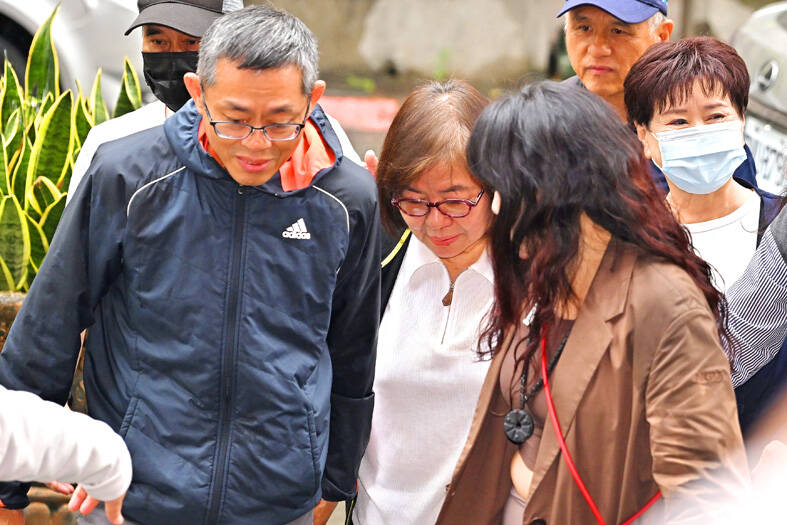
Photo: Tu Chien-jung, Taipei Times
Prosecutors appealed the decision, and at a second hearing yesterday, the court ordered Huang Lu’s detention, citing material evidence and prosecutors’ presentation.
The court found that Huang Lu was likely involved in forgery offenses under the Criminal Code, including forging or altering documents and making false entries.
She is also suspected of contravening the Personal Data Protection Act (個人資料保護法) through the illegal collection, use and processing of personal information of another individual.
“A review of the evidence indicated a likelihood of collusion in testimony and tampering with evidence,” the court said.
“More lenient measures — including release on bail, restriction to domicile or electronic monitoring — would be insufficient to prevent interference with the case,” it said.
As a result, Huang Lu was ordered to begin judicial detention yesterday for a period of two months, with restrictions placed on her communications.
Outside the Taipei District Prosecutors’ Office, KMT Chairman Eric Chu (朱立倫) said Taiwan’s judicial system was being used as a political tool to unfairly prosecute and criminally charge KMT members.
Chu also said that President William Lai (賴清德) had instructed local prosecutors to aggressively target KMT figures in an effort to suppress the opposition party.
“When they cannot find evidence, they detain suspects and carry out forceful questioning. This is a sad development in Taiwan,” Chu said.
“We urge all friends who have fought for democracy in Taiwan to join tomorrow’s rally. We must stand together to safeguard an impartial and fair justice system,” he added.
Separately yesterday, the Taiwan Yilan District Court ordered three people, including the former chief secretary of the KMT’s Yilan County chapter, Yu Ling-chieh (俞凌傑), to be detained in a case involving allegedly fake signatures in a recall campaign.
The prosecutors in charge of the case had filed a request to detain Yu and two others on the suspicion that they faked signatures on petitions to recall Democratic Progressive Party (DPP) Legislator Chen Chun-yu (陳俊宇).
The other two people ordered detained were executive members of the KMT Yilan chapter, surnamed Chen (陳) and Lee (李).
The Yilan case is the latest in a string of actions by prosecutors around the country to crack down on alleged signature fraud in campaigns to recall legislators.
The investigations, which the KMT has contended amount to political persecution by the ruling DPP, are ongoing in several major cities, including Taipei, New Taipei City, Tainan and Kaohsiung.

A signaling system malfunction disrupted high-speed rail (HSR) services beginning at 8am today, with trains temporarily reduced to three northbound and three southbound trains per hour as authorities conduct inspections. The malfunction occurred on a section of track in Miaoli County during pre-operation checks early this morning, forcing northbound and southbound trains to use a single track, the HSR operator said. The regular schedule has been replaced with three hourly trains offering only nonreserved seating in each direction, stopping at every station, it said, adding that business class cars would still have reserved seating. Departures from terminal stations are scheduled at the top

Taiwan is still in the process of assessing the possibility of recruiting workers from Eswatini, the Ministry of Foreign Affairs said yesterday, adding that its goal is to help Eswatini upgrade its vocational training centers. If there are plans to recruit workers from Eswatini, safeguarding national security, protecting public health and ensuring the employment rights of Taiwanese would be prerequisites, Department of West Asian and African Affairs Director-General Yen Chia-liang (顏嘉良) told a news conference. Key considerations would also include filling labor shortages in specific industries, and fostering bilateral professional and technical exchanges, he said. Yen was asked about the progress of labor

A US uncrewed surface vessel (USV) encountered multiple Chinese warships during an autonomous transit of the Taiwan Strait, US defense company Seasats said in a statement on Wednesday. Seasats announced that a Lightfish USV had completed the first autonomous transit of the Taiwan Strait. Over five days, the USV traversed the entire length of the Strait while constantly monitoring surface vessel traffic, the company said. The Lightfish encountered multiple Chinese warships, one of which was a Chinese People’s Liberation Army Navy (PLAN) Type 056 corvette, it said. The Chinese vessels were operating “well within Taiwan’s exclusive economic zone without transmitting their identity via the

VERBOSE VESSELS: A CGA cutter and a China Coast Guard exchanged verbal barbs for more than a day in Taiwanese-controlled waters before the Chinese vessel left The Taiwanese and Chinese coast guards had a standoff near the strategically located Pratas Islands (Dongsha Islands, 東沙群島) in the north of the South China Sea, the Coast Guard Administration (CGA) said yesterday. The two sides engaged in intense radio exchanges over sovereignty claims during the 33-hour standoff. China Coast Guard vessel 3501 eventually left the restricted waters, 26.6 nautical miles (49.2km) west of the Pratas Islands, at 5pm yesterday, the CGA said. Lying approximately between southern Taiwan and Hong Kong, the Taiwan-controlled Pratas are seen by some security experts as vulnerable to Chinese attack due to their distance — more than


 RSS
RSS