


The Taipei District Prosecutors’ Office yesterday searched the Chinese Nationalist Party’s (KMT) Taipei city chapter and questioned staff members, including the director, in a broadening probe into allegedly forged signatures in recall campaigns, Chinese-language media reported.
Investigators reportedly questioned KMT Taipei chapter director Huang Lu Chin-ju (黃呂錦茹), chapter secretary-general Chu Wen-ching (初文卿), chapter secretary Yao Fu-wen (姚富文) and first district committee executive director Tseng Fan-chuan (曾繁川).
The prosecutors’ office in a statement last night said that police searched the offices and homes of four people, including a person identified as Huang Lu “X”-ju, and the office of an unnamed political party in connection to an ongoing fraud investigation.
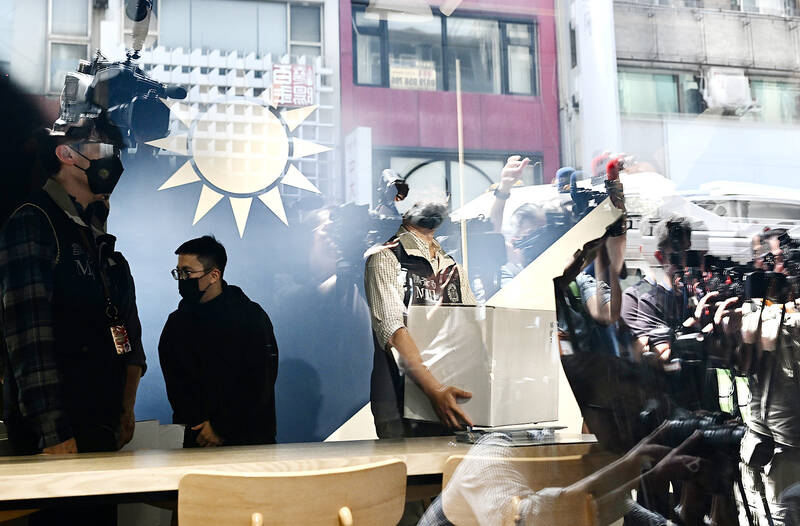
Photo: Lo Pei-de, Taipei Times
It has no bias and its line of inquiry is guided by evidence, it said, adding that the public should refrain from politicizing the work of prosecutors.
The investigation centers on allegations that recall campaigns targeting Democratic Progressive Party (DPP) legislators Rosalia Wu (吳思瑤), the party’s caucus chief executive, and Wu Pei-yi (吳沛憶) used falsified signatures.
KMT supporters were protesting last night outside the Taipei District Prosecutors’ Office in Zhongzheng District (中正), a restricted area where public assembly is not allowed.
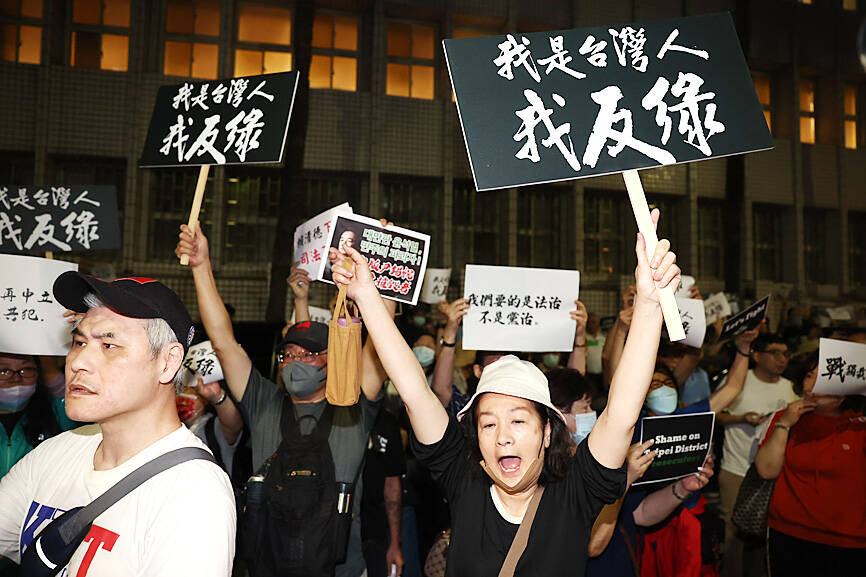
Photo: CNA
The action came two days after six people — Lee Hsiao-liang (李孝亮), Liu Szu-yin (劉思吟), Liu’s husband, Lin Jui (林叡), Lai Yi-jen (賴苡任), Man Chih-kang (滿志剛) and Chen Kuan-an (陳冠安) — posted bail in the case.
Liu, Lai, Man and Chen are KMT Youth League members dubbed in the media as the “four knights” of the bid to recall Wu.
Liu, Lai and Man each posted bail of NT$500,000, Lee and Lin each posted bail of NT$300,000 and Chen posted bail of NT$200,000, the prosecutors’ office said on Tuesday.
Prosecutors launched probes into the recall campaigns after the Central Election Commission alerted law enforcement of irregularities in signatures gathered by the campaigns.
Organizers backed by the DPP have launched recall campaigns against 35 KMT lawmakers using petitions that allegedly included 160 counterfeit signatures and 12 signatures of dead voters, the commission said.
KMT-backed recall drives against 17 DPP lawmakers had petitions that allegedly included 42 counterfeit signatures and 1,784 signatures of deceased voters, it said.
In related news, the New Taipei City District Court on Wednesday night said that six people were released on bail of NT$30,000 to NT$200,000 and barred from leaving the country in an ongoing investigation into alleged fraud in recall campaigns targeting DPP legislators Su Chiao-hui (蘇巧慧), Wu Chi-ming (吳琪銘), Chang Hung-lu (張宏陸) and Lee Kuen-cheng (李坤城).
Earlier that day, New Taipei City prosecutors directed a search of 30 residences, offices and KMT branches after receiving evidence of alleged irregularities in recall petitions, prosecutors said.
Tainan prosecutors are also investigating similar allegations in the campaign to recall DPP legislators Lin Chun-hsien (林俊憲) and Wang Ting-yu (王定宇).
On March 20, investigators searched the KMT Tainan chapter, questioning five people.
Two suspects, surnamed Chuang (莊) and Liu (劉), have been detained incommunicado, while the other three were released.
Additional reporting by Chen Yi-shao, Shih Hsiao-kuang and Jonathan Chin

SILENCING CRITICS: In addition to blocking Taiwan, China aimed to prevent rights activists from speaking out against authoritarian states, a Cabinet department said The Ministry of Foreign Affairs (MOFA) yesterday condemned transnational repression by Beijing after RightsCon, a major digital human rights conference scheduled to be held in Zambia this week, was abruptly canceled due to Chinese pressure over Taiwanese participation. This year’s RightsCon, the world’s largest conference discussing issues “at the intersection of human rights and technology,” was scheduled to take place from tomorrow to Friday in Lusaka, and expected to draw 2,600 in-person attendees from 150 countries, along with 1,100 online participants. However, organizers were forced to cancel the event due to behind-the-scenes pressure from China, the ministry said, expressing its “strongest condemnation”
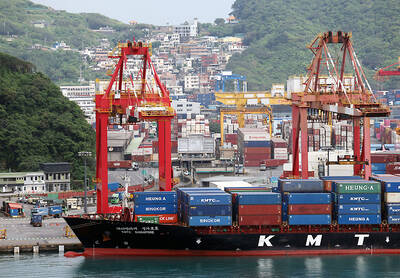
Taiwan’s economy grew far faster than expected in the first quarter, as booming demand for artificial intelligence (AI) applications drove a surge in exports, spilling over into investment and consumption, the Directorate-General of Budget, Accounting and Statistics (DGBAS) said yesterday. GDP growth was 13.69 percent year-on-year during the January-to-March period, beating the DGBAS’ February forecast by 2.23 percentage points and marking the most robust growth in nearly four decades, DGBAS senior official Chiang Hsin-yi (江心怡) told a news conference in Taipei. The result was powered by exports, which remain the backbone of Taiwan’s economy, Chiang said. Outbound shipments jumped 51.12 percent year-on-year to
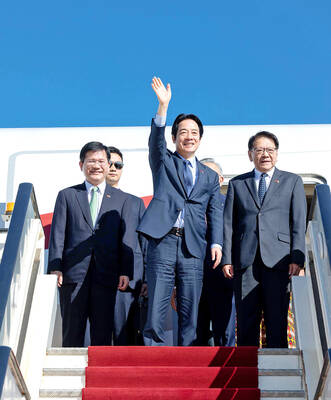
DELAYED BUT DETERMINED: The president’s visit highlights Taiwan’s right to international engagement amid regional pressure from China President Willaim Lai (賴清德) yesterday arrived in Eswatini, more than a week after his planned visit to Taiwan’s sole African ally was suspended because of revoked overflight permits. “The visit, originally scheduled for April 22, was postponed due to unforeseen external factors,” Lai wrote on social media. “After several days of careful arrangements by our diplomatic and national security teams, we successfully arrived today.” Lai said he looked forward to further deepening Taiwan-Eswatini relations through closer cooperation in the economy, agriculture, culture and education, as well as advancing the nation’s international partnerships. The president was initially scheduled to arrive in time to celebrate
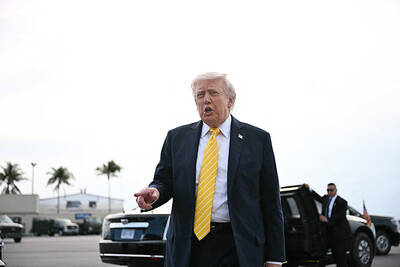
Iran’s Islamic Revolutionary Guard Corp (IRGC) yesterday said the US faced a choice between an “impossible” military operation or a “bad deal” with Tehran, after US President Donald Trump disparaged Iran’s latest peace proposal. Negotiations between the two countries have been deadlocked since a ceasefire came into effect on April 8, with only one round of direct peace talks held so far. Iran’s Tasnim and Fars news agencies reported that Tehran had submitted a 14-point proposal to mediator Pakistan, but Trump was quick to cast doubt on it. “I will soon be reviewing the plan that Iran has just sent to us, but


 RSS
RSS