


At least seven people were killed after Russia launched a barrage of drones across Ukraine overnight yesterday, local Ukrainian officials and emergency services said.
The attack on the Ukrainian capital came ahead of ceasefire negotiations in Saudi Arabia in which Ukraine and Russia are today expected to hold indirect US-mediated talks to discuss a pause in long-range attacks targeting energy facilities and civilian infrastructure.
The Ukrainian delegation is expected to meet with US officials in Saudi Arabia a day ahead of the indirect talks, Ukrainian President Voldoymyr Zelenskiy said.
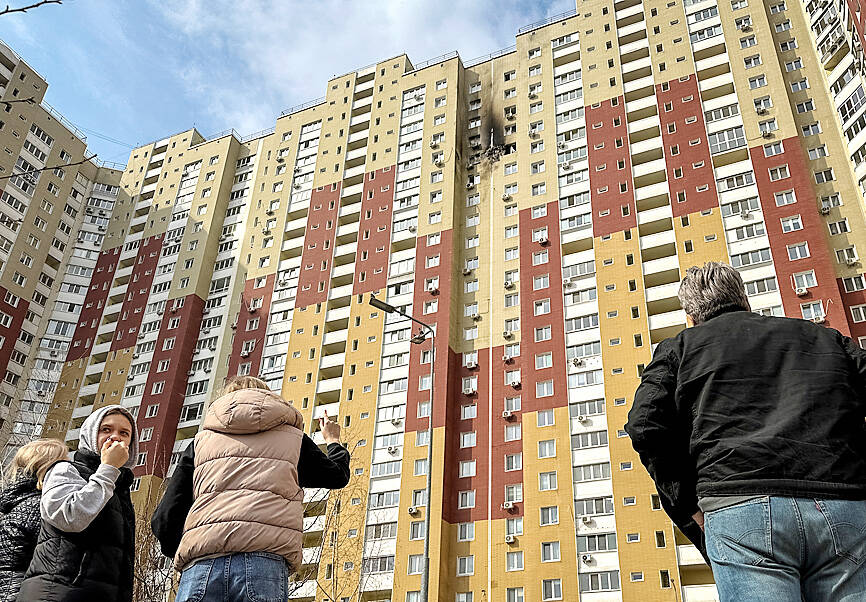
Photo: Reuters
Ukraine is planning to send technical teams to discuss the details of the partial ceasefire.
Russia launched 147 drones across Ukraine, the Ukrainian Air Force said.
Ukrainian air defenses shot down 97 and 25 others did not reach targets due to Ukrainian countermeasures.
The attacks struck the Kharkiv, Sumy, Chernihiv, Odesa and Donetsk regions, as well as the capital, Kyiv.
Three people, including a five-year-old child, were killed and 10 were injured in a drone attack on Kyiv, the city’s military administration said.
Extended sounds of explosions were heard across the Ukrainian capital in the early hours of the night as the air raid blared for more than five hours. Russian drones and debris from shot-down drones, which were flying at lower altitudes to evade air defenses, fell on residential buildings.
Two residential buildings in the Dnipro district caught fire due to falling drone debris, Kyiv City Military Administration head Tymur Tkachenko said.
A fire broke out on the top floors of a 9-story building, killing one woman, the Ukrainian State Emergency Service said.
In the district of Podil, a fire broke out on the 20th floor of a 25-story building.
In Holosiivskyi, fires broke out in a warehouse and office building, killing one person, the State Emergency Service said.
Elsewhere, four people were killed in Russian attacks on Ukraine’s Donetsk region, including three who died in a strike on the frontline Ukrainian town of Dobropillya, regional Governor Vadym Filashkin said.
In a statement on social media, Zelenskiy said attacks such as the one in Kyiv were a daily occurrence for Ukraine.
“This week alone, more than 1,580 guided aerial bombs, almost 1,100 strike drones and 15 missiles of various types were used against our people,” he said. “New solutions are needed, with new pressure on Moscow to stop both these strikes and this war.”
The Russian Ministry of Defense yesterday said it shot down 59 Ukrainian drones overnight, including 29 over the region of Rostov and 20 more over southwestern Astrakhan.
In Rostov, one person was killed and a car caught fire due to the Ukrainian drone attack, the area’s temporary governor, Yuri Slyusar, said.

‘ABUSE OF POWER’: Lee Chun-yi allegedly used a Control Yuan vehicle to transport his dog to a pet grooming salon and take his wife to restaurants, media reports said Control Yuan Secretary-General Lee Chun-yi (李俊俋) resigned on Sunday night, admitting that he had misused a government vehicle, as reported by the media. Control Yuan Vice President Lee Hung-chun (李鴻鈞) yesterday apologized to the public over the issue. The watchdog body would follow up on similar accusations made by the Chinese Nationalist Party (KMT) and would investigate the alleged misuse of government vehicles by three other Control Yuan members: Su Li-chiung (蘇麗瓊), Lin Yu-jung (林郁容) and Wang Jung-chang (王榮璋), Lee Hung-chun said. Lee Chun-yi in a statement apologized for using a Control Yuan vehicle to transport his dog to a

Taiwan yesterday denied Chinese allegations that its military was behind a cyberattack on a technology company in Guangzhou, after city authorities issued warrants for 20 suspects. The Guangzhou Municipal Public Security Bureau earlier yesterday issued warrants for 20 people it identified as members of the Information, Communications and Electronic Force Command (ICEFCOM). The bureau alleged they were behind a May 20 cyberattack targeting the backend system of a self-service facility at the company. “ICEFCOM, under Taiwan’s ruling Democratic Progressive Party, directed the illegal attack,” the warrant says. The bureau placed a bounty of 10,000 yuan (US$1,392) on each of the 20 people named in

The High Court yesterday found a New Taipei City woman guilty of charges related to helping Beijing secure surrender agreements from military service members. Lee Huei-hsin (李慧馨) was sentenced to six years and eight months in prison for breaching the National Security Act (國家安全法), making illegal compacts with government employees and bribery, the court said. The verdict is final. Lee, the manager of a temple in the city’s Lujhou District (蘆洲), was accused of arranging for eight service members to make surrender pledges to the Chinese People’s Liberation Army in exchange for money, the court said. The pledges, which required them to provide identification

INDO-PACIFIC REGION: Royal Navy ships exercise the right of freedom of navigation, including in the Taiwan Strait and South China Sea, the UK’s Tony Radakin told a summit Freedom of navigation in the Indo-Pacific region is as important as it is in the English Channel, British Chief of the Defence Staff Admiral Tony Radakin said at a summit in Singapore on Saturday. The remark came as the British Royal Navy’s flagship aircraft carrier, the HMS Prince of Wales, is on an eight-month deployment to the Indo-Pacific region as head of an international carrier strike group. “Upholding the UN Convention on the Law of the Sea, and with it, the principles of the freedom of navigation, in this part of the world matters to us just as it matters in the


 RSS
RSS