


Former Danish prime minister Anders Fogh Rasmussen and former Slovenian prime minister Janez Jansa yesterday voiced their support for Taiwan at the Yushan Forum in Taipei.
This year’s two-day forum focuses on strengthening regional cooperation.
Rasmussen told the two-day forum that since his first visit in 1994, he has seen Taiwan’s remarkable transformation over the past 30 years, and “today it stands as a beacon of liberty, a testament to how people thrive in freedom.”
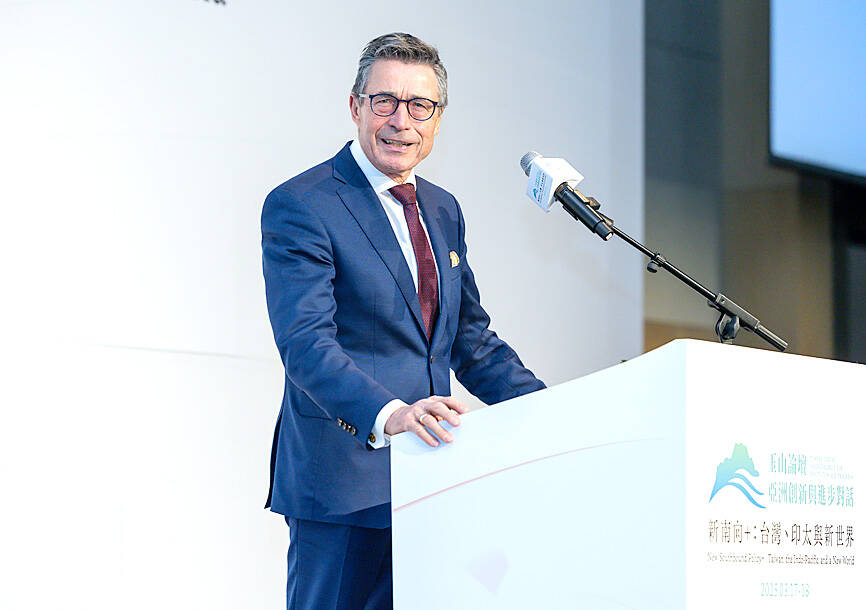
Photo: screen grab from the Presidential Office’s Flickr page
In the context of shifting global dynamics, he emphasized the importance of Indo-Pacific partners engaging in dialogue about the region’s future and reaffirmed Europe’s enduring commitment to Taiwan.
“[Chinese] President Xi [Jinping (習近平)] is watching Ukraine, and we must not send a signal by our collective weakness that aggression pays off for dictators,” Rasmussen said. “What happens in the Indo-Pacific matters very much for the freedom and security of all of Europe.”
Urging stronger political, economic and cultural ties between Taiwan and Europe, Rasmussen said that cooperation should not only be driven by short-term interests, but by “common values and a shared belief in each other’s freedom, democracy and prosperity.”
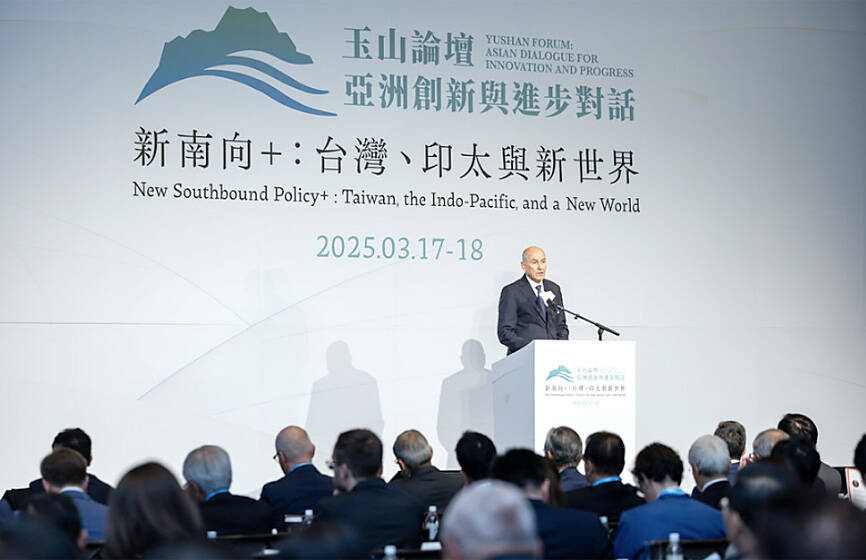
Photo: screen grab from the Presidential Office’s Flickr page
“In an increasingly aggressive and dangerous world, true friends need to stick together,” he said. “Democracies must work together to protect and promote freedom and democracy, and Taiwan belongs to our family of democracies.”
In a keynote address at a luncheon later yesterday, he urged Europe to forge closer relations with Taiwan on all fronts, particularly with the return of US President Donald Trump’s “America First” policy.
Europe must step up and pay the price needed to defend itself, meaning more defense spending, more investment in critical infrastructure and more focus on societal resilience, he said.
“In some ways, President Trump is doing us a favor. This kind of changed mindset has been needed in Europe for some time,” said the Danish politician, who also served as NATO secretary-general from August 2009 to October 2014.
Meanwhile, Jansa told the forum that the world has been changing at an accelerating pace in the past decade, driven by two key factors — technological advancements and the rising power of autocratic regimes.
“In many ways, unfortunately, we are witnessing the cold war of the 21st century unfold,” he said, adding that Europe is grappling with the devastating war in Ukraine.
While the EU is beginning to rearm, the process will take time, especially as Iran’s aggressive actions demand significant European resources in the Middle East, he said, adding that based on historical patterns and strategic logic, it can be predicted that the focus might soon shift to the Indo-Pacific region.
“Taiwan is increasingly becoming a crucial pillar of peace and stability, not only for the Indo-Pacific region, but the entire world,” Jansa said.
However, for decades, Taiwan’s hard-won freedom, democracy, prosperity and progress have been under attack, he said.
Values are not only threatened by brute force and invasion, but also through subversion and cultural warfare, including infiltration and acquisition of media, universities, cultural institutions and non-governmental organizations, he added.
“Autocratic regimes can exploit the freedom and openness of democracies, dividing them from within, through psychological warfare, and we must be fully aware of this danger,” he said.
Jansa cited how Taiwan’s economic power positions it as a key player in the democratic supply chains.
Democracies have many reasons to support Taiwan in defending its sovereignty, preserving its free and democratic way of life, and maintaining the “status quo” in the Taiwan Strait while opposing any attempts by China to annex it, Jansa said.
He added that freedom-loving people in the EU would always stand by democratic Taiwan and its 23 million citizens in their right to determine their own future.
Additional reporting by CNA
The Ministry of Transportation and Communications yesterday inaugurated the Danjiang Bridge across the Tamsui River in New Taipei City, saying that the structure would be an architectural icon and traffic artery for Taiwan. Feted as a major engineering achievement, the Danjiang Bridge is 920m long, 211m tall at the top of its pylon, and is the longest single-pylon asymmetric cable-stayed bridge in the world, the government’s Web site for the structure said. It was designed by late Iraqi-British architect Zaha Hadid. The structure, with a maximum deck of 70m, accommodates road and light rail traffic, and affords a 200m navigation channel for boats,
PRECISION STRIKES: The most significant reason to deploy HIMARS to outlying islands is to establish a ‘dead zone’ that the PLA would not dare enter, a source said A High Mobility Artillery Rocket System (HIMARS) would be deployed to Penghu County and Dongyin Island (東引) in Lienchiang County (Matsu) to force the Chinese military to retreat at least 100km from the coastline, a military source said yesterday. Taiwan has been procuring HIMARS and Army Tactical Missile Systems (ATACMS) from the US in batches. Once all batches have been delivered, Taiwan would possess 111 HIMARS units and 504 ATACMS, which have a range of 300km. Considering that “offense is the best defense,” the military plans to forward-deploy the systems to outlying islands such as Penghu and Dongyin so that
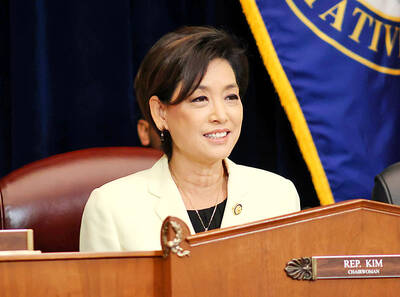
‘CLEAR MESSAGE’: The bill would set up an interagency ‘tiger team’ to review sanctions tools and other economic options to help deter any Chinese aggression toward Taiwan US Representative Young Kim has introduced a bill to deter Chinese aggression against Taiwan, calling for an interagency “tiger team” to preplan coordinated sanctions and economic measures in response to possible Chinese military or political action against Taiwan. “[Chinese President] Xi Jinping [習近平] has directed the People’s Liberation Army to be ready to invade Taiwan by 2027. China has a plan. America should have one too,” Kim said in a news release on Thursday last week. She introduced the “Deter PRC [People’s Republic of China] aggression against Taiwan act” to “ensure the US has a coordinated sanctions strategy ready should

TAIWAN ISSUE: US treasury secretary Scott Bessent said on the first day of meetings that ‘it wouldn’t be a US-China summit without the Taiwan issue coming up’ There were no surprises on the first day of the summit between US President Donald Trump and Chinese President Xi Jinping (習近平), the Mainland Affairs Council (MAC) said yesterday, as the government reiterated that cross-strait stability is crucial to the Asia-Pacific region, as well as the world. As the two presidents met for a highly anticipated summit yesterday, Chinese state media reported that Xi warned Trump that missteps regarding Taiwan could push their two countries into “conflict.” Trump arrived in China with accolades for his host, calling Xi a “great leader” and “friend,” and extending an invitation to visit the White House


 RSS
RSS