


Petitions to recall 32 Chinese Nationalist Party (KMT) lawmakers have advanced to the second stage after passing their first-phase review by the Central Election Commission (CEC).
On Tuesday last week, the CEC said that recall proposals for 19 KMT legislators, one city mayor and two city councilors had passed the first-stage threshold.
The 19 KMT lawmakers are: Wang Hung-wei (王鴻薇), Lee Yen-hsiu (李彥秀), Yeh Yuan-chih (葉元之), Niu Hsu-ting (牛煦庭), Tu Chuan-chi (涂權吉), Lu Ming-che (魯明哲), Wan Mei-ling (萬美玲), Lu Yu-ling (呂玉玲), Chiu Jo-hua (邱若華), Cheng Cheng-chien (鄭正鈐), Yu Hao (游顥), Yen Kuan-heng (顏寬恒), Liao Wei-hsiang (廖偉翔), Huang Chien-hao (黃健豪), Lo Ting-wei (羅廷瑋), Ting Hsueh-chung (丁學忠), Huang Chien-pin (黃建賓), Ma Wen-chun (馬文君) and Fu Kun-chi (傅崐萁).
Photo: Taipei Times
On Monday, another 13 KMT lawmakers were added to the list; namely, Lin Te-fu (林德福), Chang Chih-lun (張智倫), Yang Chiung-ying (楊瓊瓔), Hung Mong-kai (洪孟楷), Lo Ming-tsai (羅明才), Hsu Chiao-hsin (徐巧芯), Lai Shyh-bao (賴士葆), Liao Hsien-hsiang (廖先翔), Hsu Hsin-ying (徐欣瑩), Lin Szu-ming (林思銘), Johnny Chiang (江啟臣), Lo Chih-chiang (羅智強) and Hsieh Yi-feng (謝衣鳳).
The CEC last week also said that the recall proposals for nine Democratic Progressive Party (DPP) legislators did not meet the signature threshold, with the petitioners required to submit supplementary signatures within 10 days.
The nine are: Su Chiao-hui (蘇巧慧), Chang Hung-lu (張宏陸), Tsai Chi-chang (蔡其昌), Ho Hsin-chun (何欣純), Chen Kuan-ting (陳冠廷), Saidhai Tahovecahe, Lee Kuen-cheng (李坤城), Lee Chun-hsien (李俊憲) and Wang Ting-yu (王定宇).
The CEC on Monday said that three recall proposals against DPP legislators — namely Wu Pei-yi (吳沛憶), Rosalia Wu (吳思瑤) and Cheng Ying (陳瑩) — also did not pass the first-stage threshold, and required supplementary signatures for approval.
The Public Officials Election and Recall Act (公職人員選舉罷免法) stipulates that petitioners must present the valid signatures of at least 1 percent of the voters in the electoral district of the official being recalled in the first stage, and at least 10 percent of voters’ signatures in the second stage before a recall vote is held.
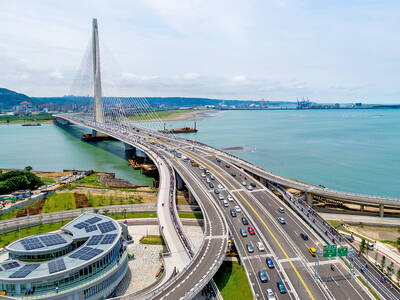
The Ministry of Transportation and Communications yesterday inaugurated the Danjiang Bridge across the Tamsui River in New Taipei City, saying that the structure would be an architectural icon and traffic artery for Taiwan. Feted as a major engineering achievement, the Danjiang Bridge is 920m long, 211m tall at the top of its pylon, and is the longest single-pylon asymmetric cable-stayed bridge in the world, the government’s Web site for the structure said. It was designed by late Iraqi-British architect Zaha Hadid. The structure, with a maximum deck of 70m, accommodates road and light rail traffic, and affords a 200m navigation channel for boats,
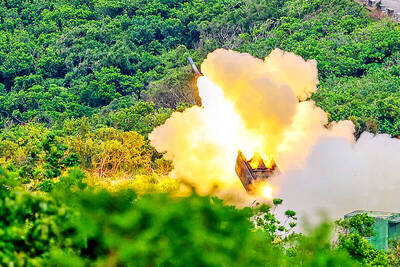
PRECISION STRIKES: The most significant reason to deploy HIMARS to outlying islands is to establish a ‘dead zone’ that the PLA would not dare enter, a source said A High Mobility Artillery Rocket System (HIMARS) would be deployed to Penghu County and Dongyin Island (東引) in Lienchiang County (Matsu) to force the Chinese military to retreat at least 100km from the coastline, a military source said yesterday. Taiwan has been procuring HIMARS and Army Tactical Missile Systems (ATACMS) from the US in batches. Once all batches have been delivered, Taiwan would possess 111 HIMARS units and 504 ATACMS, which have a range of 300km. Considering that “offense is the best defense,” the military plans to forward-deploy the systems to outlying islands such as Penghu and Dongyin so that
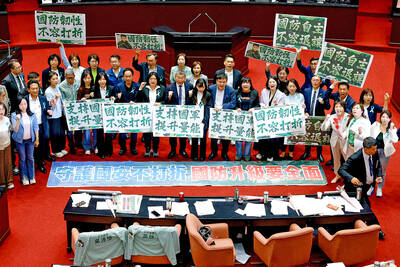
WHAT WAS ALL THAT FOR? Jaw Shaw-kong said that Cheng Li-wen had pushed for more drastic cuts and attacked him, just for the outcome to be nearly identical to his bill The legislature yesterday passed a supplementary budget bill to fund the purchase of separate packages of US military equipment, with the combined amount of spending capped at NT$780 billion (US$24.8 billion). The Chinese Nationalist Party (KMT) and Taiwan People’s Party (TPP) used their legislative majority to pass the bill, which runs until 2033 and has two main funding provisions. One was for NT$300 billion of arms sales already approved by the US for Taiwan on Dec. 17 last year, the other was for NT$480 billion for another arms package expected to be announced by Washington. The bill, which fell short of the NT$1.25
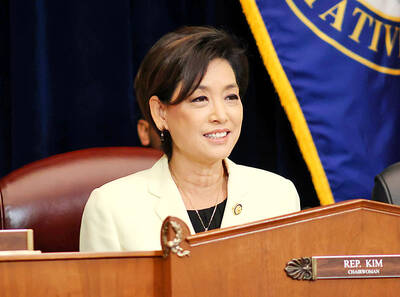
‘CLEAR MESSAGE’: The bill would set up an interagency ‘tiger team’ to review sanctions tools and other economic options to help deter any Chinese aggression toward Taiwan US Representative Young Kim has introduced a bill to deter Chinese aggression against Taiwan, calling for an interagency “tiger team” to preplan coordinated sanctions and economic measures in response to possible Chinese military or political action against Taiwan. “[Chinese President] Xi Jinping [習近平] has directed the People’s Liberation Army to be ready to invade Taiwan by 2027. China has a plan. America should have one too,” Kim said in a news release on Thursday last week. She introduced the “Deter PRC [People’s Republic of China] aggression against Taiwan act” to “ensure the US has a coordinated sanctions strategy ready should


 RSS
RSS