


A second wave of recall petitions against 12 more Chinese Nationalist Party (KMT) legislators were yesterday submitted to the Central Election Commission (CEC), bringing the total to 31.
Those in yesterday’s submission included Taipei KMT legislators Hsu Chiao-hsin (徐巧芯), Lo Chih-chiang (羅智強) and Lai Shyh-bao (賴士葆), as well as New Taipei City KMT legislators Hung Mong-kai (洪孟楷), Lo Ming-tsai (羅明才), Liao Hsien-hsiang (廖先翔), Chang Chih-lun (張智倫) and Lin Te-fu (林德福).
“This is our final stand in the battle to defend Taiwan’s democracy. If we fail, then Taiwan would be swallowed up by China,” United Microelectronics Corp founder Robert Tsao (曹興誠) said at a news conference outside the CEC in Taipei.
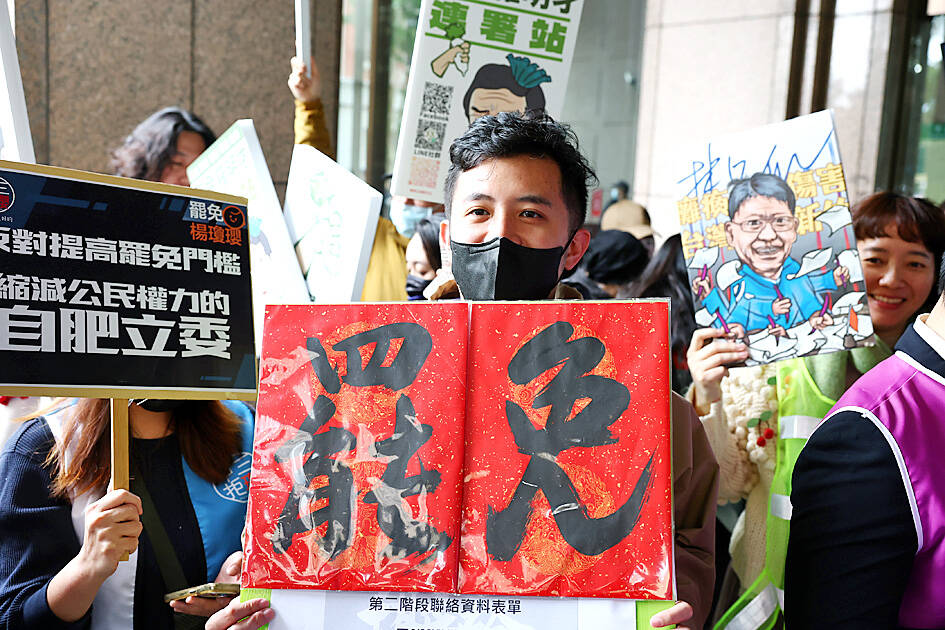
Photo: CNA
Tsao, spokesman for the Safeguard Taiwan, Anti-Communist Volunteers Alliance, is heading the recall movement.
This “big nationwide recall movement” is not about hatred against some legislators nor about helping the Democratic Progressive Party (DPP) to take back a majority in the legislature, he said.
“It is because people can see clearly KMT and Taiwan People’s Party lawmakers are taking instructions from KMT caucus whip Fu Kun-chi (傅?萁), who takes orders from Chinese government leaders in Beijing,” Tsao said.
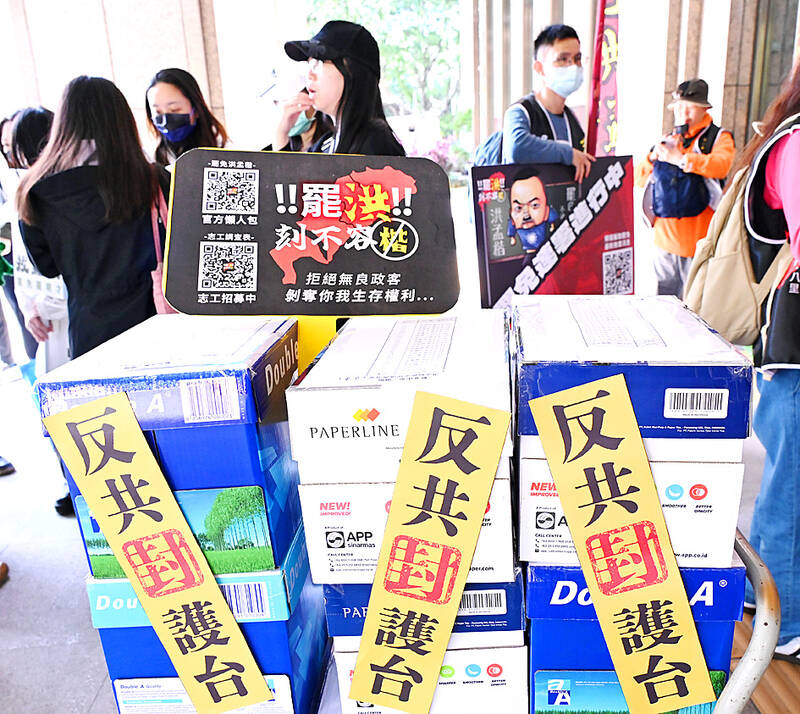
Photo: Chu Pei-hsiung, Taipei Times
The campaigners said that they had also garnered sufficient signatures in other constituencies and are planning to submit more petitions to the CEC later this week.
Meanwhile, the KMT has begun to retaliate, gathering recall signatures as it targets DPP legislators.
CEC officials said as of yesterday the CEC had received motions to recall 13 DPP lawmakers, including Taipei DPP legislators Rosalia Wu (吳思瑤) and Wu Pei-yi (吳沛憶), as well as New Taipei City DPP legislators Chang Hung-lu (張宏陸) and Su Chiao-hui (蘇巧慧), and Taichung DPP legislators Tsai Chi-chang (蔡其昌) and Ho Hsin-chun (何欣純).
The other DPP legislators facing recall votes are Huang Jie (黃捷) and Hsu Chih-chieh (許智傑) of Kaohsiung, Yilan Couty’s Chen Chun-yu (陳俊宇), and the two representing indigenous people, Chen Ying (陳瑩) and Saidhai Tahovecahe.
Separately, Hualien County Councilor Hu Jen-shun (胡仁順) of the DPP said he had requested an investigation and provided evidence to the Ministry of Justice’s Investigation about the alleged harassment of people who signed the petition to recall Fu by officials from the Hualien County Government.
The Hualien District Prosecutors’ Office yesterday said that it was investigating alleged visits to the home addresses of residents who signed the petition to recall Fu by officials from the Hualien County Household Registration Office.
Hu said that the Hualien County Government should not have access to the personal information of people participating in a recall effort as it is a contravention of the Public Officials Election and Recall Act (公職人員選舉罷免法).

A signaling system malfunction disrupted high-speed rail (HSR) services beginning at 8am today, with trains temporarily reduced to three northbound and three southbound trains per hour as authorities conduct inspections. The malfunction occurred on a section of track in Miaoli County during pre-operation checks early this morning, forcing northbound and southbound trains to use a single track, the HSR operator said. The regular schedule has been replaced with three hourly trains offering only nonreserved seating in each direction, stopping at every station, it said, adding that business class cars would still have reserved seating. Departures from terminal stations are scheduled at the top
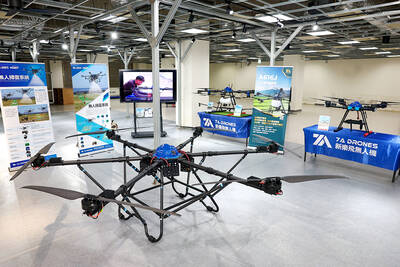
DRONE CENTRAL: Taiwan aims to become Asia’s democratic hub for drones, with most exports focused on high-quality military-grade models, an official said Taiwan’s drone industry is expected to expand significantly by 2030, producing 100,000 units per month and exporting half of them, the Ministry of Economic Affairs said yesterday. Current drone production capacity is about 15,000 units per month, but the industry can quickly scale up as demand increases, Industrial Development Administration Director-General Chiou Chyou-huey (邱求慧) told a news conference in Taipei. Taiwan’s drone output grew 2.5-fold last year to NT$12.9 billion (US$408.3 million) under a government program to develop the uncrewed vehicle sector, he said. The Executive Yuan in October last year approved plans to invest NT$44.2 billion into domestic production of uncrewed aerial

VERBOSE VESSELS: A CGA cutter and a China Coast Guard exchanged verbal barbs for more than a day in Taiwanese-controlled waters before the Chinese vessel left The Taiwanese and Chinese coast guards had a standoff near the strategically located Pratas Islands (Dongsha Islands, 東沙群島) in the north of the South China Sea, the Coast Guard Administration (CGA) said yesterday. The two sides engaged in intense radio exchanges over sovereignty claims during the 33-hour standoff. China Coast Guard vessel 3501 eventually left the restricted waters, 26.6 nautical miles (49.2km) west of the Pratas Islands, at 5pm yesterday, the CGA said. Lying approximately between southern Taiwan and Hong Kong, the Taiwan-controlled Pratas are seen by some security experts as vulnerable to Chinese attack due to their distance — more than
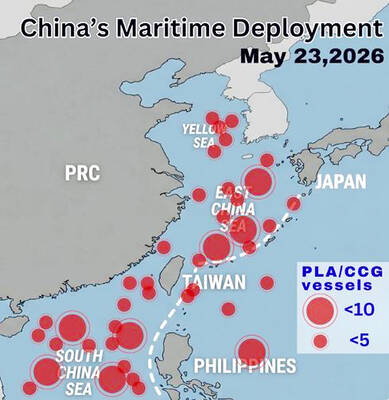
WARNING: China should stop engaging in actions that undermine regional peace and stability, as it would only build resentment among people across the Strait, the CGA said China has deployed more than 100 navy, coast guard and other vessels in waters from the Yellow Sea to the South China Sea and the western Pacific since US President Donald Trump and Chinese President Xi Jinping (習近平) met in Beijing, National Security Council Secretary-General Joseph Wu (吳釗燮) said yesterday. “In this part of the world, #China is the one & only PROBLEM wrecking the #StatusQuo & threatening regional peace & stability,” Wu wrote on X. In a separate post, he said Beijing was coercing Taiwan’s maritime domain, calling it illegal and provocative, after the Coast Guard Administration (CGA) expelled a


 RSS
RSS