


Proposed cuts to the Ministry of Health and Welfare’s (MOHW) budget might hinder disease prevention and health promotion efforts, nine medical workers’ associations said yesterday, urging legislators to consider the public’s health.
“The Legislative Yuan has reviewed the central government’s 2025 general budget and decided to cut the health ministry’s advertising budget by 60 percent and freeze its operating budget by 70 percent. That will severely weaken public health effectiveness and have a negative effect on society’s health and well-being,” they said in a joint statement.
The ministry’s advertising budget is not for normal publicity purposes, but is to increase public awareness and knowledge about diseases, so cutting the budget would affect health promotion campaigns, such as for vaccination and healthy eating, it said.
Photo: Tyrone Siu, Reuters
The statement said that if people have an insufficient understanding of the government’s public health policies, it would significantly impair their effectiveness, adding that if a disease outbreak occurred and information about it could not be disseminated, disease prevention efforts would be hindered, causing the disease to spread.
Freezing the ministry’s operating budget would affect people’s mental health resilience, cancer screening, nursing personnel preparedness, the second phase of the Improving Children’s Health Care program, epidemic prevention preparedness, chronic disease prevention improvements and other programs, it said.
“We urge legislators to re-examine the budget with wisdom, allowing the important budgets for public health to be passed,” it said, adding that “health is without distinction among parties,” so the parties should together demonstrate their determination to protect Taiwanese health.
The nine associations are the medical associations of Taipei, New Taipei City, Keelung, Taoyuan and Yilan County, as well as the Taiwan Association of Family Medicine, the ROC Primary Care Association, the Taiwan Medical Clinics Association and the Taiwan General Medical Practitioners Association.
Meanwhile, Centers for Disease Control (CDC) Deputy Director-General Philip Lo (羅一鈞) on Saturday said the legislature on Friday last week passed motions to cut several budgets across all agencies, including 80 percent of travel expenses to China.
The CDC proposed a NT$34,000 (US$1,033) budget for sending experts to China for inspection in case a disease outbreak occurs, he said.
The travel expense was used five years ago when two experts visited Wuhan, China, to bring back first-hand information about the COVID-19 outbreak there before the WHO declared it a pandemic, he said.
This allowed Taiwan to learn that the virus could be transmitted from person to person earlier than the WHO, which enhanced prevention measures, he said.
The budget is cut to NT$6,800 this year, which would not even be enough for the plane tickets, Lo said.
Chinese Nationalist Party (KMT) Legislator Wang Hung-wei (王鴻薇) yesterday called Lo’s remark “misleading,” as a special budget had been allocated for fighting COVID-19.
In response, Lo yesterday said that the NT$60 billion COVID-19 Prevention, Relief and Recovery special budget was passed on March 13, 2020, but the two experts were sent to Wuhan on Jan. 12, 2020, adding that many operations in the two months before the special act was passed were funded by the health ministry and the CDC’s annual budget.
Separately, regarding cutting the budget for traffic safety promotion, the Jing Chuan Child Safety Foundation yesterday said there is no turning back on “traffic safety reform,” adding that the KMT and Taiwan People’s Party (TPP) should substantively re-examine the budgets, instead of blindly cutting them across all agencies.
Foundation executive director Hsu Ya-jen (許雅荏) said that 70 percent of pedestrian-related traffic incidents involving children last year were caused by vehicles failing to yield to pedestrians.
She said that effective law enforcement, improvements to road intersection design and pedestrian crossing lighting, widening of sidewalks near schools and traffic safety awareness promotion are all important.
The “three E’s” of traffic safety — education, enforcement and engineering — are all important, she said, adding that several KMT and TPP lawmakers have expressed support for improving the three Es, but they are proposing to cut about NT$130 million from the Ministry of Transportation and Communications (MOTC) budget for promoting the “give way to pedestrians” and “revising responding traffic laws” campaigns.
They are wiping out the communication channels from which people receive new traffic safety education, and the MOTC would not be able to promote it through adaptive and diversified methods, she said, adding that people’s safety awareness would be postponed indefinitely.
Meanwhile, unsatisfied with the delayed enactment of the Spatial Planning Act (國土計畫法), the TPP has proposed to cut or freeze the National Land Management Agency’s NT$4.15 billion budget by 10 percent, while other legislators have proposed cuts of NT$124 million from the budget for promoting housing policies and projects.
The agency said that cutting the budget might affect the government’s rent subsidy and policies for reducing the rent burden for disadvantaged groups, while freezing it might affect the schedule for providing the funding.
An estimated 750,000 households would receive rent subsidies this year, but if the budget freeze is not removed in time, the number of households that receive the subsidy would be reduced, it said.
The opposition parties have also proposed to cut the National Police Agency’s budget by more than NT$113 million and freeze its budget by more than NT$3 billion.
The police agency yesterday said that cutting or freezing its budget would have a negative effect on its ability to maintain public security.
Budget cuts would leave insufficient funding for public security operations, and if the budget freeze is not removed in time, crime could increase.
During the period when funding is frozen, incidents of drug trafficking and scamming might increase significantly, threatening people’s personal safety and property, as well as causing the public to lose trust in the police’s ability to enforce the law and preserve public security, it said.
Separately, in response to the Legislative Yuan passing a 15 percent cut to the Sports Administration’s budget, the sports lottery dealers association yesterday said that “sports should not be sacrificed in a partisan catfight.”
Assocation chairperson Ho Yu-chi (何昱奇) said the Sports Administration’s budget only accounts for less than 0.3 percent of the central government’s total budget, adding that the cuts might affect the resources available to fund athletes.
The Poultry Association of the Republic of China on Saturday criticized the legislature’s plan to cut or freeze much of the Ministry of Agriculture’s budget, saying it would damage the poultry industry’s rights and development.
The Ministry of Finance also said that the legislature’s planned budget cut or freeze would affect people’s chances of winning the uniform invoice lottery.
Its Taxation Administration’s “commission fee” is used for funding the lottery, which is a non-statutory expenditure, so cutting the budget by NT$1.845 billion would “affect people’s small happiness” of winning the lottery, it said.
If the budget is used to fund the additional NT$500 e-invoice exclusive lottery prize, there would be an estimated additional 6.5 million chances to win the NT$500 prize this year, but if the budget is cut, there could only be about 2.9 million chances to win the prize, it said.
Additional reporting by Rachel Lin, Kao Chia-he, Yao Yue-Hung, Su Meng-chuan, Cheng Chi-fang, Wu Po-Hsuan, and CNA
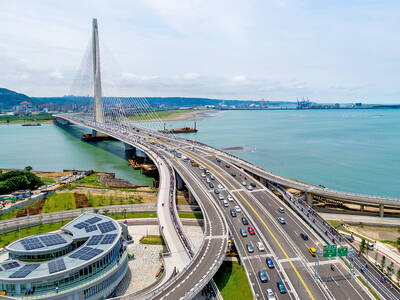
The Ministry of Transportation and Communications yesterday inaugurated the Danjiang Bridge across the Tamsui River in New Taipei City, saying that the structure would be an architectural icon and traffic artery for Taiwan. Feted as a major engineering achievement, the Danjiang Bridge is 920m long, 211m tall at the top of its pylon, and is the longest single-pylon asymmetric cable-stayed bridge in the world, the government’s Web site for the structure said. It was designed by late Iraqi-British architect Zaha Hadid. The structure, with a maximum deck of 70m, accommodates road and light rail traffic, and affords a 200m navigation channel for boats,
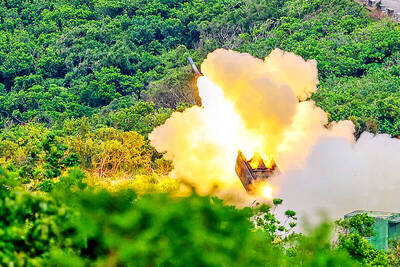
PRECISION STRIKES: The most significant reason to deploy HIMARS to outlying islands is to establish a ‘dead zone’ that the PLA would not dare enter, a source said A High Mobility Artillery Rocket System (HIMARS) would be deployed to Penghu County and Dongyin Island (東引) in Lienchiang County (Matsu) to force the Chinese military to retreat at least 100km from the coastline, a military source said yesterday. Taiwan has been procuring HIMARS and Army Tactical Missile Systems (ATACMS) from the US in batches. Once all batches have been delivered, Taiwan would possess 111 HIMARS units and 504 ATACMS, which have a range of 300km. Considering that “offense is the best defense,” the military plans to forward-deploy the systems to outlying islands such as Penghu and Dongyin so that
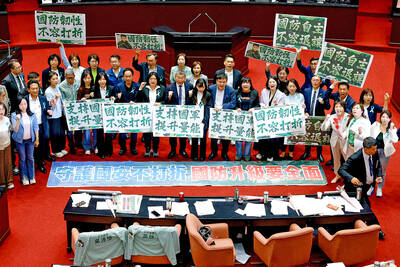
WHAT WAS ALL THAT FOR? Jaw Shaw-kong said that Cheng Li-wen had pushed for more drastic cuts and attacked him, just for the outcome to be nearly identical to his bill The legislature yesterday passed a supplementary budget bill to fund the purchase of separate packages of US military equipment, with the combined amount of spending capped at NT$780 billion (US$24.8 billion). The Chinese Nationalist Party (KMT) and Taiwan People’s Party (TPP) used their legislative majority to pass the bill, which runs until 2033 and has two main funding provisions. One was for NT$300 billion of arms sales already approved by the US for Taiwan on Dec. 17 last year, the other was for NT$480 billion for another arms package expected to be announced by Washington. The bill, which fell short of the NT$1.25
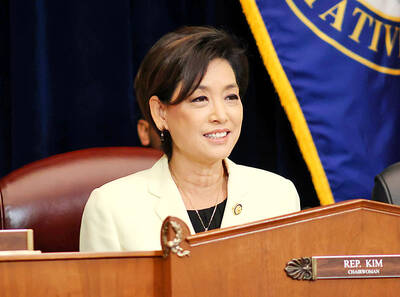
‘CLEAR MESSAGE’: The bill would set up an interagency ‘tiger team’ to review sanctions tools and other economic options to help deter any Chinese aggression toward Taiwan US Representative Young Kim has introduced a bill to deter Chinese aggression against Taiwan, calling for an interagency “tiger team” to preplan coordinated sanctions and economic measures in response to possible Chinese military or political action against Taiwan. “[Chinese President] Xi Jinping [習近平] has directed the People’s Liberation Army to be ready to invade Taiwan by 2027. China has a plan. America should have one too,” Kim said in a news release on Thursday last week. She introduced the “Deter PRC [People’s Republic of China] aggression against Taiwan act” to “ensure the US has a coordinated sanctions strategy ready should


 RSS
RSS