


North Korea yesterday fired a missile as US Secretary of State Antony Blinken visited South Korea, where he warned that Pyongyang was working ever more closely with Russia on advanced space technology.
Blinken’s trip came as investigators were trying to arrest South Korean President Yoon Suk-yeol, who has entrenched himself in his residence after being impeached for a failed attempt to impose martial law.
Blinken, who had planned to encourage South Korea to maintain Yoon’s policy of enhancing cooperation with Japan, was in talks in Seoul when North Korea fired a ballistic missile that fell into the sea.
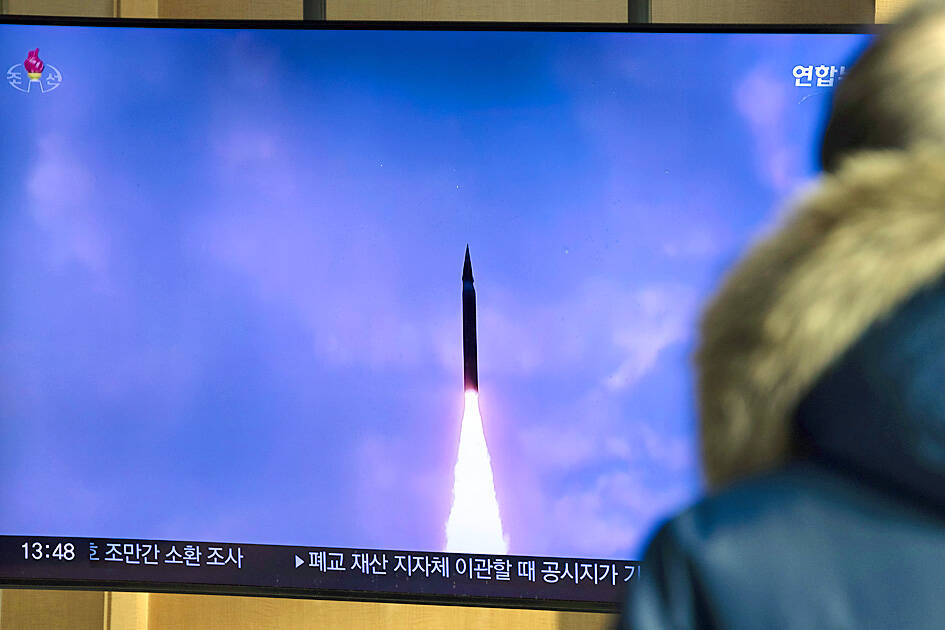
Photo: EPA-EFE
The missile flew about 1,100km, the South Korean military said.
“Today’s launch is just a reminder to all of us of how important our collaborative work is,” Blinken said, pointing to increased three-way exercises and intelligence-sharing on North Korea.
Blinken and South Korean Minister of Foreign Affairs Cho Tae-yul condemned the launch at a joint news conference, where the outgoing US top diplomat warned that Russia was stepping up support for North Korea as a reward for its help fighting Ukraine.
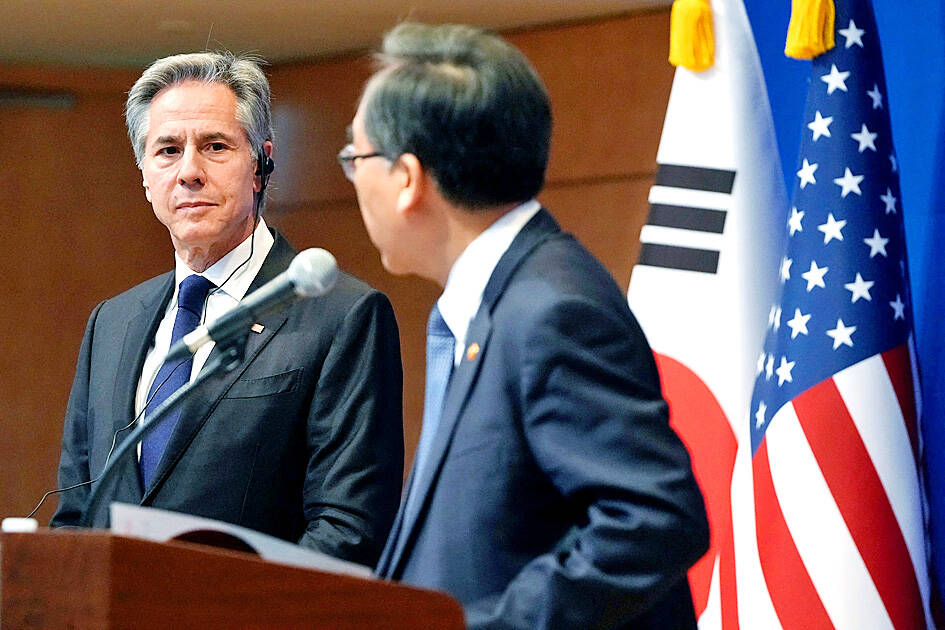
Photo: AFP
North Korea “is already receiving Russian military equipment and training. Now we have reason to believe that Moscow intends to share advanced space and satellite technology with Pyongyang,” Blinken said.
He also renewed concern that Russia, a veto-wielding UN Security Council member, would formally accept North Korea as a nuclear state, which would be a major blow to the global consensus that Pyongyang must end its program.
US and South Korean intelligence believe that North Korea late last year sent thousands of troops to fight against Ukraine and has already suffered hundreds of casualties.
In Tokyo, where Blinken was later to visit, Japanese Prime Minister Shigeru Ishiba voiced alarm that North Korea’s “technology has been improving.”
Blinken, whose hotel was within earshot of rowdy protests by supporters and opponents of Yoon, steered clear of taking sides in the bitterly divided country.
He repeated Washington’s concern over Yoon’s brief imposition of martial law on Dec. 3 last year and saluted the “democratic resilience” of South Korea, without commenting on attempts to arrest the president.
A Chinese aircraft carrier group entered Japan’s economic waters over the weekend, before exiting to conduct drills involving fighter jets, the Japanese Ministry of Defense said yesterday. The Liaoning aircraft carrier, two missile destroyers and one fast combat supply ship sailed about 300km southwest of Japan’s easternmost island of Minamitori on Saturday, a ministry statement said. It was the first time a Chinese aircraft carrier had entered that part of Japan’s exclusive economic zone (EEZ), a ministry spokesman said. “We think the Chinese military is trying to improve its operational capability and ability to conduct operations in distant areas,” the spokesman said. China’s growing
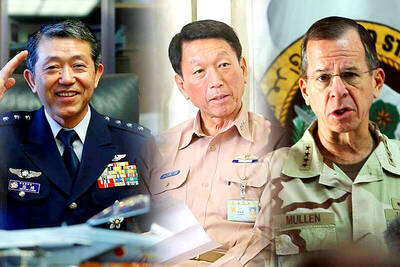
Nine retired generals from Taiwan, Japan and the US have been invited to participate in a tabletop exercise hosted by the Taipei School of Economics and Political Science Foundation tomorrow and Wednesday that simulates a potential Chinese invasion of Taiwan in 2030, the foundation said yesterday. The five retired Taiwanese generals would include retired admiral Lee Hsi-min (李喜明), joined by retired US Navy admiral Michael Mullen and former chief of staff of the Japan Self-Defense Forces general Shigeru Iwasaki, it said. The simulation aims to offer strategic insights into regional security and peace in the Taiwan Strait, it added. Foundation chair Huang Huang-hsiung

PUBLIC WARNING: The two students had been tricked into going to Hong Kong for a ‘high-paying’ job, which sent them to a scam center in Cambodia Police warned the public not to trust job advertisements touting high pay abroad following the return of two college students over the weekend who had been trafficked and forced to work at a cyberscam center in Cambodia. The two victims, surnamed Lee (李), 18, and Lin (林), 19, were interviewed by police after landing in Taiwan on Saturday. Taichung’s Chingshui Police Precinct said in a statement yesterday that the two students are good friends, and Lin had suspended her studies after seeing the ad promising good pay to work in Hong Kong. Lee’s grandfather on Thursday reported to police that Lee had sent
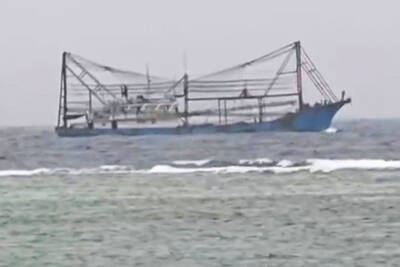
A Chinese ship ran aground in stormy weather in shallow waters off a Philippines-controlled island in the disputed South China Sea, prompting Filipino forces to go on alert, Philippine military officials said yesterday. When Philippine forces assessed that the Chinese fishing vessel appeared to have run aground in the shallows east of Thitu Island (Jhongye Island, 中業島) on Saturday due to bad weather, Philippine military and coast guard personnel deployed to provide help, but later saw that the ship had been extricated, Philippine navy regional spokesperson Ellaine Rose Collado said. No other details were immediately available, including if there were injuries among


 RSS
RSS