

The US’ National Defense Authorization Act (NDAA) enhances US support for Taiwan and counters China’s misrepresentation of UN Resolution 2758, the Formosan Association for Public Affairs (FAPA) said in a statement on Tuesday.
The Washington-based Taiwanese nonprofit promotes cooperation between Taiwan and the US.
US President Joe Biden on Monday signed the NDAA for the 2025 fiscal year into law. The bill authorized US$895 billion for the US Department of Defense, including up to US$300 million for measures that promote Taiwan-US security cooperation and enhance Taiwan’s defense capabilities.
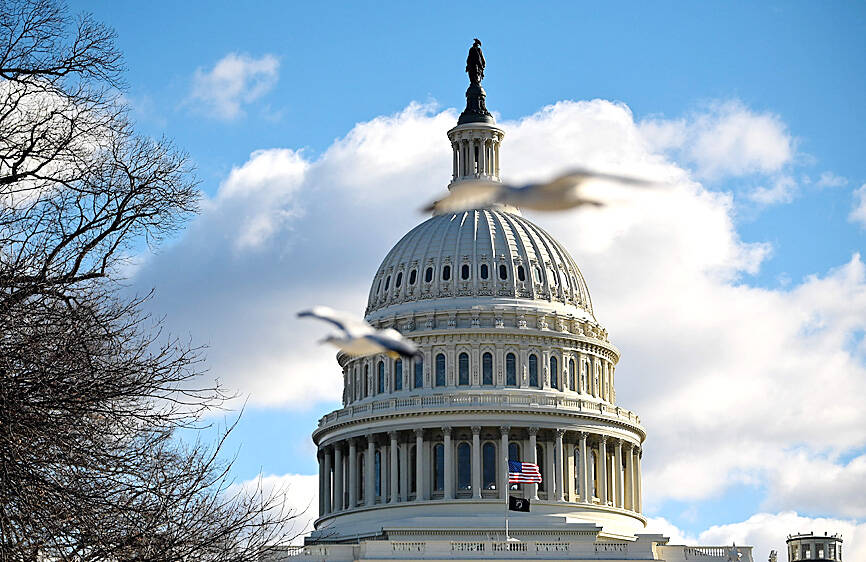
Photo: AFP
Among the NDAA provisions favorable to Taiwan was the Building Options for the Lasting Security of Taiwan through European Resolve Act, aimed at enhancing US-Europe cooperation to bolster Taiwan’s security and international presence, the FAPA said.
The bill also encourages the US and Europe to stress the differences between their “one China” policies and that of Beijing’s “one China principle,” and refute Beijing’s claims that UN Resolution 2758 recognizes its territorial claims over Taiwan, the group said.
It applauded the “critical legislation to counter the People’s Republic of China’s (PRC) groundless territorial claims over Taiwan, and ensure Taiwan’s continued freedom and independence amid China’s increasing aggression toward Taiwan,” the statement said.
The “FAPA strongly urges the incoming [US president-elect] Donald Trump administration to prioritize and intensify efforts to combat the PRC’s baseless territorial claims and its escalating aggression toward Taiwan,” FAPA president Kao Su-mei (林素梅) said in the statement.
However, the NDAA’s provisions only authorize Pentagon programs, but the actual funding has to be covered in a separate spending bill for the fiscal year ending in September next year, Reuters reported, indicating that funding for all of the measures is not guaranteed.
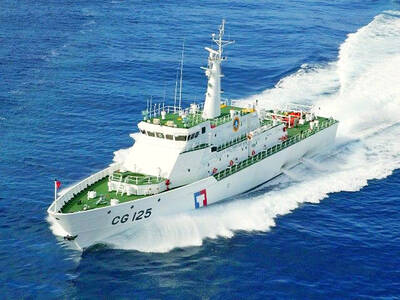
GEOPOLITICAL SIGNIFICANCE: The CGA’s nonmilitary role makes it a tool to avert diplomatic issues, an official said, while confirming the donation of a ship to Manila Coast Guard Administration (CGA) ships are scheduled to sail to the Philippines bearing the words “Taiwan Coast Guard” in a high-profile visit in October next year, the first such visit by a Taiwanese maritime law enforcement vessel to the Southeast Asian nation, the agency said yesterday. The CGA also confirmed that it had donated one of its decommissioned patrol vessels to the Philippines in a rare transfer of a retired ship to a nondiplomatic ally. The Republic of China (ROC) Navy last made such a visit in 1974, shortly before the Philippines switched diplomatic recognition to the People’s Republic of China in

SOFT TENNIS: Yu Kai-wen and Huang Shih-yuan narrowly defeated their Japanese rivals to capture Taiwan’s first gold at the Asian Games in Nagoya Yu Kai-wen (余凱文) and Huang Shih-yuan (黃詩媛) won Taiwan’s first gold of this year’s Asian Games, defeating a Japanese duo in a nail-biter in the soft tennis mixed doubles final in Nagoya, Japan, while Johnny Sun (孫家閎) won silver in wushu and Shih Cheng-chung (石政中) won bronze in men’s kumite. Yu and Huang narrowly defeated Japan’s Toshiki Uematsu and Rena Temma 5-4 (2-4, 5-3, 4-2, 1-4, 1-4, 4-0, 1-4, 4-1, 7-5) to give Taiwan its first gold in soft tennis mixed doubles at an Asian Games since 2018. Sun secured Taiwan’s first wushu medal at this year’s game, with a combined score

CALL FOR CHANGE: They urged the UN to facilitate Taiwan’s involvement in the body, recognize its peace efforts and to work with members in preventing military conflict Representatives to the UN from five of Taiwan’s diplomatic allies sent a joint letter to UN Secretary-General Antonio Guterres on Friday, calling for the country’s inclusion in the body. Allies in the letter sent ahead of the 81st session of the UN General Assembly General Debate made three demands in support of Taiwan: inclusion, recognition and camaraderie. They implored the UN to seek an appropriate way to facilitate Taiwan’s meaningful involvement in the world governing body, saying that UN Resolution 2758, which accepted the People’s Republic of China (PRC) as a member of the UN, does not exclude Taiwan. Beijing claims that the

‘GLOBAL WARNING’: The infiltration is not just a local problem, as Beijing has been deploying the same tactics worldwide against Western democracies, a report said Between 50,000 and 100,000 Chinese spies are operating in Taiwan, far more than the National Security Bureau’s previous estimate of 5,000, German journalist and author Jurgen Kremb said on Monday. Kremb presented his research, titled “The War of Spies: How China’s Intelligence Services Are Infiltrating Taiwan — and What Europe Must Learn from It,” at a joint event held by the Taiwan offices of the Friedrich Naumann Foundation and the European Values Center for Security Policy. The report was published in June in the Ministry of Justice Investigation Bureau’s Prospect & Exploration Monthly (展望與探索月刊). By spies, he said he was referring to informants,


 RSS
RSS