


Hamas and two other Palestinian militant groups on Saturday said that a Gaza ceasefire deal with Israel is “closer than ever,” provided Israel does not impose new conditions.
Last week, indirect negotiations between Israel and Hamas mediated by Qatar, Egypt, and the US were held in Doha, rekindling hope of an agreement.
“The possibility of reaching an agreement [for a ceasefire and prisoner exchange deal] is closer than ever, provided the enemy stops imposing new conditions,” Hamas, Islamic Jihad and the leftist Popular Front for the Liberation of Palestine said in a rare joint statement issued after talks in Cairo on Friday.

Photo: Reuters
A Hamas leader on Saturday said that talks had made “significant and important progress” over the past few days.
“Most points related to the ceasefire and prisoner exchange issues have been agreed upon,” he said on condition of anonymity as he was not authorized to speak publicly on the issue.
“Some unresolved points remain, but they do not hinder the process. The agreement could be finalized before the end of this year, provided it is not disrupted by [Israeli Prime Minister Benjamin] Netanyahu’s new conditions,” he said.
He said that if an agreement is reached, it would be implemented in phases, ending with “a serious prisoner exchange deal, a permanent ceasefire and a complete withdrawal [of Israeli forces] from Gaza.”
On Wednesday last week, US Secretary of State Antony Blinken said he was “hopeful” for a deal, but avoided making any predictions as to when it would actually materialize.
“I don’t want to hazard a guess as to what the probability is,” he said at the Council on Foreign Relations.
“It should happen. It needs to happen. We need to get people home,” he said, referring to the release of hostages under a ceasefire deal.
Palestinian militants led by Hamas abducted 251 hostages during their attack on Israel on Oct. 7 last year. Of those, 96 are still held in Gaza, including 36 the Israeli military says are dead.
Efforts to strike a truce and hostage release deal have repeatedly failed over key stumbling blocks.
Despite numerous rounds of indirect talks, Israel and Hamas have agreed to just one truce, which lasted for a week at the end of last year.
Negotiations have faced multiple challenges since then, with the primary point of contention being the establishment of a lasting ceasefire.
Netanyahu has repeatedly stated that he does not want to withdraw Israeli troops from the Philadelphi Corridor, a strip of land cleared and controlled by Israel along Gaza’s border with Egypt.
Another unresolved issue is the governance of post-war Gaza.
Israel has said repeatedly that it would not allow Hamas to run the territory ever again.
EUROPEAN TARGETS: The planned Munich center would support TSMC’s European customers to design high-performance, energy-efficient chips, an executive said Taiwan Semiconductor Manufacturing Co (TSMC, 台積電), the world’s largest contract chipmaker, yesterday said that it plans to launch a new research-and-development (R&D) center in Munich, Germany, next quarter to assist customers with chip design. TSMC Europe president Paul de Bot made the announcement during a technology symposium in Amsterdam on Tuesday, the chipmaker said. The new Munich center would be the firm’s first chip designing center in Europe, it said. The chipmaker has set up a major R&D center at its base of operations in Hsinchu and plans to create a new one in the US to provide services for major US customers,
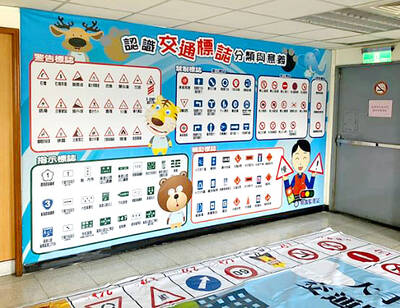
The Ministry of Transportation and Communications yesterday said that it would redesign the written portion of the driver’s license exam to make it more rigorous. “We hope that the exam can assess drivers’ understanding of traffic rules, particularly those who take the driver’s license test for the first time. In the past, drivers only needed to cram a book of test questions to pass the written exam,” Minister of Transportation and Communications Chen Shih-kai (陳世凱) told a news conference at the Taoyuan Motor Vehicle Office. “In the future, they would not be able to pass the test unless they study traffic regulations

GAINING STEAM: The scheme initially failed to gather much attention, with only 188 cards issued in its first year, but gained popularity amid the COVID-19 pandemic Applications for the Employment Gold Card have increased in the past few years, with the card having been issued to a total of 13,191 people from 101 countries since its introduction in 2018, the National Development Council (NDC) said yesterday. Those who have received the card have included celebrities, such as former NBA star Dwight Howard and Australian-South Korean cheerleader Dahye Lee, the NDC said. The four-in-one Employment Gold Card combines a work permit, resident visa, Alien Resident Certificate (ARC) and re-entry permit. It was first introduced in February 2018 through the Act Governing Recruitment and Employment of Foreign Professionals (外國專業人才延攬及雇用法),

‘A SURVIVAL QUESTION’: US officials have been urging the opposition KMT and TPP not to block defense spending, especially the special defense budget, an official said The US plans to ramp up weapons sales to Taiwan to a level exceeding US President Donald Trump’s first term as part of an effort to deter China as it intensifies military pressure on the nation, two US officials said on condition of anonymity. If US arms sales do accelerate, it could ease worries about the extent of Trump’s commitment to Taiwan. It would also add new friction to the tense US-China relationship. The officials said they expect US approvals for weapons sales to Taiwan over the next four years to surpass those in Trump’s first term, with one of them saying


 RSS
RSS