


The US Congress averted a Christmastime government shutdown early yesterday after weeks of tense negotiations that went down to the wire, passing a bill to fund federal agencies through mid-March.
With the midnight deadline already expired by minutes, senators dropped normal procedure to fast-track the package to a vote, halting government shutdown preparations and saving Christmas for more than 800,000 workers at risk of being sent home without pay.
“It’s good news that the bipartisan approach in the end prevailed... It’s a good outcome for America and the American people,” US Senate Democratic Majority Leader Chuck Schumer said in a speech on the Senate floor.
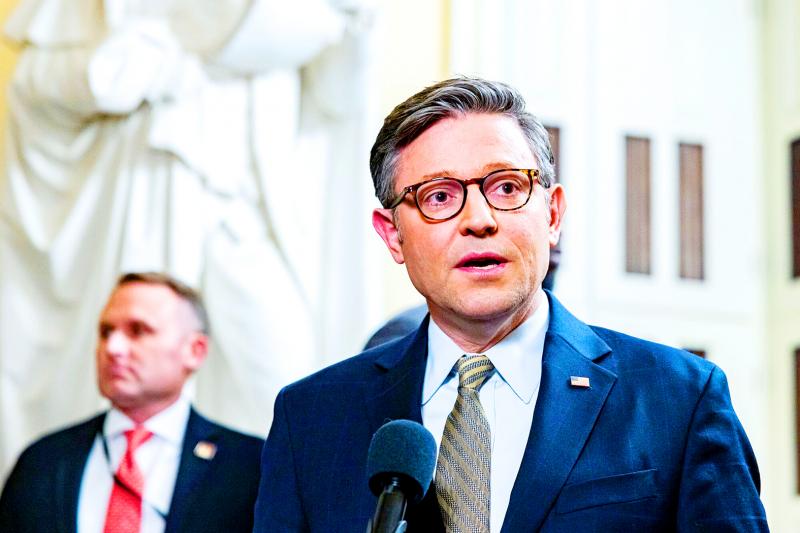
Photo: Bloomberg
The Democrats run the Senate, so there was never much doubt that the funding package would get a rubber stamp after the party was crucial in helping the Republican majority in the House of Representatives pass the bill earlier in the day.
However, with senators often dragging their feet over complex legislation, there were fears that the funding fight might spill into next week.
That would have meant non-essential operations winding up, with up to 875,000 workers furloughed and as many as 1.4 million more required to work without pay.
Congress’s setting of government budgets is always a fraught task, with both chambers closely divided between Republicans and Democrats.
US president-elect Donald Trump and tech billionaire Elon Musk, his incoming “efficiency czar,” created much of the drama this time around by pressuring Republicans in an 11th hour intervention to renege on a funding bill they had painstakingly agreed with Democrats.
Two subsequent efforts to find compromise fell short, leaving Republican US House of Representatives Speaker Mike Johnson at the last chance saloon as he spent much of Friday huddling with aides to find a way to keep government agencies running.
If the funding bill had failed, non-essential government functions would have been put on ice. Employees in key services such as law enforcement would have continued working, but would only have been paid once government funding had resumed.
Many parks, monuments and national sites would have closed at a time when millions of visitors are expected.
Lawmakers avoided all that holiday-season pain by funding the government until March 14 next year in a package that includes US$110 billion in disaster aid and financial relief for farmers.
It is essentially the same as a bill that failed miserably in a vote Thursday — except without a two-year suspension of the country’s self-imposed borrowing limit demanded by Trump.
The influence of Musk, the world’s richest man, over the Republicans — and his apparent sway with Trump — has become a focus for Democratic attack, with questions raised over how an unelected citizen can wield so much power.
There is growing anger even among Republicans over Musk’s interference after he trashed the original funding agreement in a blizzard of posts — many of them wildly inaccurate — on his social media platform X.

A subsidiary of a Hong Kong-based company that has lost control of two critical ports on the Panama Canal said it is seeking US$2 billion of compensation in damages from Panama over its “illegal” takeover of the ports. Panama Ports Co, a unit of Hong Kong’s CK Hutchison Holdings (長江和記實業), on Friday said in a statement that it is demanding the sum under international arbitration proceedings that it had already started. The Panamanian government last week seized control of the Balboa and Cristobal ports on each end of the Panama Canal, after the country’s Supreme Court declared earlier that a concession allowing
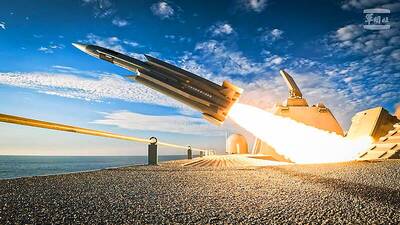
DETERRENCE: With 1,000 indigenous Hsiung Feng II and III missiles and 400 Harpoon missiles, the nation would boast the highest anti-ship missile density in the world With Taiwan wrapping up mass production of Hsiung Feng II and III missiles by December and an influx of Harpoon missiles from the US, Taiwan would have the highest density of anti-ship missiles in the world, a source said yesterday. Taiwan is to wrap up mass production of the indigenous anti-ship missiles by the end of year, as the Chungshan Institute of Science and Technology has been meeting production targets ahead of schedule, a defense official with knowledge of the matter said. Combined with the 400 Harpoon anti-ship missiles Taiwan expects to receive from the US by 2028, the nation would have

POSSIBILITIES EMERGE: With Taiwan’s victory and Japan’s narrow win over Australia, Taiwan now have a chance to advance if South Korea also beat the Aussies Taiwan has high hopes that the national baseball team would advance to the World Baseball Classic (WBC) quarter-finals after clinching a crucial 5-4 victory over South Korea in a nail-biting extra-inning game at the Tokyo Dome yesterday. Boosted by three home runs — two solo shots by Yu Chang (張育成) and Cheng Tsung-che (鄭宗哲) and a two-run homer by Stuart Fairchild — the triumph gave Taiwan a much-needed second victory in the five-team Pool C, where only the top two finishers would advance to the knockout stage in Miami, Florida. Entering extra innings with the game tied at four apiece, Taiwan scored

MISSION OF PEACE: The foreign minister urged Beijing to respect Taiwan’s existence as an independent nation, and work together to ensure peace and stability in the region Minister of Foreign Affairs Lin Chia-lung (林佳龍) yesterday rejected Chinese Minister of Foreign Affairs Wang Yi’s (王毅) comments about Taiwan, criticizing China as a “troublemaker” in the international community and a disruptor of cross-strait peace. Speaking at a news conference on the sidelines of the Chinese National People’s Congress, Wang said that Taiwan has always been a territory of China and that it would be impossible for it to become its own country. The “return” of Taiwan to China was the natural outcome of the Chinese people’s resistance against Japan in World War II, and that any pursuit of independence was “doomed


 RSS
RSS