


The US House of Representatives on Thursday overwhelmingly rejected a Republican-led funding bill aimed at averting a government shutdown, with federal agencies due to run out of cash on yesterday evening and cease operations starting this weekend.
The contentious legislation would have kept the government open through mid-March and suspended the country’s borrowing limit for US president-elect Donald Trump’s first two years in office.
However, dozens of debt hawks in the Republican ranks — unhappy about allowing the national debt to rise unchecked for half of Trump’s term — rebelled against their own leadership to sink the package.
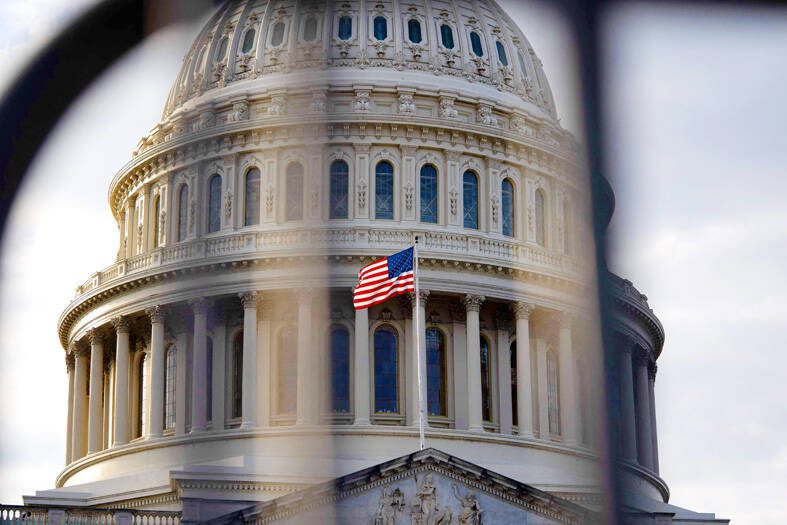
Photo: AFP
It marked a defeat for the Republican leader, who with tech billionaire Elon Musk — his incoming “efficiency czar” — had thrown his weight behind the plan.
With party leaders announcing no further votes in the House on Thursday, the race to keep the lights on and prevent 875,000 non-essential workers being sent home over Christmas without pay is set to go down to the wire.
“We will regroup and we will come up with another solution, so stay tuned,” Republican US House of Representatives Speaker Mike Johnson — who led the negotiations — told reporters.
The bill was supposed to fix a mammoth bipartisan package that Trump and Musk sabotaged on Wednesday amid conservatives’ complaints about unrelated items in the text ballooning its overall cost.
The retooled version was considered under a fast-track method that required two-thirds support, but Democrats refused to help Republicans overcome their rank-and-file rebels and it failed to win even a straightforward majority.
“The... proposal is not serious, it’s laughable. Extreme MAGA Republicans are driving us to a government shutdown,” Democratic US House of Representatives Minority Leader Hakeem Jeffries said ahead of the vote.
The White House described it as a “giveaway for billionaires.”
Republicans would likely try again with a more pared-down bill, although the party leadership offered no clear path forward, telling reporters they would have to meet to discuss a Plan C.
Democrats, who control the US Senate, have little political incentive to help Republicans and Jeffries has insisted they would only vote for the bipartisan package, meaning Trump’s party would have to go it alone on any further efforts.

A Chinese aircraft carrier group entered Japan’s economic waters over the weekend, before exiting to conduct drills involving fighter jets, the Japanese Ministry of Defense said yesterday. The Liaoning aircraft carrier, two missile destroyers and one fast combat supply ship sailed about 300km southwest of Japan’s easternmost island of Minamitori on Saturday, a ministry statement said. It was the first time a Chinese aircraft carrier had entered that part of Japan’s exclusive economic zone (EEZ), a ministry spokesman said. “We think the Chinese military is trying to improve its operational capability and ability to conduct operations in distant areas,” the spokesman said. China’s growing

Taiwan yesterday denied Chinese allegations that its military was behind a cyberattack on a technology company in Guangzhou, after city authorities issued warrants for 20 suspects. The Guangzhou Municipal Public Security Bureau earlier yesterday issued warrants for 20 people it identified as members of the Information, Communications and Electronic Force Command (ICEFCOM). The bureau alleged they were behind a May 20 cyberattack targeting the backend system of a self-service facility at the company. “ICEFCOM, under Taiwan’s ruling Democratic Progressive Party, directed the illegal attack,” the warrant says. The bureau placed a bounty of 10,000 yuan (US$1,392) on each of the 20 people named in

Nine retired generals from Taiwan, Japan and the US have been invited to participate in a tabletop exercise hosted by the Taipei School of Economics and Political Science Foundation tomorrow and Wednesday that simulates a potential Chinese invasion of Taiwan in 2030, the foundation said yesterday. The five retired Taiwanese generals would include retired admiral Lee Hsi-min (李喜明), joined by retired US Navy admiral Michael Mullen and former chief of staff of the Japan Self-Defense Forces general Shigeru Iwasaki, it said. The simulation aims to offer strategic insights into regional security and peace in the Taiwan Strait, it added. Foundation chair Huang Huang-hsiung

PUBLIC WARNING: The two students had been tricked into going to Hong Kong for a ‘high-paying’ job, which sent them to a scam center in Cambodia Police warned the public not to trust job advertisements touting high pay abroad following the return of two college students over the weekend who had been trafficked and forced to work at a cyberscam center in Cambodia. The two victims, surnamed Lee (李), 18, and Lin (林), 19, were interviewed by police after landing in Taiwan on Saturday. Taichung’s Chingshui Police Precinct said in a statement yesterday that the two students are good friends, and Lin had suspended her studies after seeing the ad promising good pay to work in Hong Kong. Lee’s grandfather on Thursday reported to police that Lee had sent


 RSS
RSS