


Hong Kong has become a center for financial crime as Beijing tightened its grip on the territory, US lawmakers said, highlighting the worsening ties between the former British colony and Washington.
Since Beijing imposed a National Security Law on Hong Kong in 2020, the territory “has shifted from a trusted global financial center to a critical player in the deepening authoritarian axis” of China, Iran, Russia and North Korea, the heads of the US House of Representatives’ Select Committee on the Chinese Communist Party (CCP) said in a letter to US Secretary of the Treasury Janet Yellen.
The letter was signed by the committee chairman, Republican Representative John Moolenaar, and the panel’s top Democrat, Raja Krishnamoorthi.
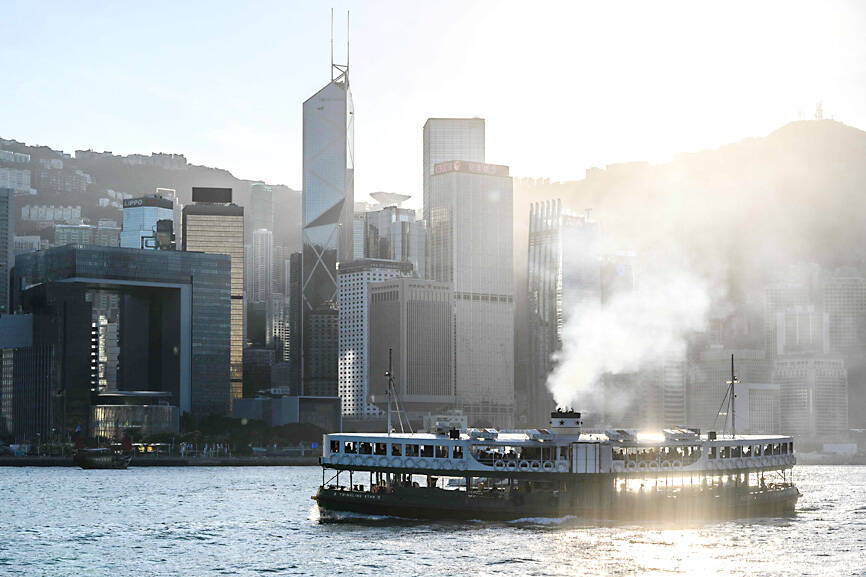
Photo: AFP
The shift has raised questions over “whether longstanding US policy towards Hong Kong, particularly towards its financial and banking sector, is appropriate,” they said.
Hong Kong’s government did not immediately respond to a request for comment yesterday.
The relationship between Hong Kong and the US has deteriorated over a crackdown on dissent that US officials say has eroded the rule of law and democratic rights.
US lawmakers have stepped up efforts to penalize the territory, although it remains unclear if those efforts would bear fruit. In September, the House passed a bill that could see the closure of Hong Kong’s economic and trade offices in the US. The measure still needs to be approved by the Senate and signed by the president to become law.
US president-elect Donald Trump’s pick for secretary of state, Marco Rubio, has said the offices are mouthpieces for the CCP. Hong Kong officials have strongly condemned the bill’s passage, with Chief Executive John Lee (李家超) saying US businesses would will suffer if it is passed.
In their letter, Moolenaar and Krishnamoorthi said Hong Kong had become a “global leader” in illicit practices such as:
‧ Giving Russia access to prohibited Western technology
‧ Forming front companies for buying banned Iranian oil
‧ Helping with the trade of gold from Russia
‧ Running ships that conduct illegal trade with North Korea.
The letter also cited research that it said showed that about 40 percent of goods shipped to Russia from Hong Kong last year were on a “common high priority” list of items that the US and the EU use to focus sanctions enforcement.
Those items included “semiconductors and other technology that Russia most needs for its war in Ukraine,” the letter said.
Taiwan Semiconductor Manufacturing Co (TSMC, 台積電), the world’s largest foundry service provider, yesterday said that global semiconductor revenue is projected to hit US$1.5 trillion in 2030, after the figure exceeds US$1 trillion this year, as artificial intelligence (AI) demand boosts consumption of token and compute power. “We are still at the beginning of the AI revolution, but we already see a significant impact across the whole semiconductor ecosystem,” TSMC deputy cochief operating officer Kevin Zhang (張曉強) said at the company’s annual technology symposium in Hsinchu City. “It is fair to say that in the past decade, smartphones and other mobile devices were
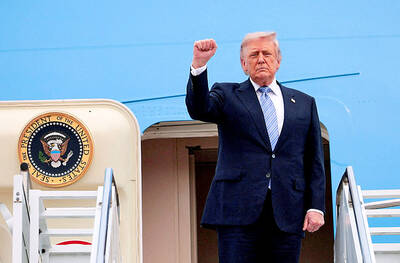
US-CHINA SUMMIT: MOFA welcomed US reassurance of no change in its Taiwan policy; Trump said he did not comment when Xi talked of opposing independence US President Donald Trump yesterday said he has not made a decision on whether to move forward with a major arms package for Taiwan after hearing concerns about it from Chinese President Xi Jinping (習近平). Trump’s comments on Taiwan came as he flew back to Washington after wrapping up critical talks in which both leaders said important progress was made in stabilizing US-China relations even as deep differences persist between the world’s two biggest powers on Iran and Taiwan. “I will make a determination,” Trump said, adding: “I’ll be making decisions. But, you know, I think the last thing we need right
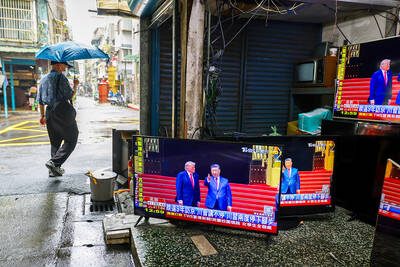
TAIWAN ISSUE: US treasury secretary Scott Bessent said on the first day of meetings that ‘it wouldn’t be a US-China summit without the Taiwan issue coming up’ There were no surprises on the first day of the summit between US President Donald Trump and Chinese President Xi Jinping (習近平), the Mainland Affairs Council (MAC) said yesterday, as the government reiterated that cross-strait stability is crucial to the Asia-Pacific region, as well as the world. As the two presidents met for a highly anticipated summit yesterday, Chinese state media reported that Xi warned Trump that missteps regarding Taiwan could push their two countries into “conflict.” Trump arrived in China with accolades for his host, calling Xi a “great leader” and “friend,” and extending an invitation to visit the White House
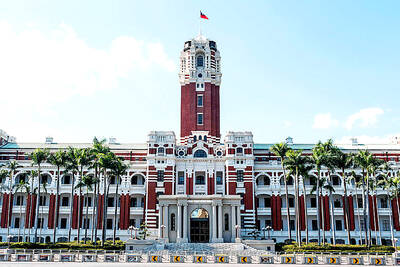
SECURITY: Taipei presses the US for arms supplies, saying the arms sales are not only a reflection of the US security commitment to Taiwan but also serve as a mutual deterrent against regional threats Taiwan is committed to preserving the cross-strait “status quo” and contributing to regional peace and stability, the Presidential Office said yesterday. “It is an undeniable fact that the Republic of China is a sovereign and independent democratic nation,” Presidential Office spokeswoman Karen Kuo (郭雅慧) reiterated, adding that Beijing has no right to claim sovereignty over Taiwan. The statements came after US President Donald Trump warned against Taiwanese independence. Trump wrapped up a state visit to Beijing on Friday, during which Chinese President Xi Jinping (習近平) had pressed him not to support Taiwan. Taiwan depends heavily on US security backing to deter China from carrying


 RSS
RSS