


Taiwan last night blanked world No. 1 Japan 4-0 to win the World Baseball Softball Confederation’s (WBSC) Premier12 for the first time.
Taiwanese ace Lin Yu-min (林昱珉) held defending champions Japan to just one hit and no runs in the first four innings, before catcher Lin Chia-cheng (林家正) opened the fifth inning with a solo home run. That was soon followed by a three-run homer from Taiwanese captain Chen Chieh-hsien (陳傑憲) to put Taiwan ahead in the prestigious tournament of the world’s top 12 baseball teams.
In addition to a superb performance from 21-year-old Arizona Diamondbacks prospect Lin, three more Taiwanese pitchers held Japan to just four hits total in nine innings.

Photo: CNA
The win is Taiwan’s best performance in the history of the top three international baseball tournaments — the Olympics, Premier12 (and its predecessor, the Baseball World Cup) and the World Baseball Classic.
Taiwan won a silver and three bronze medals during the Baseball World Cup format, which ended in 2011 and was replaced by the Premier12 and an expanded World Baseball Classic.
Back home, many in Taipei, New Taipei City, Taichung and Taoyuan cheered on Taiwan at viewings at city hall buildings, while sports arenas in Yilan, Hsinchu and Taitung counties and in Tainan also held viewing events. Taiwan’s Showtime Cinemas (秀泰影城) chain also sold tickets for those wanting to watch the match on the big screen.

Photo: AFP
Taiwan was the youngest team in the Premier12, based on player data from the WBSC.
WBSC statistics showed the age average of Taiwanese players was 24.5, followed by South Korea at 24.8, Japan at 25.2, Panama at 25.4, the Dominican Republic at 25.5, Australia at 25.7, Cuba at 25.8, Mexico at 25.9, the Netherlands at 26.1, Venezuela at 26.3, Puerto Rico at 26.5 and the US at 27.5.
Chen Chieh-hsien was also named the 2024 Premier12 MVP due to an explosive 0.625 hitting percentage with 14 hits in 22 at bats, including two homeruns.

Photo: Chen Chih-chu, Taipei Times
Prior to Saturday’s game, Taiwan was fined US$2,000 by the WBSC following complaints that it changed up its pitcher after learning it had already qualified for the final, the Chinese Taipei Baseball Association said.
Japan complained to the organizers that original Taiwanese starter Lin had been replaced with Chen Po-ching (陳柏清) after Taiwan learned it had qualified for the final due to the US beating Venezuela earlier that day.
Japan filed an official complaint to the WBSC, saying that Taiwan’s sudden move was unsportsmanlike.

Photo: CNA
Meanwhile, in the bronze-medal game, US starting pitcher Casey Lawrence gave up only four hits and no runs, and struck out seven in the first six innings, in the US’ 6-1 victory over world No. 4 Venezuela.
It was back-to-back wins for the US over their South American rivals from the group stage. On Saturday, the US edged Venezuela 6-5 to deny the Group A winners a chance at the championship title.
Yesterday, the US were on the verge of a shutout heading into the bottom of the eighth inning, after racking up two runs each in the third, sixth and eighth innings.

Photo: CNA
However, Venezuela staged an unsuccessful comeback in the bottom of the eighth, after designated hitter Hernan Perez scored off a sacrifice fly from second baseman Alexi Amarista.
It is the US’ first bronze in the tournament, after winning silver in the first edition in 2015. During the Baseball World Cup format, which ended in 2011, the US had four gold wins, behind only Cuba, who had racked up an impressive 25 over the tournament’s history.
Additional reporting by CNA

Photo: AFP

Photo: CNA

Photo: CNA

A signaling system malfunction disrupted high-speed rail (HSR) services beginning at 8am today, with trains temporarily reduced to three northbound and three southbound trains per hour as authorities conduct inspections. The malfunction occurred on a section of track in Miaoli County during pre-operation checks early this morning, forcing northbound and southbound trains to use a single track, the HSR operator said. The regular schedule has been replaced with three hourly trains offering only nonreserved seating in each direction, stopping at every station, it said, adding that business class cars would still have reserved seating. Departures from terminal stations are scheduled at the top
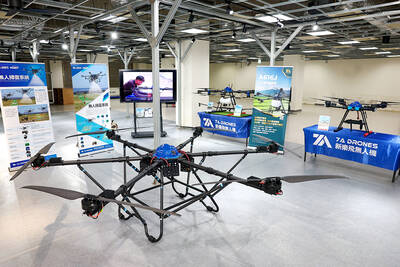
DRONE CENTRAL: Taiwan aims to become Asia’s democratic hub for drones, with most exports focused on high-quality military-grade models, an official said Taiwan’s drone industry is expected to expand significantly by 2030, producing 100,000 units per month and exporting half of them, the Ministry of Economic Affairs said yesterday. Current drone production capacity is about 15,000 units per month, but the industry can quickly scale up as demand increases, Industrial Development Administration Director-General Chiou Chyou-huey (邱求慧) told a news conference in Taipei. Taiwan’s drone output grew 2.5-fold last year to NT$12.9 billion (US$408.3 million) under a government program to develop the uncrewed vehicle sector, he said. The Executive Yuan in October last year approved plans to invest NT$44.2 billion into domestic production of uncrewed aerial

VERBOSE VESSELS: A CGA cutter and a China Coast Guard exchanged verbal barbs for more than a day in Taiwanese-controlled waters before the Chinese vessel left The Taiwanese and Chinese coast guards had a standoff near the strategically located Pratas Islands (Dongsha Islands, 東沙群島) in the north of the South China Sea, the Coast Guard Administration (CGA) said yesterday. The two sides engaged in intense radio exchanges over sovereignty claims during the 33-hour standoff. China Coast Guard vessel 3501 eventually left the restricted waters, 26.6 nautical miles (49.2km) west of the Pratas Islands, at 5pm yesterday, the CGA said. Lying approximately between southern Taiwan and Hong Kong, the Taiwan-controlled Pratas are seen by some security experts as vulnerable to Chinese attack due to their distance — more than
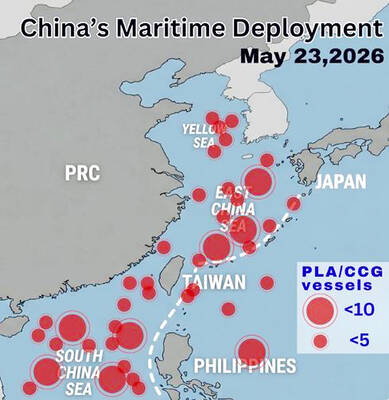
WARNING: China should stop engaging in actions that undermine regional peace and stability, as it would only build resentment among people across the Strait, the CGA said China has deployed more than 100 navy, coast guard and other vessels in waters from the Yellow Sea to the South China Sea and the western Pacific since US President Donald Trump and Chinese President Xi Jinping (習近平) met in Beijing, National Security Council Secretary-General Joseph Wu (吳釗燮) said yesterday. “In this part of the world, #China is the one & only PROBLEM wrecking the #StatusQuo & threatening regional peace & stability,” Wu wrote on X. In a separate post, he said Beijing was coercing Taiwan’s maritime domain, calling it illegal and provocative, after the Coast Guard Administration (CGA) expelled a


 RSS
RSS