

US president-elect Donald Trump on Thursday announced that Susie Wiles, one of his two campaign managers, would be his White House chief of staff, entrusting a top position to a political operative who helped the Republican win the election.
The appointment was the first of what is expected to be a flurry of staffing announcements as Trump girds for a return to the White House on Jan. 20.
As gatekeeper to the president, the chief of staff typically wields great influence. The person manages White House staff, organizes the president’s time and schedule, and maintains contact with other government departments and lawmakers.
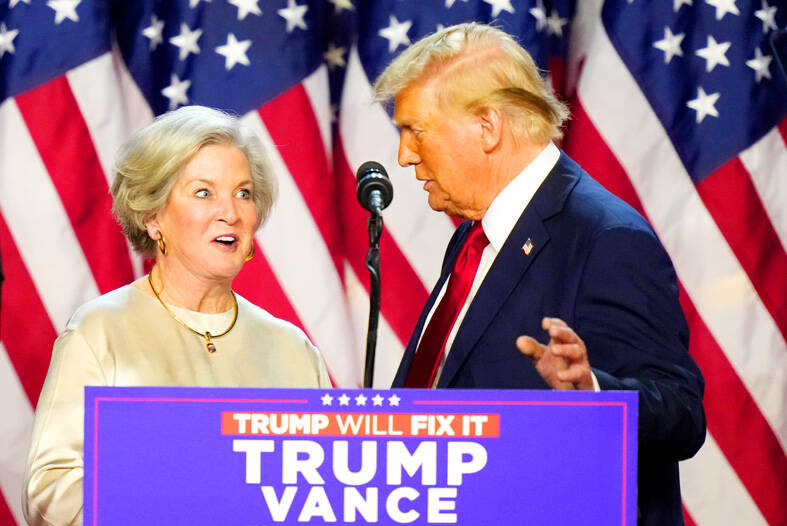
Photo: AP
The low-key Wiles, 67, would be the first woman to serve as White House chief of staff.
“Susie is tough, smart, innovative, and is universally admired and respected,” Trump said in a statement. “I have no doubt that she will make our country proud.”
Trump has been secluded at his Mar-a-Lago club in Palm Beach, Florida, since defeating US Vice President Kamala Harris, the Democrat candidate, in Tuesday’s election.
He is considering a wide array of people for top jobs in his administration, many of them familiar figures from his 2017 to 2021 presidency, four sources said.
Wiles, a long-time Florida-based political strategist, and fellow campaign manager Chris LaCivita are credited with running a more disciplined operation for Trump’s third presidential bid compared with his past campaigns.
Trump thanked them both during his victory speech early on Wednesday.
“Susie likes to stay in the back, let me tell you,” Trump said, as she stood toward the back of the stage. “We call her the ice maiden.”
Several people who have worked with Wiles said in interviews on Thursday that she would provide stability and sage counsel to Trump in the White House.
Trump ran through four chiefs of staff — an unusually high number — during his 2017 to 2021 term as they struggled to rein in the famously undisciplined president.
“Susie is a strong woman and a true leader with a proven track record of getting things done,” Republican strategist Ford O’Connell said.
Wiles previously worked on Ronald Reagan’s 1980 presidential campaign and helped Florida Governor Ron DeSantis win election in 2018. She served as a senior adviser on Trump’s 2016 and 2020 bids.
Trump chose Wiles over former House of Representatives speaker Kevin McCarthy, a California Republican who is close to Trump and has been a frequent visitor to Mar-a-Lago.
Sources said McCarthy had been in contention as well as Brooke Rollins, who was the former acting director of Trump’s Domestic Policy Council.
A fierce Trump ally, New Elise Stefanik, is under consideration to be US ambassador to the UN, a source familiar with the matter said.
Former US ambassador to Germany Richard Grenell, who was an acting intelligence chief in Trump’s first term and was with him when he recently met Ukrainian President Volodymyr Zelenskiy in New York, is under consideration for secretary of state.
US Senator Bill Hagerty, a former US ambassador to Japan, is also under consideration for that position, the sources said.
Asked by CNN about being considered for a role in Trump’s administration, Hagerty said: “I’ll leave the speculation to the speculators.”
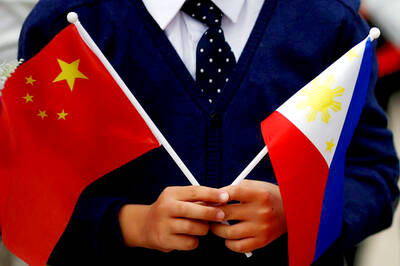
The Philippine Coast Guard yesterday said it has deployed its largest vessel and an aircraft to challenge a Chinese research ship operating off northern Batanes near Taiwan, adding that a Chinese coast guard vessel had also moved in. The Philippine operation “disrupted the vessel’s unauthorized marine scientific research and compelled it to leave its loitering position,” said Jay Tarriela, Philippine Coast Guard spokesperson on South China Sea issues. The Philippine Coast Guard said the BRP Teresa Magbanua and an aircraft were deployed to counter the Chinese vessel, which it said had remained about 37 nautical miles northwest of Itbayat Island since Monday. The
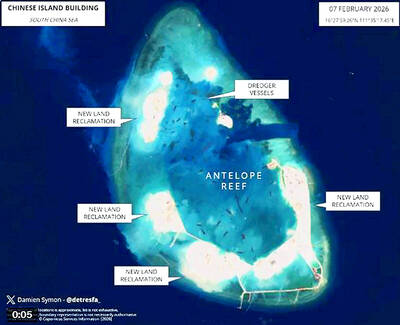
RUNWAY: Analysts said the first aircraft landing is expected by the middle of next year, while Chinese state media said it would serve civilian needs Chinese construction of a runway on Antelope Reef (Lingyang Reef, 羚羊礁) in the Paracel Islands (Xisha Islands, 西沙群島), is well under way with analysts estimating it could be completed by the middle of next year, strengthening Beijing’s military control over the disputed South China Sea. Satellite images reviewed by Reuters show grading work, piles of gravel and concrete, and compaction cranes in operation to build a full-scale runway that military attaches and security analysts say could be one of China’s most important offshore bases in the region. The images, taken on Friday last week by commercial satellite imagery provider Vantor, also show

SHIFTING COOPERATION: With the new arrangement, US representatives would be able to participate directly in defense discussions, including weapons procurement Taiwan-US military cooperation is deepening, with the Pentagon expected to station personnel at the Ministry of National Defense (MND), sources said. The NT$470 million (US$14.77 million) joint program is scheduled to run from this year through 2028, under which the Pentagon would dispatch representatives from the Office of the Under Secretary of Defense for Policy and the Institute for Defense Analyses, a senior military official said on condition of anonymity, adding that one representative from each organization would be stationed at the ministry’s headquarters. The Office of the Under Secretary of Defense for Policy is one of the US’ bodies responsible for

DEFENSE: The US House speaker dismissed speculation that Trump is using arms sales as a negotiating tactic with Beijing amid concern over delayed deliveries Taiwan is a partner whose “stability and independence” are important to US national security and the economy, US House of Representatives Speaker Mike Johnson said on Monday when asked about arms sales to Taipei in an interview with Fox Business. Asked whether US President Donald Trump was using a long-delayed US$14 billion arms deal as a negotiating tactic for trade with Beijing, Johnson said that he “wouldn’t read too much into that.” The delayed arms package is “related to the Iran conflict” and the need for missile stocks in the Middle East, he said. “If you look over [Trump’s] two terms, he will


 RSS
RSS