


South Korean author Han Kang won this year’s Nobel Prize in Literature for “her intense poetic prose that confronts historical traumas and exposes the fragility of human life,” the award-giving body said yesterday.
The prize is awarded by the Swedish Academy and is worth 11 million Swedish kronor (US$1.06 million).
“She has a unique awareness of the connections between body and soul, the living and the dead, and in her poetic and experimental style has become an innovator in contemporary prose,” Anders Olsson, chairman of the academy’s Nobel Committee, said in a statement.
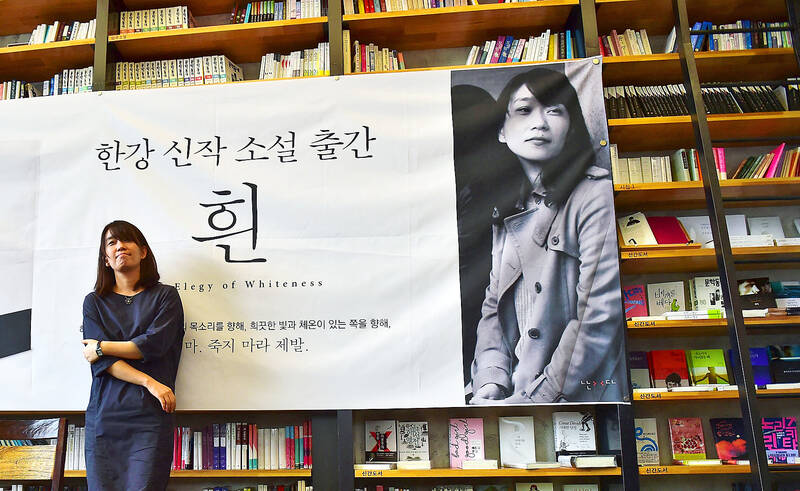
Photo: AFP
Han, the first South Korean to win the literature prize, began her career in 1993 with the publication of a number of poems in the magazine Literature and Society, while her prose debut came in 1995 with the short story collection Love of Yeosu.
Born in 1970, she comes from a literary background, her father being a well-regarded novelist.
Han won the Man Booker International Prize for fiction for her novel The Vegetarian in 2016, the first of her novels to be translated into English and regarded as her major international breakthrough.
In The Vegetarian, after struggling with gruesome recurring nightmares, Yeong-hye, a dutiful wife, rebels against societal norms, forsaking meat and stirring concern among her family that she is mentally ill.
Two of her books have been made into films: The Vegetarian in 2009, directed by Lim Woo-seong, and 2011’s Scars, by the same director.
Her 2002 novel Your Cold Hands, which bears obvious traces of Han’s interest in art, reproduces a manuscript left behind by a missing sculptor who is obsessed with making plaster casts of female bodies.
“There is a preoccupation with the human anatomy and the play between persona and experience, where a conflict arises in the work of the sculptor between what the body reveals and what it conceals,” the academy said in an official biography.
She is the second South Korean to win a Nobel prize ever, after 2000 peace prize winner and former South Korean president Kim Dae-jung.
Bookmaker favorites ahead of the announcement included Chinese writer Can Xue (殘雪) and many other perennial possible candidates such as Kenya’s Ngugi Wa Thiong’o and Australia’s Gerald Murnane.
“I was able to talk to Han Kang over the phone,” Mats Malm, permanent secretary of the Swedish Academy, told a news conference. “She was having an ordinary day, it seems, she had just finished supper with her son.”
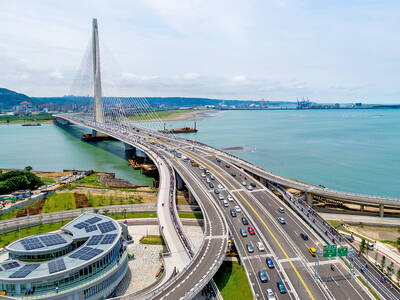
The Ministry of Transportation and Communications yesterday inaugurated the Danjiang Bridge across the Tamsui River in New Taipei City, saying that the structure would be an architectural icon and traffic artery for Taiwan. Feted as a major engineering achievement, the Danjiang Bridge is 920m long, 211m tall at the top of its pylon, and is the longest single-pylon asymmetric cable-stayed bridge in the world, the government’s Web site for the structure said. It was designed by late Iraqi-British architect Zaha Hadid. The structure, with a maximum deck of 70m, accommodates road and light rail traffic, and affords a 200m navigation channel for boats,
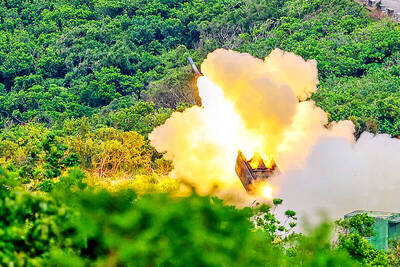
PRECISION STRIKES: The most significant reason to deploy HIMARS to outlying islands is to establish a ‘dead zone’ that the PLA would not dare enter, a source said A High Mobility Artillery Rocket System (HIMARS) would be deployed to Penghu County and Dongyin Island (東引) in Lienchiang County (Matsu) to force the Chinese military to retreat at least 100km from the coastline, a military source said yesterday. Taiwan has been procuring HIMARS and Army Tactical Missile Systems (ATACMS) from the US in batches. Once all batches have been delivered, Taiwan would possess 111 HIMARS units and 504 ATACMS, which have a range of 300km. Considering that “offense is the best defense,” the military plans to forward-deploy the systems to outlying islands such as Penghu and Dongyin so that

Taiwan Semiconductor Manufacturing Co (TSMC, 台積電), the world’s largest foundry service provider, yesterday said that global semiconductor revenue is projected to hit US$1.5 trillion in 2030, after the figure exceeds US$1 trillion this year, as artificial intelligence (AI) demand boosts consumption of token and compute power. “We are still at the beginning of the AI revolution, but we already see a significant impact across the whole semiconductor ecosystem,” TSMC deputy cochief operating officer Kevin Zhang (張曉強) said at the company’s annual technology symposium in Hsinchu City. “It is fair to say that in the past decade, smartphones and other mobile devices were

‘CLEAR MESSAGE’: The bill would set up an interagency ‘tiger team’ to review sanctions tools and other economic options to help deter any Chinese aggression toward Taiwan US Representative Young Kim has introduced a bill to deter Chinese aggression against Taiwan, calling for an interagency “tiger team” to preplan coordinated sanctions and economic measures in response to possible Chinese military or political action against Taiwan. “[Chinese President] Xi Jinping [習近平] has directed the People’s Liberation Army to be ready to invade Taiwan by 2027. China has a plan. America should have one too,” Kim said in a news release on Thursday last week. She introduced the “Deter PRC [People’s Republic of China] aggression against Taiwan act” to “ensure the US has a coordinated sanctions strategy ready should


 RSS
RSS