


Taiwan on Sunday defeated Japan 6-1 to clinch the nation’s first U-18 Asian Baseball Championship since 2007 in a rain-interrupted showdown at Taipei’s Tianmu Stadium.
Taiwan came from behind after shortstop Yusei Ishizuka’s RBI put Japan ahead 1-0 in the first inning.
In the top of the third inning, outfielder Ko Ching-hsien (柯敬賢) hit an RBI triple to left-center field to tie the game, before a sacrifice fly from Tseng Wei-che (曾偉喆) pulled Taiwan ahead 2-1.
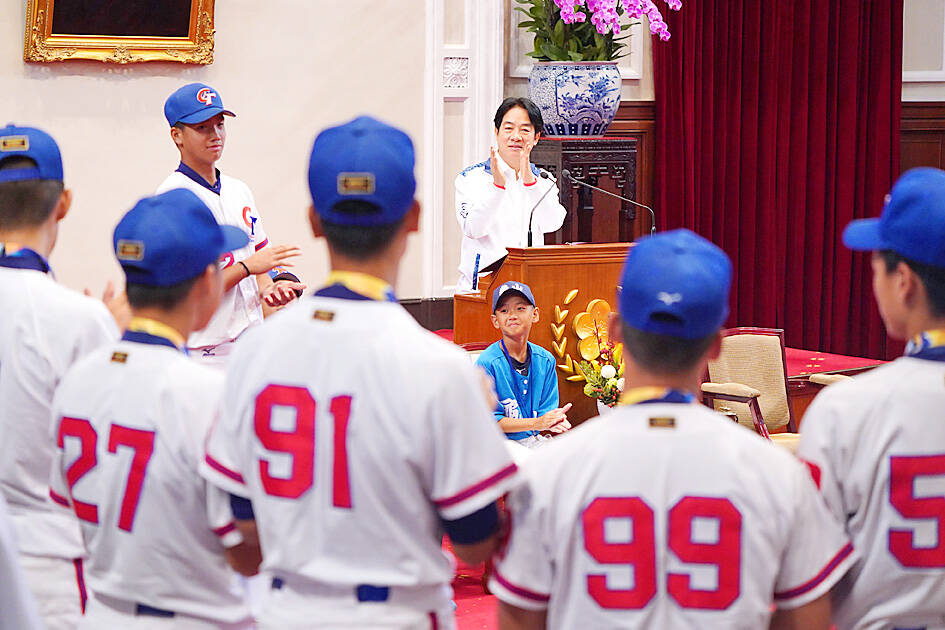
Photo: CNA
In the top of the fifth, Ko, who signed to the Los Angeles Dodgers in June, hit a sacrifice fly to widen the gap to 3-1.
Taiwan added another three runs in the top of the sixth and seventh, giving them a healthy lead that they kept until the end.
Sunday’s championship game, interrupted twice due to on-and-off heavy rain, was sweet revenge for Taiwan, who lost 1-0 to Japan on Friday during the Super Round.

Photo: CNA
It was Taiwan’s only loss of the tournament, after they were undefeated in the opening round.
This year is the third time Taiwan has won the tournament, following victories in 2001 and 2007.
Taiwan, Japan and South Korea have dominated the tournament since its inception in 1994, with Japan and South Korea both winning five titles and Taiwan four.
Earlier on Sunday, South Korea crushed the Philippines 8-0 to finish third in the eight-team tournament, which also featured Pakistan, Thailand, Hong Kong and Sri Lanka.
The top three finishers qualify for next year’s U-18 Baseball World Cup.
Meanwhile, at the WBSC U-23 Baseball World Cup in Shaoxing, China, Taiwan have not fared as well as their younger compatriots, facing potential elimination after losing their first three games in Group B of the opening round.
Taiwan on Sunday were pipped 4-3 by Nicaragua, after losing 7-5 to the Netherlands on Saturday and 3-1 to South Korea on Friday, the opening day of the tournament at Shaoxing Baseball and Softball Sports Culture Center.
Taiwan last night were to play South Africa, who are also tied at the bottom of the group with three losses.
President William Lai (賴清德) yesterday at the Presidential Office met with the national baseball teams competing in the Little League World Series, Junior League Baseball World Series and U-15 Baseball World Cup, who snatched gold, silver and bronze respectively.
“You strive for honor for yourselves and the country, and the country shines because of you,” Lai said, calling them “heroes of Taiwan.”
Lee Cheng-da (李政達), who coached the team that competed in the Little League World Series, always motivates players to be brave and fearless, to fight to the end, to believe in their teammates and to enjoy the game, Lai said, adding his warm and positive attitude has moved many and set an example for all baseball coaches working at grass-roots level.
Separately, the Executive Yuan yesterday held the first advisory meeting in preparation for the establishment of the Ministry of Sports and Sports Development, with Premier Cho Jung-tai (卓榮泰) expressing the hope that it could be operational next year.
The Executive Yuan also announced the 48 members to serve on the advisory group, including boxer Lin Yu-ting (林郁婷), retired tennis player Lu Yen-hsun (盧彥勳), retired badminton player Lee Yang (李洋), table tennis player Chuang Chih-yuan (莊智淵), judoka Lien Chen-ling (連珍羚), weightlifter Kuo Hsing-chun (郭婞淳), archer Lei Chien-ying (雷千瑩), soccer commentator Max Shih (石明謹), Taiwan Baseball Hall of Fame chairman George Chao (趙士強) and e-sports player Bruce Hsiang (向玉麟).
Additional reporting by Chen Yun and CNA

Japan has deployed long-range missiles in a southwestern region near China, the Japanese defense minister said yesterday, at a time when ties with Beijing are at their lowest in recent years. The missiles were installed in Kumamoto in the southern region of Kyushu, as Japan is attempting to shore up its military capacity as China steps up naval activity in the East China Sea. “Standoff defense capabilities enable us to counter the threat of enemy forces attempting to invade our country ... while ensuring the safety of our personnel,” Japanese Minister of Defense Shinjiro Koizumi said. “This is an extremely important initiative for
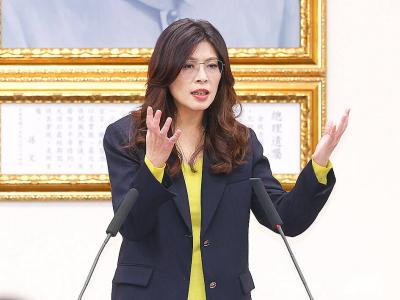
Chinese Nationalist Party (KMT) Chairwoman Cheng Li-wun (鄭麗文) today accepted an invitation from Chinese President Xi Jinping (習近平) to lead a delegation to China next month, saying she hopes to promote the peaceful development of cross-strait relations and bring stability to the Taiwan Strait. “I am grateful and happy to accept this invitation,” Cheng said in a statement from the KMT chairperson’s office. Cheng said she hopes both sides can work together to promote the peaceful development of cross-strait relations, enhance exchange and cooperation, bring stability to the Taiwan Strait and improve people’s livelihoods. At today's news conference, Cheng said any efforts to

MORE POPULAR: Taiwan Pass sales increased by 59 percent during the first quarter compared with the same period last year, the Tourism Administration said The Tourism Administration yesterday said that it has streamlined the Taiwan Pass, with two versions available for purchase beginning today. The tourism agency has made the pass available to international tourists since 2024, allowing them to access the high-speed rail, Taiwan Railway Corp services, four MRT systems and four Taiwan Tourist Shuttles. Previously, five types of Taiwan Pass were available, but some tourists have said that the offerings were too complicated. The agency said only two types of Taiwan Pass would be available, starting from a three-day pass with the high-speed rail and a three-day pass with Taiwan Railway Corp. The former costs NT$2,800
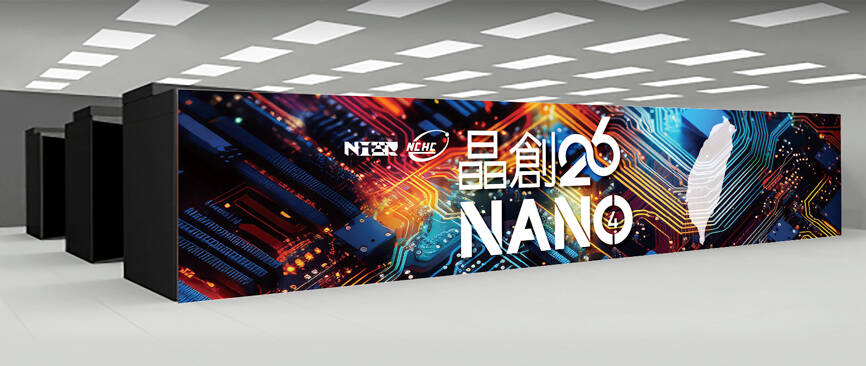
The nation’s fastest supercomputer, Nano 4 (晶創26), is scheduled to be launched in the third quarter, and would be used to train large language models in finance and national defense sectors, the National Center for High-Performance Computing (NCHC) said. The supercomputer, which would operate at about 86.05 petaflops, is being tested at a new cloud computing center in the Southern Taiwan Science Park in Tainan. The exterior of the server cabinet features chip circuitry patterns overlaid with a map of Taiwan, highlighting the nation’s central position in the semiconductor industry. The center also houses Taiwania 2, Taiwania 3, Forerunner 1 and


 RSS
RSS