


President William Lai (賴清德) yesterday told sailors aboard a combat-ready warship at a major base in the Taiwan Strait that he had their backs, thanking them for safeguarding Taiwanese security.
Speaking to sailors on board the warship Cheng Ho at the Magong (馬公) base in Penghu County, Lai said the navy sets great store on working together as one.
“As commander-in-chief of the three services, I want to stress that the government will back all of you,” he said in a message broadcast throughout the ship by loudspeaker.
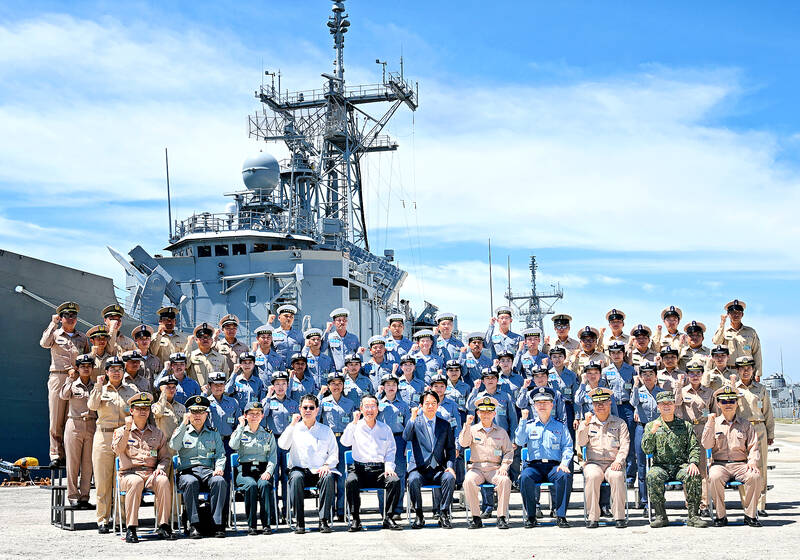
Photo: Fang Pin-chao, Taipei Times
The Cheng Ho — named after a Ming Dynasty Chinese admiral and explorer — is a Taiwan-built warship based on the design for the US Oliver Hazard Perry class of frigates.
A live RIM-66 Standard missile stood ready in its launcher at the ship’s bow as Lai spoke onboard.
Speaking to officers shortly afterward at a lunch at the base, Lai said the government was committed to further improving the weapons of the armed forces.
Penghu is also home to an important air base, from which Taiwanese air force jets regularly scramble to shadow Chinese military aircraft and warships operating around Taiwan.
Lai reviewed soldiers at an air defense facility near the air base, watching a drill with a fixed twin-mount Stinger surface-to-air missile, designed for close-in defense.
In related news, a successful subcontractor bid for a military base on Thursday laid the final piece of groundwork realizing the Ministry of National Defense’s plans for five missile bases forming a defensive perimeter extending 150km to the south, a ministry tender showed.
The project for the base in Taitung County’s Taiping Township (太平) was awarded to an undisclosed party, costing NT$1.57 billion (US$49.18 million), with construction having started last month and to continue through July 2027.
Bases are to be built in Tainan’s Sinjhong District (新中), the military port in Kaohsiung’s Zuoying District (左營), the eastern coast of Pingtung County, Pingtung County’s Pucian Township (埔墘), Taiping and Yunlin County’s Huwei Township (虎尾), a source said.
The source said the first base equipped with Harpoon missiles would be in Tainan and would likely complete construction by August 2027.
The source said all the bases are expected to be completed simultaneously and would be inspected concurrently in three years.
The navy’s 400 land-launched Harpoon missiles are expected to be delivered by 2028.
The missiles are to be placed under the jurisdiction of the littoral combat command, which would be officially established in 2026 alongside an arsenal of locally developed Hsiung Feng (“Brave Wind,” 雄風) missiles.
The source said that the Harpoon missiles purchased are the RGM-84L-4 Block II (U), the most up-to-date version, and have an effective range exceeding the 148km of the Hsiung Feng missiles.
The source said that the littoral combat command, with such an arsenal of missiles and the 25 radar trucks included in the missile package, would have greater capabilities to deter the Chinese People’s Liberation Army Navy.
The source said the radar trucks are compatible with the navy’s surveillance and reconnaissance system, adding that the network formed by the vehicles would have one node immediately take up the workload of another in case it is attacked or otherwise taken out of commission.
Additional reporting by Ben Blanchard
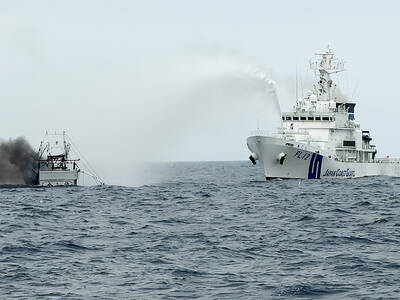
CREDIT-GRABBER: China said its coast guard rescued the crew of a fishing vessel that caught fire, who were actually rescued by a nearby Taiwanese boat and the CGA Maritime search and rescue operations do not have borders, and China should not use a shipwreck to infringe upon Taiwanese sovereignty, the Coast Guard Administration (CGA) said yesterday. The coast guard made the statement in response to the China Coast Guard (CCG) saying it saved a Taiwanese fishing boat. The Chuan Yu No. 6 (全漁6號), a fishing vessel registered in Keelung, on Thursday caught fire and sank in waters northeast of Diaoyutai Islands (釣魚台). The vessel left Keelung’s Badouzih Fishing Harbor (八斗子漁港) at 3:35pm on Sunday last week, with seven people on board — a 62-year-old Taiwanese captain surnamed Chang (張) and six

LEVERAGE: China did not ‘need to fire a shot’ to deny Taiwan airspace over Africa when it owns ‘half the continent’s debt,’ a US official said, calling it economic warfare The EU has raised concerns about overflight rights following the delay of President William Lai’s (賴清德) planned state visit to the Kingdom of Eswatini after three African nations denied overflight clearance for his charter at the last minute. Taiwanese allies Paraguay and Saint Kitts and Nevis, as well as several US lawmakers and the Inter-Parliamentary Alliance on China (IPAC) condemned China for allegedly pressuring the countries. Lai was scheduled to fly directly to Taiwan’s only African ally from yesterday to Sunday to celebrate the 40th anniversary of King Mswati III’s accession and his 58th birthday, but Seychelles, Mauritius and Madagascar suddenly revoked

RISKY BUSINESS: The ‘incentives’ include initiatives that get suspended for no reason, creating uncertainty and resulting in considerable losses for Taiwanese, the MAC said China’s “incentives” failed to sway sentiment in Taiwan, as willingness to work in China hit a record low of 1.6 percent, a Ministry of Labor survey showed. The Directorate-General of Budget, Accounting and Statistics (DGBAS) also reported that the number of Taiwanese workers in China has nearly halved from a peak of 430,000 in 2012 to an estimated 231,000 in 2024. That marked a new low in the proportion of Taiwanese going abroad to work. The ministry’s annual survey on “Labor Life and Employment Status” includes questions respondents’ willingness to seek employment overseas. Willingness to work in China has steadily declined from
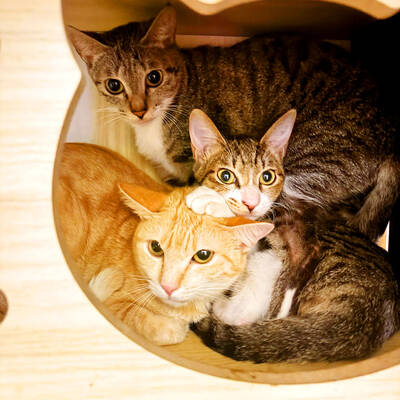
The number of pet cats in Taiwan surpassed that of pet dogs for the first time last year, reaching 1,742,033, a 32.8 percent increase from 2023, the Ministry of Agriculture said yesterday, citing a survey. By contrast, the number of pet dogs declined slightly by 1.2 percent over the same period to 1,462,528, the ministry said. Despite the shift, households with dogs still slightly outnumber those with cats by 1.2 percent. However, while the number of households with multiple dogs has remained relatively stable, households keeping more than two cats have increased, contributing to the overall rise in the feline population. The trend


 RSS
RSS