


The government is to recruit college-educated workers from abroad to meet a rising demand for labor, National Development Council (NDC) Minister Paul Liu (劉鏡清) said in an interview published yesterday.
The council’s projections show that 350,000 unfilled job openings are expected by 2028, while demographics indicate that the workforce would only grow by 150,000, Liu told the Liberty Times (sister paper of the Taipei Times).
That would result in a labor shortage of 200,000 workers for 80,000 blue-collar jobs and 120,000 high-skill jobs, he said, adding that the council’s overseas recruitment strategy is designed to tackle the latter.

Photo: Chang Chia-juei, Taipei Times
Starting next year, the council would launch three offices to recruit Taiwanese tech workers employed in San Francisco’s Silicon Valley and in Los Angeles, he said.
For many overseas Taiwanese, a job in Taiwan means greater opportunities for advancement and a chance to take care of their parents, Liu said.
The council is to help Tainan, Taitung County and Hualien County-based businesses recruit from the world’s 35 million digital nomads, who on average earn NT$2 million (US$62,547) a year, he said, adding that talks with local governments were ongoing.
A council analysis of LinkedIn user data showed that Bengaluru, India, has one of the world’s highest concentrations of tech workers engaged in artificial intelligence (AI)-related fields, making the city a priority, Liu said.
The council’s recruitment efforts there would start in November, he said.
Projects to import skilled workers from foreign countries are a partial solution to Taiwan’s labor shortage, he said, adding that productivity must be improved in industries from services to manufacturing.
Introducing AI and other digital technologies would be key to that process, he said.
All students should have access to science, technology, engineering and mathematics (STEM) education, including those who do not specialize in a STEM field, to improve job prospects and encourage technology use in other sectors, he said.
Workforce retraining programs are being created to improve the digital skills of people who already have jobs, Liu added.
The government would tackle the nation’s long-term workforce shortage by increasing supply and reducing demand, he said.

AIR SUPPORT: The Ministry of National Defense thanked the US for the delivery, adding that it was an indicator of the White House’s commitment to the Taiwan Relations Act Deputy Minister of National Defense Po Horng-huei (柏鴻輝) and Representative to the US Alexander Yui on Friday attended a delivery ceremony for the first of Taiwan’s long-awaited 66 F-16C/D Block 70 jets at a Lockheed Martin Corp factory in Greenville, South Carolina. “We are so proud to be the global home of the F-16 and to support Taiwan’s air defense capabilities,” US Representative William Timmons wrote on X, alongside a photograph of Taiwanese and US officials at the event. The F-16C/D Block 70 jets Taiwan ordered have the same capabilities as aircraft that had been upgraded to F-16Vs. The batch of Lockheed Martin
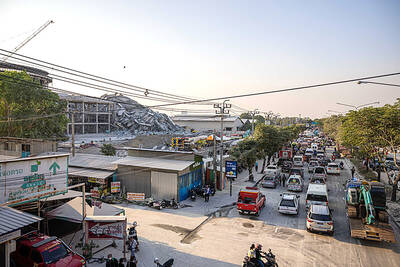
GRIDLOCK: The National Fire Agency’s Special Search and Rescue team is on standby to travel to the countries to help out with the rescue effort A powerful earthquake rocked Myanmar and neighboring Thailand yesterday, killing at least three people in Bangkok and burying dozens when a high-rise building under construction collapsed. Footage shared on social media from Myanmar’s second-largest city showed widespread destruction, raising fears that many were trapped under the rubble or killed. The magnitude 7.7 earthquake, with an epicenter near Mandalay in Myanmar, struck at midday and was followed by a strong magnitude 6.4 aftershock. The extent of death, injury and destruction — especially in Myanmar, which is embroiled in a civil war and where information is tightly controlled at the best of times —
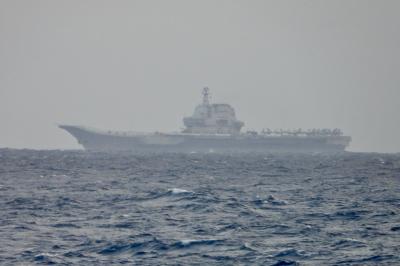
China's military today said it began joint army, navy and rocket force exercises around Taiwan to "serve as a stern warning and powerful deterrent against Taiwanese independence," calling President William Lai (賴清德) a "parasite." The exercises come after Lai called Beijing a "foreign hostile force" last month. More than 10 Chinese military ships approached close to Taiwan's 24 nautical mile (44.4km) contiguous zone this morning and Taiwan sent its own warships to respond, two senior Taiwanese officials said. Taiwan has not yet detected any live fire by the Chinese military so far, one of the officials said. The drills took place after US Secretary

THUGGISH BEHAVIOR: Encouraging people to report independence supporters is another intimidation tactic that threatens cross-strait peace, the state department said China setting up an online system for reporting “Taiwanese independence” advocates is an “irresponsible and reprehensible” act, a US government spokesperson said on Friday. “China’s call for private individuals to report on alleged ‘persecution or suppression’ by supposed ‘Taiwan independence henchmen and accomplices’ is irresponsible and reprehensible,” an unnamed US Department of State spokesperson told the Central News Agency in an e-mail. The move is part of Beijing’s “intimidation campaign” against Taiwan and its supporters, and is “threatening free speech around the world, destabilizing the Indo-Pacific region, and deliberately eroding the cross-strait status quo,” the spokesperson said. The Chinese Communist Party’s “threats


 RSS
RSS