


Chinese and Philippine coast guard ships collided at sea, damaging at least two vessels, in an encounter early yesterday near a new flash point in their increasingly alarming confrontations in the disputed South China Sea.
Each blamed the other for the collision near Sabina Shoal (Xianbin, 仙濱暗沙), a disputed atoll in the Spratly Islands (Nansha Islands, 南沙群島), where Taiwan and Vietnam also have overlapping claims.
There were no reports of injuries.
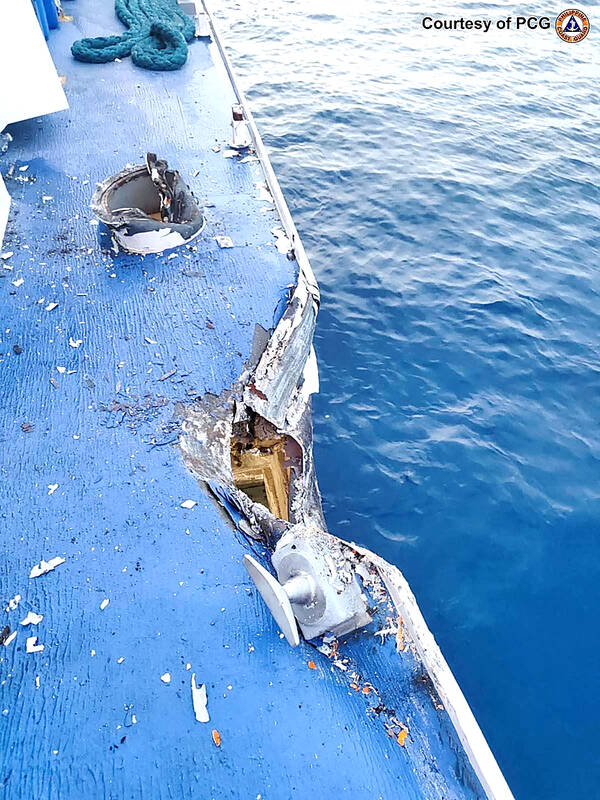
Photo: AFP / PCG
China’s coast guard accused the Philippines of deliberately crashing one of its ships into a Chinese vessel.
It said in a statement on its Web site that two Philippine Coast Guard ships entered waters near the shoal, ignored a warning from the Chinese coast guard and intentionally collided with one of the Chinese boats at 3:24am.
“The Philippine side is entirely responsible for the collision,” China Coast Guard spokesman Gan Yu (甘羽) said. “We warn the Philippine side to immediately stop its infringement and provocation, otherwise it will bear all the consequences arising from that.”
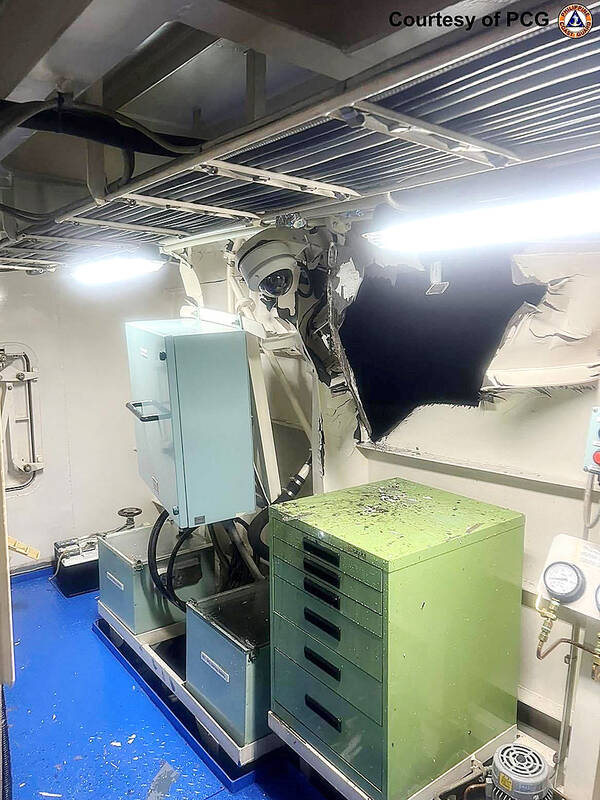
Photo: AFP / PCG
Philippine National Security Council Assistant Director-General Jonathan Malaya accused the Chinese coast guard of falsely saying the Philippine coast guard ships had rammed its vessels.
Video and photographs, including ones taken by journalists from a US television station who were on board one of the Philippine coast guard ships, showed that the Chinese ships caused the collisions, Malaya told a news forum in Manila.
The Philippines’ National Task Force on the West Philippine Sea said two of the coast guard ships, BRP Bagacay and BRP Cape Engano, “encountered unlawful and aggressive maneuvers” from Chinese coast guard vessels while en route to Patag and Lawak islands, which are occupied by Filipino forces, in the contested region.
“These dangerous maneuvers resulted in collisions, causing structural damage to both Philippine Coast Guard vessels,” the statement said.
The Philippine coast guard said one of the Chinese ships rammed the BRP Cape Engano, ripping a 1.1m hole on the right side.
An engine exhaust was also damaged, it said.
About 16 minutes later, BRP Bagacay was rammed twice on its left and right sides by another Chinese vessel, leaving a hole 91cm wide and 76cm long, and a dent that was 30.5cm deep, the Philippine coast guard said.
“This is the biggest structural damage we have incurred as a result of the dangerous maneuvers carried out by the Chinese coast guard,” Philippine Coast Guard Commodore Jay Tarriela said at the news forum.
The task force said the Philippine coast guard “stands firm in its responsibility to ensure the safety and security of our maritime domain while addressing any threats to our national interests.”
In a separate statement, Gan said a Philippine ship that was turned away from Sabina Shoal entered waters near the disputed Second Thomas Shoal (Renai Shoal, 仁愛暗沙), ignoring the Chinese coast guard’s warnings.
“The Chinese coast guard took control measures against the Philippine ship in accordance with law and regulation,” he added.
PROVOCATIVE: Chinese Deputy Ambassador to the UN Sun Lei accused Japan of sending military vessels to deliberately provoke tensions in the Taiwan Strait China denounced remarks by Japan and the EU about the South China Sea at a UN Security Council meeting on Monday, and accused Tokyo of provocative behavior in the Taiwan Strait and planning military expansion. Ayano Kunimitsu, a Japanese vice foreign minister, told the Council meeting on maritime security that Tokyo was seriously concerned about the situation in the East China and South China seas, and reiterated Japan’s opposition to any attempt to change the “status quo” by force, and obstruction of freedom of navigation and overflight. Stavros Lambrinidis, head of the EU delegation to the UN, also highlighted South China Sea

The final batch of 28 M1A2T Abrams tanks purchased from the US arrived at Taipei Port last night and were transported to the Armor Training Command in Hsinchu County’s Hukou Township (湖口), completing the military’s multi-year procurement of 108 of the tanks. Starting at 12:10am today, reporters observed more than a dozen civilian flatbed trailers departing from Taipei Port, each carrying an M1A2T tank covered with black waterproof tarps. Escorted by military vehicles, the convoy traveled via the West Coast Expressway to the Armor Training Command, with police implementing traffic control. The army operates about 1,000 tanks, including CM-11 Brave Tiger
Taiwan Semiconductor Manufacturing Co (TSMC, 台積電), the world’s largest contract chipmaker, said it expects its 2-nanometer (2nm) chip capacity to grow at a compound annual rate of 70 percent from this year to 2028. The projection comes as five fabs begin volume production of 2-nanometer chips this year — two in Hsinchu and three in Kaohsiung — TSMC senior vice president and deputy cochief operating officer Cliff Hou (侯永清) said at the company’s annual technology symposium in Silicon Valley, California, last week. Output in the first year of 2-nanometer production, which began in the fourth quarter of last year, is expected to

Taiwan’s drone exports surged past US$100 million in the first quarter, exceeding last year’s full-year total, with the Czech Republic emerging as the largest buyer, the Ministry of Economic Affairs said. Exports of complete drones reached US$115.85 million in the period, about 1.2 times the total recorded for all of last year, the ministry said in a report. Exports to the Czech Republic accounted for about US$100 million, far outpacing other markets. Poland, last year’s top destination, recorded about US$11.75 million in the first quarter. Taiwan’s drone exports have expanded rapidly in the past few years, with last year’s total


 RSS
RSS