


Taiwan is to secure at least one medal at the Paris Olympics following boxer Wu Shih-yi’s (吳詩儀) quarter-final victory in the women’s 60kg (lightweight) division, while the nation’s male badminton players topped their groups.
Wu defeated Maria Jose Palacios of Ecuador, a Pan American Games bronze medalist last year, by majority decision, with four out of five judges scoring in her favor.
The 26-year-old pugilist is guaranteed to win at least a bronze medal, as there is no bronze-medal match in boxing.
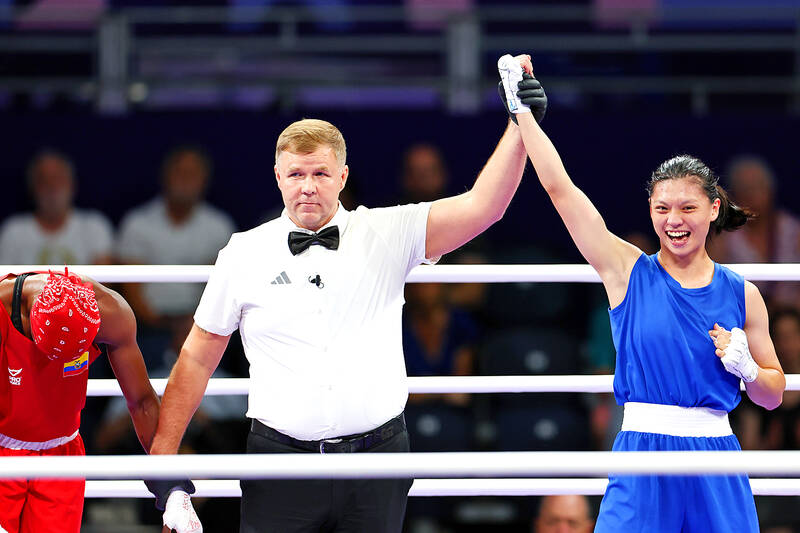
Photo: CNA
The victory was significant for Taiwan.
Wu’s success came after the elimination of three Taiwanese boxers, including Kan Chia-wei (甘佳葳) in the men’s 71kg (welterweight) category on the same day, as well as the exit of top medal hope judoka Yang Yung-wei (楊勇緯) in the men’s 60kg event on Saturday.
Wu made her Olympic debut in Tokyo three years ago, where she struggled with injuries and was eliminated in the round-of-16.
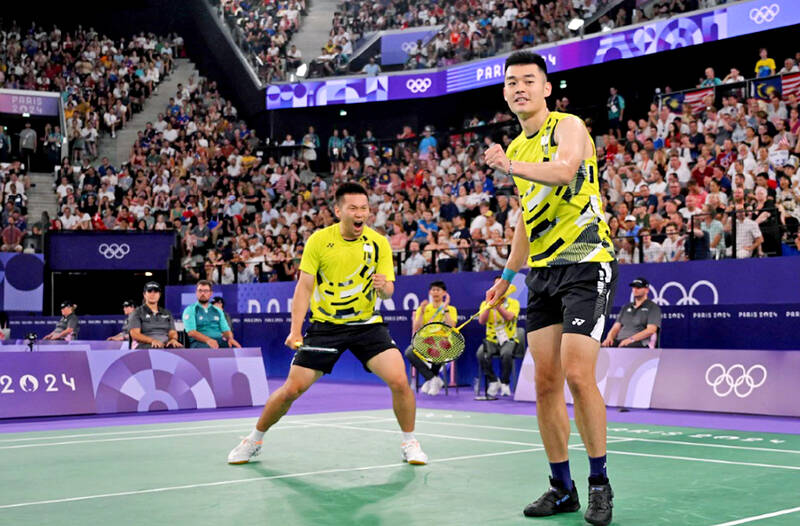
Photo: AFP
This time, after her unanimous victory in the round-of-32 over South Korea’s Oh Yeon-ji, who won a bronze medal at last year’s World Championship, Wu advanced to the quarter-finals after fourth seed Cynthia Ogunsemilore of Nigeria failed a drug test.
Wu today in the semi-finals faces China’s Yang Wenlu (楊文璐), who previously defeated Wu by a unanimous decision en route to gold at the Asian Games in Hangzhou, China, last year.
“This is not the end, but another beginning,” Wu said.
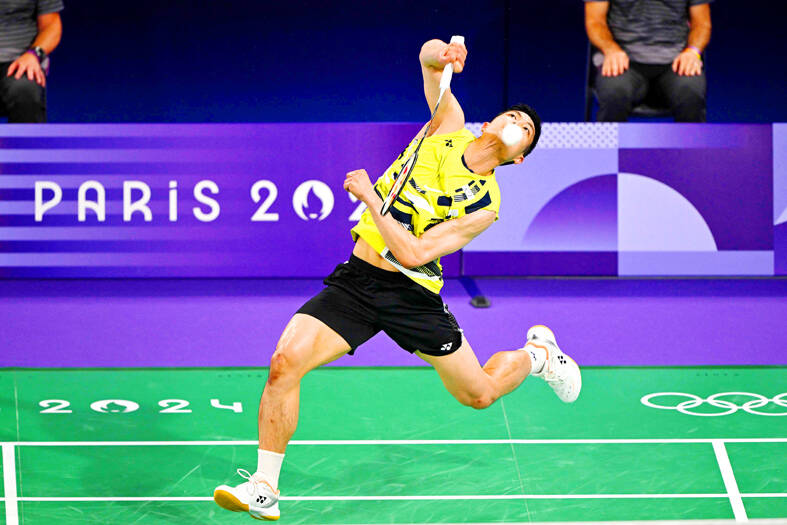
Photo: AFP
Taiwan’s badminton players had good news in the men’s singles and the men’s doubles, with veteran Chou Tien-chen (周天成) and Tokyo Olympic gold medalists Lee Yang (李洋) and Wang Chi-lin (王齊麟) finishing first in their groups, advancing to the round-of-16 and quarter-finals respectively.
Chou, 34, won 21-18, 21-13 against Hong Kong’s Lee Cheuk-yiu (李卓耀) in 44 minutes.
After securing the match point with a smash, Chou pumped his right fist and shouted in celebration.
“I just wanted to boost [Team Taiwan’s] morale,” he said.
Wang shared a similar sentiment after the Taiwanese duo outlasted China’s Liu Yuchen (劉雨辰) and Ou Xuanyi (歐烜屹) in 66 minutes.
Wang lay on the ground and yelled with clenched fists after seeing the shuttlecock land outside of the line to score their final point, coming back from a game down to win 17-21, 21-17, 24-22.
Although Wang had a dip in form over the past two matches, Lee Yang’s clutch performance on Wednesday helped elevate his partner’s game, ELTA TV anchor Lee Yu-ting (李祐廷) said.
Lee Yang and Wang had already secured a quarter-final berth going into the match and they relaxed early in Wednesday’s game.
“I kept telling Chi-lin that as we enter the quarter-finals, we can’t relax too much, we should keep it going,” Lee Yang said after surviving the so-called “group of death.”
Only the top two duos in each group advanced to the quarter-finals, but due to an error by the Badminton World Federation, the international governing body, Group D contained five pairings, one more than the other groups.
In addition to the Chinese world No. 9s, the group included the world No. 2 pairing from Denmark, No. 8 from Japan and No. 45 from the US.
Chou yesterday defeated Japan’s Kodai Naraoka 21-12, 21-16 in 55 minutes in the round-of-16 to advance to the quarter-finals.
The win marked the third time Taiwan’s star shuttler has made it to the quarter-finals at the Olympics. He is scheduled to play in the semi-finals today.
Lee Yang and Wang also advanced to the semis, beating Thailand’s Supak Jomkoh and Kittinupong Kedren 21-14, 21-17.

‘NO SECURITY RISK’: The Railway Bureau reassured the public that the technicians’ activities were limited to technical guidance and did not involve sensitive systems The Railway Bureau yesterday said it had invited eight Chinese technicians to assist with an airport MRT construction project. The bureau issued the confirmation after an Internet user said Chinese nationals had entered the construction zone of Taiwan Taoyuan International Airport’s Terminal 3 project. They asked why “individuals from an enemy state” were allowed access to such a major national infrastructure project, which raised serious concerns over Taiwan’s industrial safety, sensitive systems and information security. The bureau’s Northern Region Engineering Branch Office said subcontractor Taiwan Handle Industrial Co (台灣手把工業) of the Taoyuan airport MRT’s “Contract No. CU05 Project A14 Station Civil, MEP &

The National Chungshan Institute of Science and Technology yesterday showcased its locally developed variants of the Vision 60 robotic patrol dog, which it plans to deploy on the nation’s outlying territories in the South China Sea. The variants were produced under the Joint Lab project — created by the institute and domestic companies — and assembled with domestically produced motors, lenses and artificial intelligence (AI) systems alongside licensed tech from the US, Missile and Rocket Systems Research Division deputy director Jen Kuo-kang (任國光) told the media event at a military base in Taipei’s Dazhi (大直) area. Taiwan has built up its strengths

NOT IMMEDIATE: Taiwan has a chance to appeal the proposed 10 percent tariff before it starts, while other countries face a 12.5 percent tariff from the trade office Taiwan is among 60 economies determined by the US to have failed to impose or enforce a ban on the importation of goods produced with forced labor, according to a notice released on Tuesday by the Office of the US Trade Representative (USTR), which proposed imposing an additional 10 percent or more tariff on them. The USTR in a statement said that following an investigation, it had determined under Section 301 of the Trade Act of 1974 that the failure of the 60 economies to impose and effectively enforce a prohibition on the importation of goods produced with forced labor is
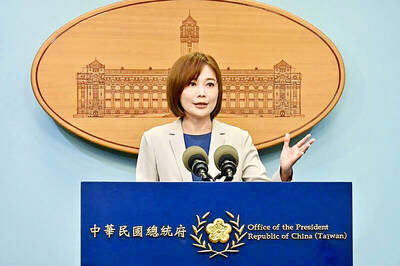
TIT-FOR-TAT: The US allegedly revoked the visa of a Chinese national working at Xinhua News Agency in the US in response to Beijing’s expulsion of Vivian Wang The Presidential Office yesterday condemned China for expelling a New York Times correspondent from Beijing following the newspaper’s interview with President William Lai (賴清德), saying the move highlighted Beijing’s suppression of press freedom and its threat to international news media. Taiwan has noted a series of recent incidents in which Beijing used similar tactics to “threaten and pressure international media outlets and journalists,” Presidential Office spokeswoman Karen Kuo (郭雅慧) said in a statement. “This concerns not only press freedom and freedom of expression, but also the safety of journalists, and Taiwan and relevant partners are paying close attention to the situation,” she


 RSS
RSS